The Industrial Phase-Transfer Catalysis Experts

PTC Tip of the Month E-Newsletter

PTC Protects Water-Sensitive Compounds from Water While Achieving High Yield

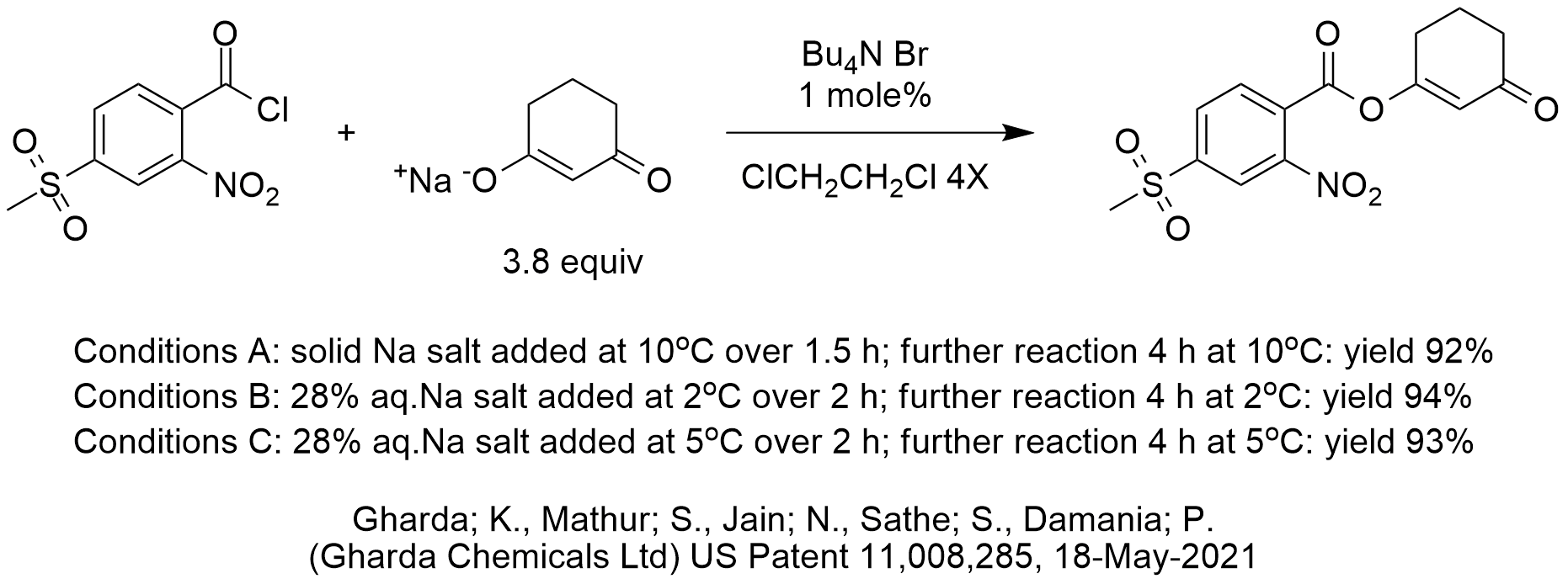
This patent describes the synthesis of the compound mesitrione. The fifth step of six chemical steps is the PTC acylation of the sodium salt of cyclohexanedione. The cyclohexanedione anion reacts at the enol oxygen with a water-sensitive benzoyl chloride.

Acyl chlorides are sensitive to hydrolysis and the inventors note that they worked at low temperature between 0 C and 15 C to avoid hydrolysis. They describe three different sets of conditions that give 92%-94% yield.

The inventors do not highlight the advantage of PTC in this system which is the use of the phase boundary to protect the acyl chloride from water by dissolving the organic acyl chloride in dichloroethane that is immiscible with water. The phase-transfer quat cation transfers the cyclohexanedione anion into the bulk organic phase where it reacts with enhanced reactivity with the acyl chloride with little to no hydration and little to no hydrolysis.

We speculate that the inventors chose to add solid sodium salt of cyclohexanedione in the first set of conditions (“Conditions A”) in order to minimize the amount of water in the system and thus minimize hydrolysis. The inventors were even bolder in Conditions B and C by adding the sodium salt of cyclohexanedione as a 28% aqueous solution, first at 2 C, then at 5 C.

The inventors did not describe their agitation system, but we would recommend avoiding over-agitation since that would cause non-catalyzed interfacial hydrolysis.

Further optimization of this PTC acylation should be possible, focused on reducing the excess sodium salt of cyclohexanedione while achieving a yield in the high 90’s. If your company needs to achieve high yield of reactions using water-sensitive compounds in the presence of water, now contact Marc Halpern of PTC Organics to benefit from highly specialized expertise in developing low-cost high-performance green chemistry processes using phase-transfer catalysis, specifically for water-sensitive compounds.

High-Dilution PTC N-Alkylation

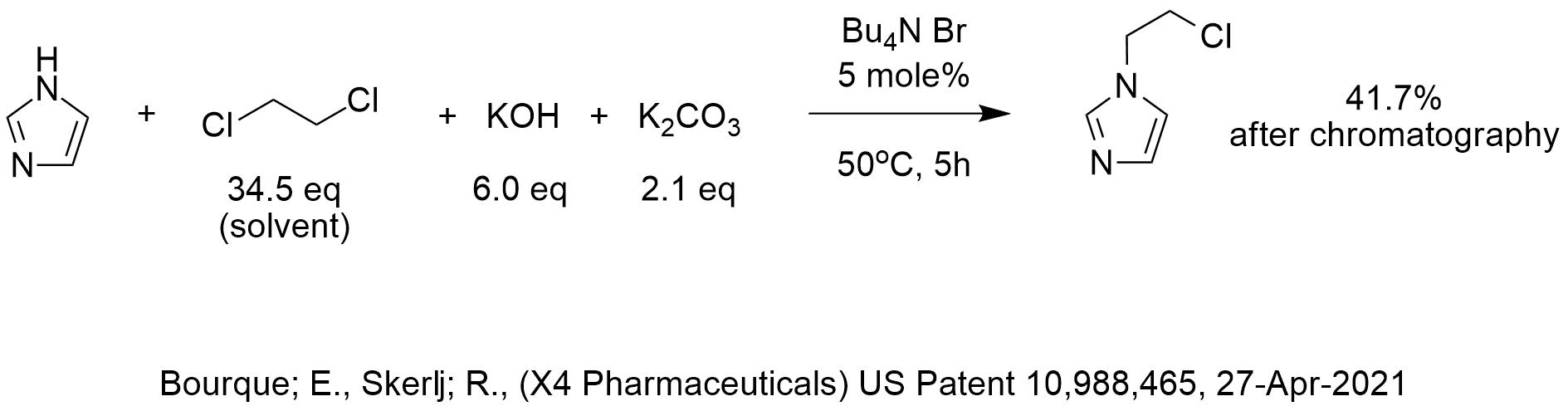
A patent was issued 3 days ago that describes the PTC N-alkylation of imidazole with dichloroethane shown in the diagram. The desired product requires reaction at only one end of the alkylating agent. It is reasonable to assume that the inventors used a very large excess of dichloroethane (34.5 equiv!) as solvent to maximize the probability that the imidazolide anion (formed from imidazole and base) will collide with a dichloroethane molecule rather than a 2-chloroethyl imidazole molecule. Before discussing combining high dilution with the strengths of PTC, let’s talk about the reaction conditions chosen.

The reaction is a solid-liquid PTC system with no added water. In fact, during the workup, the solids were filtered off for separation from the product and consisted of the excess base and KCl byproduct.

Also during workup, the organic phase was washed with water twice, maybe not necessarily to remove residual salts, but probably to begin to separate the tetrabutylammonium salt from the product before purification by chromatography. Tetrabutylammonium salts have a very high affinity for dichloroethane and is quite hard to separate from this solvent by just water washing as I explicitly published in 1998 (http://phasetransfer.com/catsep.pdf). The yield after chromatography was only 41.7%. Since quats have a high affinity to chromatography materials (such as silica), the column undoubtedly removed the phase-transfer catalyst.

I am not totally sure but I think that imidazole is also soluble in dichloroethane. If so, then high dilution is likely even more of a requirement to achieve selectivity of displacement of only one chlorine atom.

It turns out that phase-transfer catalysis provides the opportunity to simulate high dilution in certain systems.

If we assume that the N-alkylation under PTC conditions occurs in the bulk organic phase and not at the interface, then we can control the amount of reactive imidazolide anion in the organic reaction phase by setting the catalyst loading. Let’s say that we use 2 mole% quat, then we can only have no more than 2 mole% imidazolide anion in the reaction phase in the form of [Q+Im-]. If we choose a nonpolar solvent in which imidazole is not very soluble and if we minimize interfacial reaction between imidazolide anion and alkylating agents in the organic phase, then we can create an effective dilution of 100:1 at the outset of the reaction by using 2 mole% quat and 2 equiv of alkylating agent, even though the entire reactor actually contains 1 equiv imidazole and 2 equiv of alkylating agent. The ratio of chloroethylimidazole to dichloroethane will still increase as the reaction progresses, but the ratio of quat imidazolide to alkylating agent IN THE REACTION PHASE will still remain lower throughout the reaction profile than if not using a quat. This improves selectivity.

By the way, the pKa of imidazole is 14.5. Since the pKa of water is 15.7, then when mixing NaOH and imidazole, about 90% of the imidazole will be deprotonated in the imidazolide anion form. So, in order to minimize undesired contact between the imidazolide anion (present to a large extent) and the alkylating agent, we should work at an intermediate rpm and avoid over-agitation.

If your company wants the most highly specialized expertise in industrial phase-transfer catalysis now contact Marc Halpern of PTC Organics to achieve the lowest cost highest performance green chemistry using PTC.

Why Are PTC Quats So Expensive in “2020 Qtr 5”?

Yes, you read that right… “2020 Qtr 5!” is the morbidly humorous term that some purchasing managers in the chemical industry are using to describe the first quarter of 2021 that ends this week.

As you know, 2020 was an extremely unusual year and that included the prices of chemicals, especially petrochemicals and especially quats.

As you likely know, quaternary ammonium salts which are the most common large scale commercial phase-transfer catalysts, are produced from amines which are produced from alcohols which are produced from alkenes.

For example, butanol is produced by hydroformylation of propylene. Butanol is a raw material for tributylamine which is the starting material for tetrabutylammonium bromide (TBAB) and methyl tributyl ammonium chloride.

The disruptions in the petrochemical markets in 2020 due to COVID-19 were severe and prices fluctuated making supply unpredictable. Those of you who do not work in the purchasing departments of your companies may not be aware that shipping costs increased very dramatically in 2020, sometimes more than 100% and lead times to fulfill chemical orders went from days/weeks to weeks/months!!!

The global demand for surface disinfectants and hand sanitizers experienced a crazy sudden increase and biocidal quats such as didecyl dimethyl ammonium chloride became one of the hottest items in the world. If you look at the bottle of disinfectant concentrate that you couldn’t even buy in April 2020, you will see a list of quaternary ammonium salts as the active ingredients, usually the ONLY active ingredient. If you were using one of those quat salts in your commercial PTC processes, you might have had to shut down your plant!

Several readers of the PTC Tip of the Month reached out to us in mid-2020 asking if we knew of any secret quat suppliers. In one case, a chemist contacted me to ask for his local hospital.

Billions of people around the world were happy to usher in 2021 and forget about the nightmare of 2020. Those of us who lost loved ones to COVID-19 (my uncle succumbed to COVID-19 in March 2020 in a hospital in New York City) will NEVER forget the pandemic. But we somehow have to move on and that included the psychological stress of 2020.

As the revolutionary vaccines are now being distributed in early 2021, there is an expectation that within a few months, markets may start to stabilize. However, oil prices continued to rise from $47/barrel on January 1 to $66 in mid-March. Availability, inflationary pricing and lead times for petrochemical derivatives continued to be tight in early 2021.

And then…the petrochemical industry in Texas quite literally froze during February 10-20. Petrochemical plants in Texas shut down suddenly and unexpectedly and that meant that alkenes were and continue to still be scarce. The shut down of the Suez Canal for nearly a week now in March, delayed 12% of the world’s shipping trade and that certainly didn’t help.

Propylene (PGP = polymer grade propylene) increased in price by 140% from $843 per metric ton on November 20, 2020 to $2,028 per metric ton on February 5, 2021 (data for propylene and butanol shown here) JUST BEFORE the Texas weather crisis shutdown! Butanol prices increased by 167% from April 20, 2020 to January 29, 2021 BEFORE the shut downs in Texas. That is when people started morbidly joking that the first quarter of 2021 was the fifth quarter of 2020.

We do not know when the prices, availability and shipping costs for quaternary ammonium phase-transfer catalysts will return to “normal” (whatever that means). But at least we understand how the various disruptions in the petrochemical markets affected our ability to obtain our catalysts.

A silver lining in this crisis is that COVID-19 forced new manufacturing entrants into the global quat salt supply chain. That means that as demand for disinfectant biocide quats decreases, prices may find a new low, but not too low, as the newly increased capacity is rationalized. Of course, that is a very long term thought since prices, availability and shipping costs are likely to remain tight over the next few quarters.

Most of the subscribers to the PTC Tip of the Month newsletter are process chemists and process engineers. We live in a space of uncertainty as we pursue process chemistry breakthroughs that have never been attempted before. The thoughts shared above demonstrate that the purchasing managers at your companies also live in a space that in the past year has been as uncertain as we experience in breakthrough R&D.

Say thank you to a purchasing manager at your company for keeping the supply chain moving forward since the product that your company sells pays your salary, pays for the flasks, pays for the HPLC and everything else you need to do the remarkable work that you do.

Iodide – Potential PTC Poison

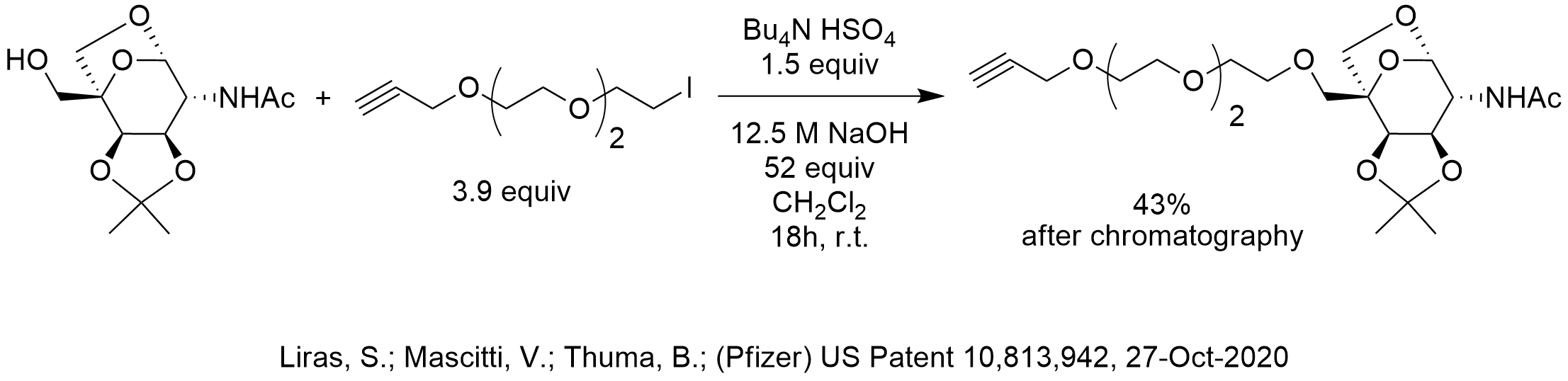
When stoichiometric (or more) TBA HSO4 is used, the question needs to be asked, why? We speculate that iodide poisoning of the phase-transfer catalyst might be at play in the reaction shown in the diagram. Let’s discuss.

As we teach in our 2-day course “Industrial Phase-Transfer Catalysis” (on manual page 76), quaternary ammonium cations have a higher affinity for larger softer polarizable anions with low charge density. Iodide is a rather large soft polarizable anion and is also a very good leaving group.

Quats are soft cations and their affinities for soft anions are higher than for hard anions with high charge density.

For that reason, iodide and even tosylate can sometimes be a catalyst poison for quaternary ammonium phase-transfer catalysts. It depends on the relative affinities toward the quat cation of the competing anions: iodide and the desired nucleophile.

The reaction shown in the diagram was described in a patent that issued a few days ago. The reaction is the O-alkylation of an alcohol that has 12 carbon atoms, one nitrogen and 7 oxygen atoms, so it is not obvious how organophilic the alkoxide might be.

The reason we are discussing catalyst poisoning is that iodide is the leaving group and tetrabutylammonium hydrogen sulfate is used in excess, which is very rare.

We don’t know why the inventors chose to use so much TBA HSO4, but when we are trying to interpret choice of reaction conditions, we must consider the possibility of catalyst poisoning, especially when using iodide as the leaving group.

By the way, the inventors also used PTC for an O-alkylation using propargyl bromide using catalytic tetrabutylammonium iodide, catalytic sodium iodide, THF as the solvent and KOH as the base.

Now contact Marc Halpern of PTC Organics to explore how to leverage PTC Organics’ highly specialized expertise in industrial phase-transfer catalysis to achieve low-cost high-performance green chemistry for your commercial processes and process in development.

PTC Promotes Pd-Catalyzed Hydrogenation

Phase-transfer catalysis is often used to improve transition metal catalyzed reactions. We have been reporting a lot of phase-transfer catalyzed Suzuki applications in recent years but not too many hydrogenations, though we teach some in our 2-day course “Industrial Phase-Transfer Catalysis.”

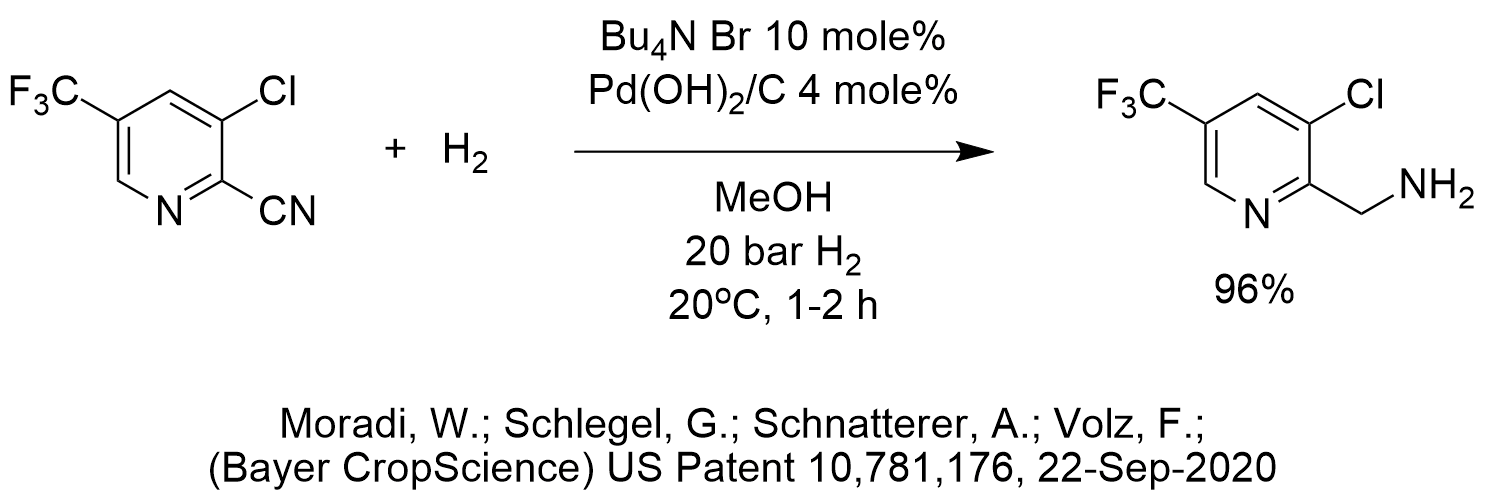
This month, Dr. Schnatterrer’s process R&D department at Bayer, that frequently develops PTC applications, screened nine tetramethyl-, tetraethyl- and tetrabutylammonium salts to enhance hydrogenation using 15 different palladium catalysts. The reaction shown in the diagram uses TBAB with palladium hydroxide on carbon (Noblyst P1071) in methanol. The product was isolated as a 20% solution in methanol. The methanolic solution of the amine product was used in te next step which was a N-benzoylation.

Other PTC palladium co-catalyzed hydrogenations we have seen use Aliquat 336 as the phase-transfer catalyst and toluene as the solvent.

Separation of High Temperature Phase-Transfer Catalysts from Product: HEG Cl and Tetraphenyl Phosphonium Bromide

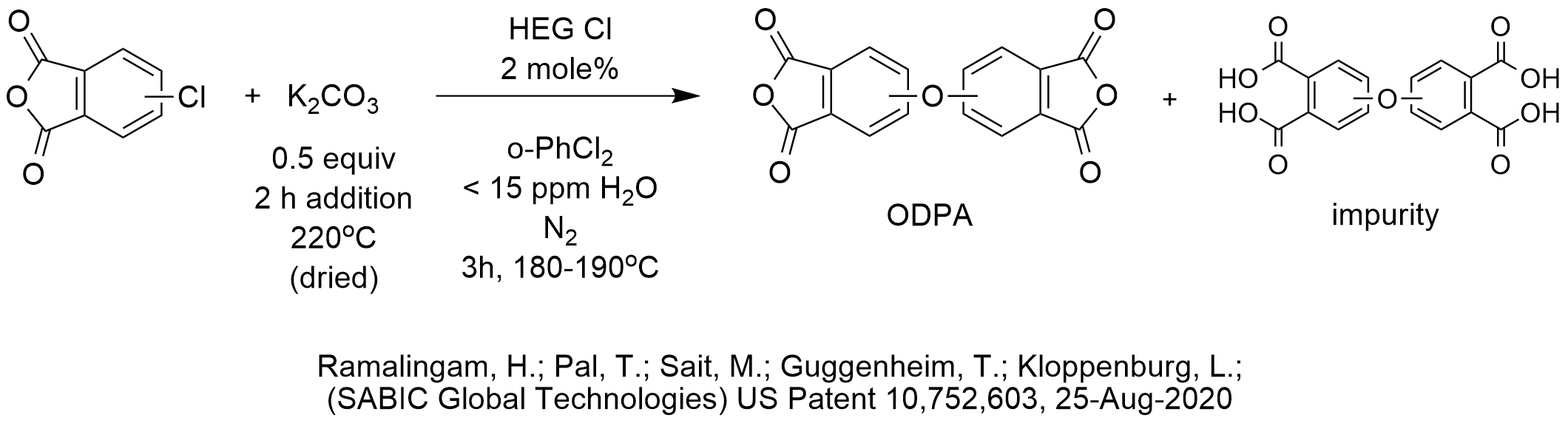
This patent describes the purification of oxydiphthalic anhydride (ODPA; useful as a monomer for polyetherimides engineering thermoplastics) after it is formed by consecutive phase-transfer catalysis reactions shown as one step in the diagram. These PTC displacement reactions require high temperature and require thermally stable phase-transfer catalysts, such as hexaethyl guanidinium chloride (HEG Cl) and tetraphenyl phosphonium bromide (TPPB). The reaction also requires azeotropic drying for both reactivity to minimize side reactions.

Two different procedures were used to synthesize ODPA. ODPA is a solid that is precipitated during workup, then washed with a solvent for purification. The suitability of a particular solvent was based on the solubility of the reactants, byproducts, reaction intermediates and catalyst. The goal was to dissolve the phase-transfer catalyst and the impurities while not dissolving the desired ODPA product.

After measuring solubility of the reactants, byproducts, reaction intermediates and catalyst in 10 different solvents, seven solvents were screened for the washing step of the ODPA solid in the workup. Methanol was clearly shown to be the best solvent to clearly achieve simultaneous high yield (no loss of product during workup) and high purity (separate the phase-transfer catalyst and impurities from the product).

Tetraphenyl phosphonium bromide was found to be an effective catalyst for the PTC reactions. However, its removal from the ODPA during the washing step was not complete and ODPA product purity was only 96.5% to 97.8% after three washes of the solvents screened (isolated yields were 15%-85%). In contrast, when using HEG Cl, removal of HEG Cl from the ODPA by three washes with methanol gave non-detectable residual HEG Cl in the product with overall product purity at 99.48% and 91% isolated yield. HEG Cl appears to be the best catalyst for this application with the well chosen workup.

Effective separation of phase-transfer catalyst from the product is so important that we dedicate a section of our 2-day course “Industrial Phase-Transfer Catalysis” to this topic. Now click here to inquire about conducting this valuable PTC course in-house at your company (by live Zoom video conference or in person when travel is feasible).

Analyzer for Tetraalkyl Ammonium Cations

One of the recurring practical challenges we face in PTC process development is performing analysis of our products at the end of the PTC reaction to assure that there is no phase-transfer catalyst residue in our products. This is especially true for analyzing samples for the presence of tetraalkyl quaternary ammonium salts since they have no chromophores for typical detector in HPLC and they are not volatile to go through a GC injection port, though they do break down in injector ports tp form trialkylamines that can sometimes be analyzed.

A patent was issued last week that appears to address the issue of analyzing for tetraalkyl quaternary ammonium cations. I must admit that I am not an expert in mass spectrometry. I know just enough about MS to understand that cations are hurled through a magnetic field and are separated by their mass that determines their trajectory on a curve with a radius depending on the mass of the cation.

Tetraalkyl ammonium quats are already cations and don’t need to be bombarded by anything to form cations. Accordingly, the invention described in Cooks, R.; Baird, Z.; Wei, P.; (Purdue Research Foundation) US Patent 10,720,316, 21-Jul-2020, utilizes the concept used in mass spectrometry to analyze for tetraalkyl quaternary ammonium cations. I have read the patent a couple of times and, frankly, I need someone to explain it to me in layman’s terms.

A key concept in the patent is that “the invention provides sample analysis systems that are configured to analyze ions at or above atmospheric pressure and without the use of laminar gas flow.”

The preferred analyzer appears to consist of three curved electrodes separated from each other by a non-conductive spacer and at least one of the three curved electrodes includes an opening through which a probe may be inserted.

A solution of 10 microM each of tetrapropyl-, tetrabutyl-, tetrahexyl-, and tetradodecylammonium bromide in acetonitrile was analyzed by performing separation of the ions in air without the use of a vacuum or a flowing gas. Instead, pulsed voltages were employed with the multi-electrode system as a means to inject ions into the curved ion path and effect a separation of the tetraalkylammonium cations.

The patent contains many diagrams of the analyzer configuration as well as graphs and pictures of the analysis of the tetraalkyl ammonium cations.

If you have faced the challenge of analyzing residual quat in your product, you may want to forward this patent to the creative problem solvers in your analytical department to see if they can utilize this information, or buy a piece of equipment that can perform such analysis.

History and Alternative Explanation for the “Halpern q-Value” for Quat Structure-Activity Relationship in PTC T-Reactions

I invented the empirical “q-value” parameter when I was too lazy to work in the lab one day in 1988. At that time, we just received a new MacIntosh computer that had CricketGraph installed and it had the amazing capability to draw a graph from data, something that my Lotus 1-2-3 software on my Leading Edge Model D at home could not yet do, even though it had dual 5.25” floppy drives and upgraded whopping 256 KB RAM.

Now might be a good time to get a cup of coffee to read the story of the “Halpern q-value” which I hope you will find to be at least mildly interesting, if not entertaining and of course valuable from a scientific standpoint. Spoiler alert: this story will end with an article that I just learned has an alternative explanation of the q-value. That article by Denmark and Henle from 2015 has excellent correlations and excellent suggestion for underlying fundamentals…something that has been missing from my empirical q-value parameter for decades.

For several years in the 1980’s, I was looking for a way to EMPIRICALLY represent an asymptotic diminishing effect of the number of carbons of an alkyl group as a predictor for reactivity of interfacial PTC reactions (later refined to be transfer-rate limited PTC reactions – “T-Reactions” – in discussions with the superstars Charles Starks and Charles Liotta in Starks’ penthouse in Tulsa, Oklahoma in 1991). In the early 1980’s, I found that many PTC-NaOH reactions, that behaved very differently than almost all other non-NaOH PTC reactions, gave unusually high reactivity as the number of carbon atoms DECREASED for at least one of the four alkyl chains of a quaternary ammonium phase-transfer catalyst, with extra special dominant effect of the length of the shortest alkyl chain on the quat cation as long as there were at least 8-10 carbon atoms total on the quat. Quats such as tetraethyl ammonium (8 carbon atoms total) were usually totally useless for almost all non-NaOH PTC reactions but worked great for PTC-NaOH reactions. This was the basis for my Ph.D. thesis in 1983 (“Phase-Transfer Catalysis of Hydroxide Ion Initiated Reactions: Mode of Action and Applications”) and my first 15 publications before leaving graduate school. In particular, I found that methyl tributyl ammonium was an outstanding phase-transfer catalyst for PTC-NaOH reactions, though the reviewers of Tetrahedron Letters didn’t think this merited publication (a psychological blow in my early years since they published almost anything!). Years later, I had no trouble convincing chemical companies to use hundreds of tons per year of this phase-transfer catalyst in single processes due to multiple factors of excellent performance, but I am getting ahead of my story.

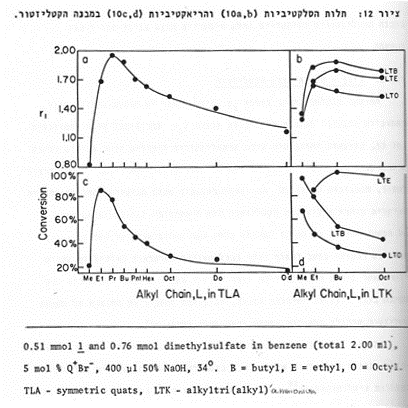
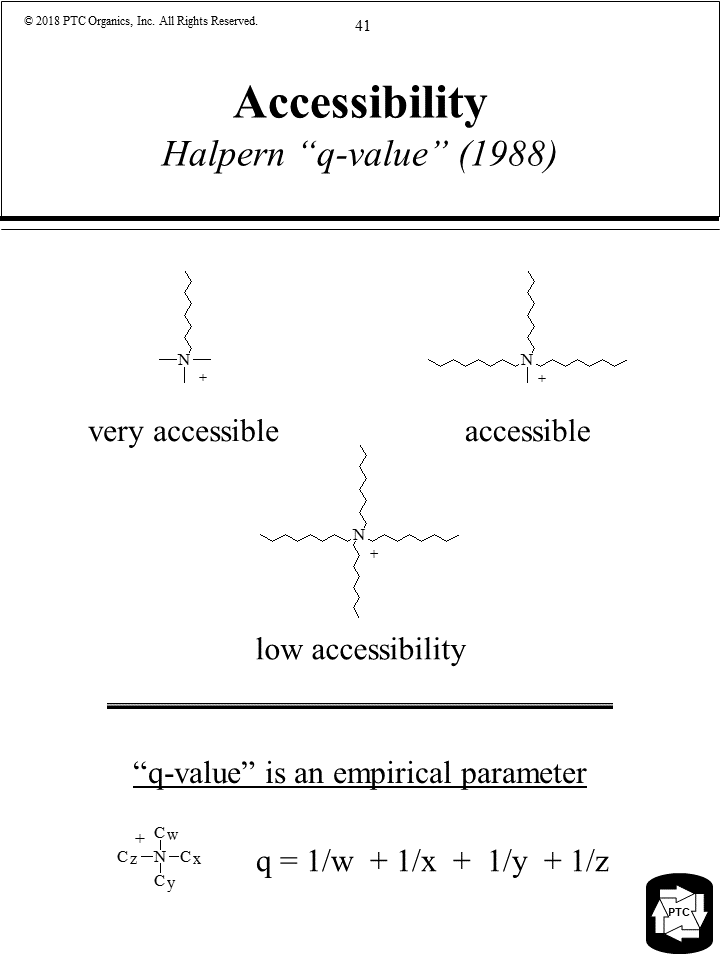
By 1979 (1st year graduate student), I speculated that the accessibility of the positive charge on the nitrogen of the quat might be a plausible factor for affecting reactivity, especially due to the very pronounced high reactivity of nonsymmetrical quats with one methyl group or three ethyl groups. For example, in the alkylation of deoxybenzoin (pKa 16), the order of quat reactivity was methyl tributyl ammonium > ethyl tributyl ammonium > tetrabutyl ammonium > octyl tributyl ammonium. The alkyl trioctyl ammonium series behaved in the same exact way, except that the alkyl tributyl ammonium curve was higher in reactivity than the alkyl trioctyl ammonium curve. That is how I came up with idea of “accessibility” of the positive charge on the nitrogen atom as a likely factor that affects reactivity in many, though not all PTC-NaOH reactions, that happened to make up about 60% of commercial PTC applications at that time.

The raw data are shown in Figure 1 in the bottom 2 curves “c” and “d” (scanned from my Ph.D. thesis…hence the Hebrew figure title).

Figure 1: Quat Structure Effect on Reactivity (bottom graphs “c” and “d”) and O-/C-Selectivity (upper graphs “a” and “b”) in the Alkylation of Deoxybenzoin
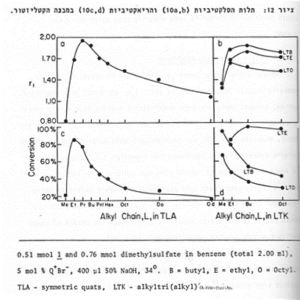
There was something special about a quat with one methyl group (together with 3 alkyl groups with C4 or higher) or three ethyl groups, that induced extra high reactivity in PTC-NaOH reactions.

I looked at a variety of potential metrics and correlations without success from 1979 to 1983 (at which time I left graduate school to start my career). These attempts included looking at bathochromic shifts in the UV of quat picrates and C-13 NMR behavior of the carbon in quat thiocyanates. Eventually, I gave up…

…until that day of lab laziness in 1988 with a brand new Mac on my desk that had the first hard drive I ever saw (a massive tower with an amazing 20 MB of storage capacity!).

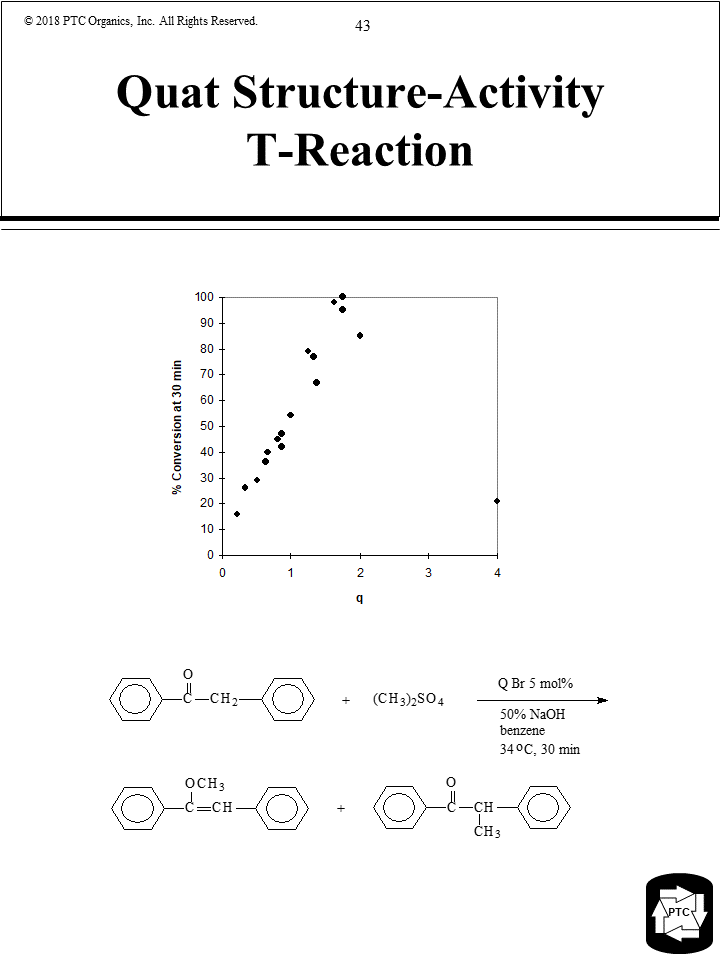
In that moment, it all of a sudden hit me that the ridiculously simple arithmetic function of the reciprocal might do the trick since the difference between 1/1 and 1/2 was big, between 1/2 and 1/3 smaller, between 1/3 and 1/4 even smaller and between 1/10 and 1/11 made almost no difference. After all, Coulombs Law tells us that the attraction force between two charges drops off rapidly with the square of the distance between them, so it was not unreasonable to think that accessibility of the positive charge on the nitrogen made a difference on ion pairing.  So, I simply added the four reciprocals of each of the four alkyl chains of each of 16 quats, both symmetrical and nonsymmetrical, and I plotted them against the reactivities I found for the alkylation of deoxybenzoin that I measured 9 years earlier (just before I met my wife with whom I am soon to celebrate our 40th wedding anniversary). Lo and behold, 15 of the 16 points lined up in almost a straight line.

Just as I hit “Enter” when creating the Cricket Graph plot of the reciprocal sums versus the reactivities of these 16 reactions, the cleaning lady walked in when I screamed out loud something along the lines of “holy excrement!” The cleaning lady asked if I was OK and I showed her the approximate straight line (except for tetramethylammonium) while excitedly communicating that I have been looking for such a correlation for the better part of a decade. She did not share my enthusiasm and left shaking her head about these crazy scientists.

I was excited because this was the first time anyone ever came close to making sense for correlating or even predicting reactivity simultaneously for both symmetrical and nonsymmetrical quat cations. To this day, I have not seen other attempts to quantifiably correlate quat structure with reactivity for both symmetrical and nonsymmetrical quats. In fact, whenever I teach this industrial PTC course, the #1 comment I get in the evaluation forms is that the participants were not aware that there is a systematic method to evaluate and optimize PTC applications nor did they know that the Halpern q-value was a part of that valuable thought process that minimizes the number of experiments required to develop and optimize PTC applications under industrial process development project pressures and deadlines.

This is why I recently presented the new lecture “How to Improve Process R&D Efficiency Using Phase-Transfer Catalysis” that is ow available for free viewing for a limited time at https://vimeo.com/421146888.

In any case, the original graph that correlated q-value with the reactivity of the alkylation of deoxybenzoin is shown in Figure 2, which is a page from my course “Industrial Phase-Transfer Catalysis” exactly as it has appeared in 56 sessions of this course since 1996. Figure 2 also shows how the Halpern q-value is first introduced during the course as an “empirical parameter.”

Figure 2: The Halpern q-value correlation for Reactivity of the PTC Alkylation of Deoxybenzoin from the Industrial PTC Course Manual
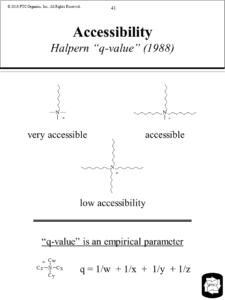
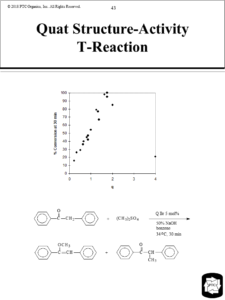
Apparently, I exhausted all my creative ability that day in coming up with the notion of adding four reciprocals, so I non-creatively named this empirical parameter “q-value” wherein “q” referred to some property of a “quat cation.”

I immediately knew that the q-value was nothing more than an empirical parameter. I presented the q-value to Starks and Liotta who I first met a couple of years earlier in December 1986 at a PTC summit at Catalytica in Silicon Valley, due to the efforts of Howard Alper and David Hamm.

We could not figure out a rational explanation for why the q-value worked and I was encouraged when Charles Liotta (absolutely brilliant scientist with an amazing sense of humor, outstanding interpersonal skills and a master at ballroom dancing!) said that the q-value was probably a valid parameter to consider. Starks and Liotta were my greatest mentors.

Starks, Liotta and I conducted a few sessions of a 3-day PTC course for process chemists in the US and the UK between 1990 and 1995. Whenever I presented the q-value, I always stated that it was nothing more than an empirical parameter and any of you who have my PTC course manual (I conducted the 2-day version of the industrial PTC course 56 times from 1996 to 2019) can look up in the manual and see that I refer to the q-value as a strictly empirical parameter.

At the same time, since the dominance of one methyl group or three ethyl groups on the quat, affects reactivity so much, I have always stated that until and unless a better explanation is offered, I will refer to the q-value as a metric of accessibility of the positive charge on the nitrogen of a quat.

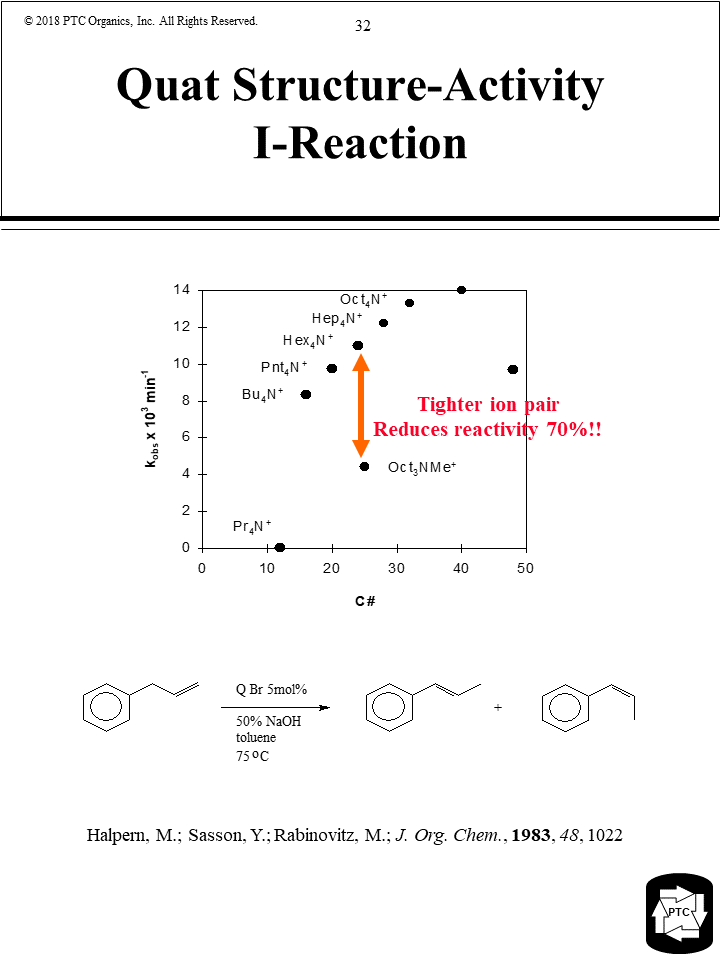
In fact, Figure 3 shows that methyl trioctylammonium gives 70% less reactivity than tetrahexylammonium in the PTC-NaOH isomerization of allylbenzene which is an “I-Reaction” (not a T-Reaction). Since these two quats have about the same number of carbons atoms (25 vs 24) and methyl trioctylammonium dissolves fully in the solvent toluene, a plausible explanation in 1983 was that the methyl trioctyl ammonium cation had a more accessible positive charge on the nitrogen atom than tetrahexyl ammonium and the tighter ion pair reduced reactivity. This is just one of several examples shown in my course “Industrial Phase-Transfer Catalysis” in which PTC I-Reactions go much slower with more accessible quats with the same number of atoms, such as decyl triethyl ammonium versus tetrabutylammonium, both with 16 carbon atoms but radically different accessibilities of the positive charge. I still think that ion pairing is very important and that q-value is useful as a predictor for reactivity in PTC I-Reactions, especially when comparing both nonsymmetrical quats and symmetrical quats for a single reaction. Afterv all, in the real world, we do not limit ourselves to just symmetrical quats.

Figure 3: Methyl Trioctyl Ammonium Shows Greatly Decreased Reactivity Relative to Tetrahexylammonium for a PTC I-Reaction Even Though They Have Nearly the Same Number of Carbon Atoms…Likely Accessibility of the Positive Charge Affects Ion Pair Tightness
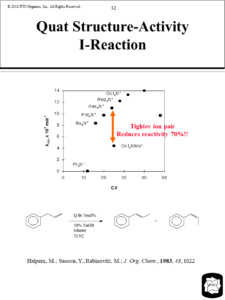
A couple of weeks ago, I happened to stumble across a paper (Denmark, S.; Henle, J.; Chem. Sci., 2015, 6, 2211) that addresses the underlying fundamentals of the q-value instead of just stating the empirical correlation between q-value and reactivity for PTC “T-Reactions.” This article is VERY worthwhile reading.

The authors found excellent correlations between reactivity of one of the classical PTC T-Reactions (an O’Donnell C-alkylation) and the “quaternary ammonium cross sectional area (XSA) as a general descriptor for transport-limiting PTC rate approximations.”

One of the strengths of the empirical q-value that has served me well over the past 3 decades has been the ability to compare the wide array of commercially available quat salts, INCLUDING NONSYMMETRICAL quats, for the optimization of large scale commercial PTC processes that has saved our customers and commercial partners hundreds of millions of dollars. The Chem Sci paper cited above refers only to symmetrical quat cations. So, while the Halpern q-value may not be a philosophically accurate concept for accessibility, it remains a very valuable empirical predictor of real world performance for real world quats, including nonsymmetrical quats such as methyl tributyl ammonium, Aliquat 336 and Adogen 464.

When I entered into the field of PTC in 1976 as a 2nd year undergraduate student, 5 years after the publication of Starks’ classical 1971 paper that first disclosed the term “phase-transfer catalysis,” the undeniable difference in quat structure-activity relationships between almost all PTC-NaOH reactions and almost all non-NaOH PTC reactions was noticed but not discussed in the open literature. When I performed the study in 1980 of the kinetics of the isomerization of allylbenzene using PTC-NaOH conditions (Figure 3 above), I was shocked to obtain perfect pseudo-1st order kinetics and higher reactivity with more organophilic quats, just as observed for almost all non-NaOH PTC systems. That paper was published in 1983 (Halpern, M.; Sasson, Y.; Rabinovitz, M.; J. Org. Chem., 1983, 48, 1022) and is probably the paper with the most consistent kinetic behavior through 6 half-lives for a PTC-NaOH system.

Here we are, 50 years after the coining of the term “phase-transfer catalysis,” and we still don’t have a full understanding of the mechanism of the most widely used commercial PTC applications which are PTC-hydroxide systems. Nevertheless, I am glad that many process chemists have been able to leverage the empirical Halpern q-value over several decades to achieve low-cost high-performance green chemistry to create/save jobs and help the environment, including using nonsymmetrical quats such as methyl tributyl ammonium chloride, that has a q-value of 1.75 (and used to be called Aliquat 175 by Henkel-Cognis-BASF when I helped them market that catalyst).

If your company wants to benefit from the most highly specialized expertise in industrial phase-transfer catalysis to achieve low-cost high-performance green chemistry while saving jobs (maybe yours!) and while helping the environment, now contact Marc Halpern of PTC Organics Inc to explore integrating this highly valuable well-seasoned expertise with your commercial goals in the most practical and operational manner.

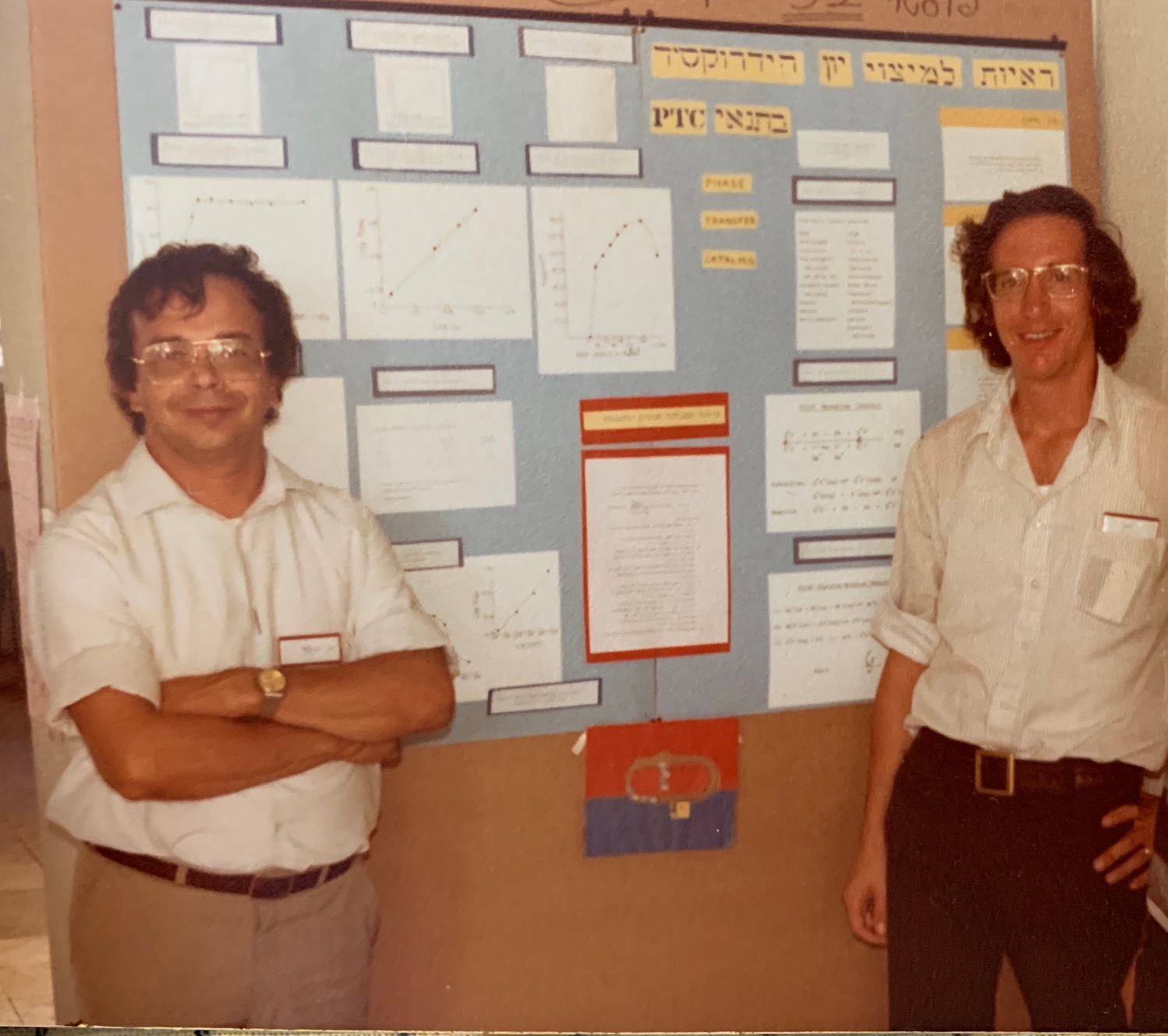
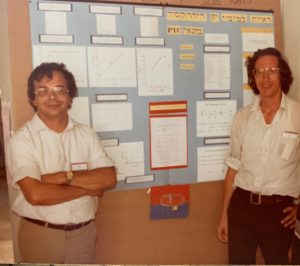
Figure 4: Marc Halpern (long hair on the right) and Professor Mordecai Rabinovitz at Marc Halpern’s First Poster Session In Jerusalem circa 1980 (the letters “PTC” are visible…a model of QX transfer using volumetric flask caps on a circular track between a blue aqueous phase and a red organic phase is hanging from the bottom of the poster!) My body mass has increased roughly 50% since that picture was taken and it’s not muscle!

Potassium Phosphate as Base for PTC Reactions

Yoel Sasson may be the most prolific contributor in the history of phase-transfer catalysis to the advancement of academic PTC reactions and mechanistic papers in an extremely diverse range of applications. One of his fascinating papers (Ind. Eng. Chem. Res. 2007, 46, 3016-3023) describes the use of potassium phosphate for the PTC C-alkylation of diethyl malonate, PTC oxidation of fluorene and PTC isomerization of allylbenzene. As an aside, Dr. Sasson, Dr. Rabinovitz and I published together the first comprehensive kinetic study of a PTC-NaOH reaction which was the isomerization of allylbenzene. My very first publication was the PTC deuteration of fluorene (from lab work that I performed as a second year undergraduate in the summer 1976 with Dr. Itamar Wilner, a graduate student at that time).

In this paper, Dr. Sasson and his associates studied in great detail the reaction of diethyl malonate with dibromoethane to form the cyclopropyl ring shown in the diagram. They examined the effect of different bases, phase-transfer catalysts, solvents, hydration levels (thermal pretreatment of K3PO4), particle size, and temperature to determine energy of activation.

When performing the PTC C-alkylation using potassium phosphate as the base and toluene as the solvent at 70 deg C for 8 hours with 5 mole% phase-transfer catalyst, the expensive 18-crown-6 gave higher conversion (73%) than classical less expensive phase-transfer catalysts such as tetrabutylammonium bromide (63%), cetyl trimethylammonium bromide (60%) and PEG-600 (56%). Under these conditions, no PTC gave 8% conversion.

Obviously, the closed ring crown ether bound well to the K+ cation of the potassium phosphate to enhance the reaction in toluene. The open chain polyethylene glycol catalyzed the reaction but not as effectively.

When the solvent was dimethylacetamide, the conversion was 94% in 4 hours. DMSO showed an initial rate higher by an order of magnitude higher than in DMA.

An extremely interesting result was that when heating using microwave irradiation, potassium phosphate outperformed potassium t-butoxide!

As is almost always the case in solid-liquid PTC reactions, hydration levels are crucial to reaction rate. When using DMA as the solvent, 5 mole% 18-crown-6 as the phase-transfer catalyst at 70 deg C and 4 hours reaction time, 96% conversion was observed with traces of water in the K3PO4, 85% conversion at 2 weight% water, 74% conversion at 5 weight% water, 62% conversion at 10 weight% water and 40% conversion at 20 weight% water in the potassium phosphate.

This excellent article is a must-read if you want to consider using potassium phosphate as a base in PTC applications.

If you need to achieve low-cost high-performance green chemistry for strong base reactions, now contact Marc Halpern of PTC Organics who started publishing a 15-part series entitled “Hydroxide Ion Initiated Reactions Using Phase-Transfer Catalysis: Mode of Action and Applications” in the 1970’s and has been practicing strong base PTC ever since.

PTC-TEMPO Hypochlorite Oxidation

In recent years, we have seen more reports about using phase-transfer catalysis for oxidations of primary alcohols to aldehydes using hypochlorite to reoxidize spent catalytic TEMPO in-situ. PTC-hypochlorite-TEMPO oxidations are often reported using high shear mixers and short reaction times from less than 1 second to 8 minutes.

One reason for short contact times is to minimize over-oxidation of the aldehyde to the carboxylic acid. Two reasons to use a phase-transfer catalyst are [1] to control the amount of inorganic hypochlorite in the organic reaction phase that presumably minimizes overoxidation of the aldehyde to the acid and [2] when the phase-transfer catalyst transfers hypochlorite into the bulk organic phase from its hydrated form in the aqueous phase, the hypochlorite anion is more active and we can then work at a lower temperature which can further enhance selectivity the greater control over the reaction.

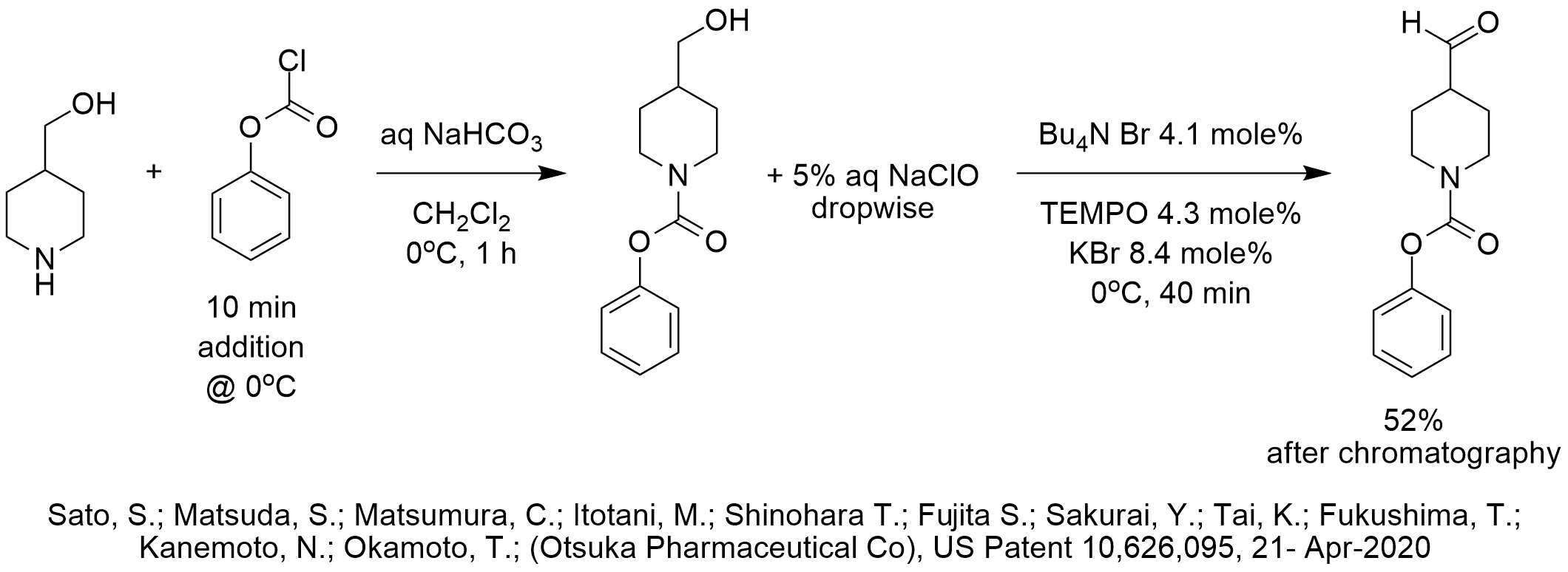
This patent reports a TBAB-TEMPO-hypochlorite oxidation of an alcohol to an aldehyde at 0 deg C with a 30-min dropwise addition of hypochlorite and a 10-min post-addition reaction time. No mention was made of the type of agitation used.

The original PTC-hypochlorite oxidation of primary alcohol to aldehyde by Lee and Friedman in the 1970’s showed that ethyl acetate and methylene chloride were the best solvents for this reaction. The inventors of this patent used methylene chloride.

It is not known why the inventors added extra catalytic KBr to the reaction mixture. If any of our readers have an idea why, please share. One thought might be to form the more reactive hypobromite in-situ, but if so, then the bromide from the TBAB might be sufficient.

No isolation or even a phase separation was reported between piperidinemethanol and phenyl chloroformate, so a full equivalent of NaCl was present when the reactants and catalysts for the oxidation were added.

The reaction was performed on a sub-gram scale, so the yield after two steps and after flash chromatography does not suggest low yield. It is not kniwn how much over-oxidation to carboxylic acid may have occurred.

When your company needs the most highly specialized expertise in industrial phase-transfer catalysis, now contact Marc Halpern of PTC Organics to explore how to improve your performance.