The Industrial Phase-Transfer Catalysis Experts

PTC Tip of the Month E-Newsletter

Chloromethylation Catalyzed by Quat Salts

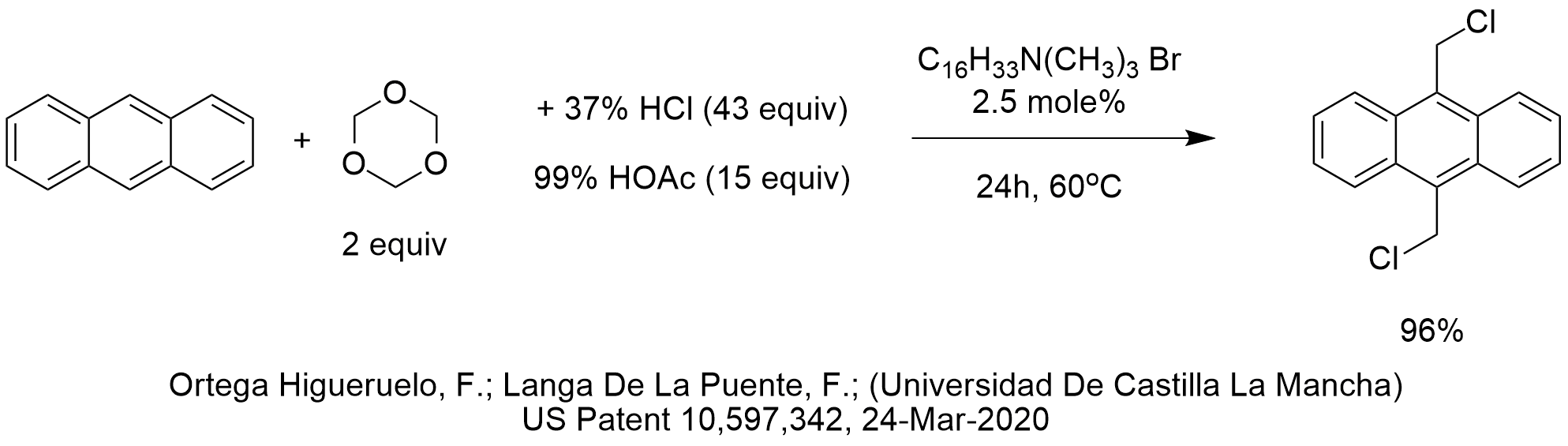
This patent describes the chloromethylation of anthracene (only anthracene). Before commenting on this patent, it is important to be aware that chloromethylation reactions often produce as a byproduct the highly toxic compound bischloromethylmethyl ether which has a history of being so hazardous and lethal that it is addressed in United States Code of Federal Regulations and OSHA standards that include special personal protective equipment, ventilation, personal exposure monitoring and other safety requirements. Please do not repeat the reaction condition shown in this patent without fully written hazardous operations analysis performed by licensed professionals including industrial hygienists plus all necessary equipment and procedures to avoid even small personal exposure to the reaction mixture, workup and byproduct streams.

Chloromethylation is an electrophilic aromatic substitution initiated by a source of formaldehyde, trioxane in this case, an acid and a chloride source, HCl in this case.

The inventors screened hexadecyl trimethyl ammonium bromide, a variety of tetrabutylammonium salts, and a crown ether as the “phase-transfer catalysts.” As shown in the figure, hexadecyl trimethyl ammonium bromide gave 96% yield under the conditions shown. The tetrabutylammonium salts bromide, fluoride, nitrate, hexafluorophosphate and perchlorate gave 70%-83% yield. Two crown ethers gave 63%-67% yield. Benzyl trimethyl ammonium chloride gave 70% yield.

Since hexadecyl trimethyl ammonium bromide gave 96% yield and the much smaller benzyl trimethyl ammonium chloride gave only 70% yield, we speculate that the preferred mechanism may be related to its surfactant properties given the classical head-and-tail structure for quat surfactants with one long alkyl chain. However, there is no organic liquid phase and no mention was made of emulsions. The inventors state that they used vigorous stirring at 1500 rpm which suggests that enhanced interfacial interactions are useful. Based on the very vigorous agitation and the high effectiveness of the surfactant hexadecyl trimethyl ammonium chloride, we speculate that an interfacial mechanism may be more valid for this application than a true phase-transfer mechanism.

There is an aqueous phase and the product is a solid that is filtered from the reaction mixture. The inventors note that the process requires no further purification other than crystallization, washing the solid product with ethanol and drying.

No mention was made in the procedures or body of the patent of any safety precautions to protect against exposure to the potentially formation of bischloromethylmethyl ether. While we understand that there is no requirement to do so in a patent, we would like to emphasize again that it is imperative to perform a thorough and professionally competent hazard operations analysis and take all possible safety precautions before considering any attempt to repeat these reaction conditions even on a small scale.

When your company is considering any potential phase-transfer catalysis application, contact Marc Halpern of PTC Organics to benefit from highly specialized expertise in industrial phase-transfer catalysis.

PTC Reaction of Thionyl Chloride – VALUABLE READER INPUT!

Last month we asked your help in understanding what appears to be a phase-transfer catalyzed reaction of thionyl chloride. Following are the high quality answers provided by our loyal, creative and intelligent readers.

Special thanks to Scott Sherwood, Danny Levin, Peter Wuts, Dan Henton, Maria Nieves Perez Payan and Jeffrey Marra, who provided excellent thought processes from which the entire PTC community benefits!

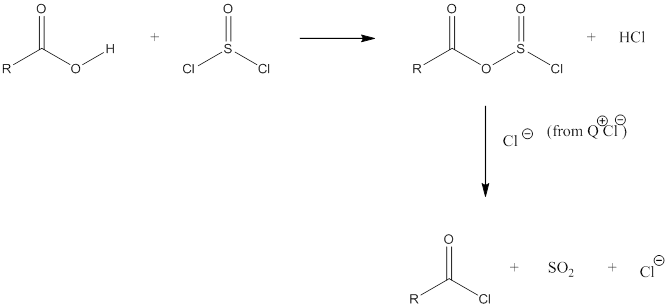
There seems to be consensus for the formation of a mixed anhydride-sulfonyl chloride as an intermediate that is promoted by the quat chloride.

Scott Sherwood wrote:

I have a possible explanation for the role of the quaternary ammonium chloride in the carboxylic acid => [acid chloride] => ester reaction scheme.

The quaternary ammonium chloride is a source of “naked” chloride to allow for the decomposition of the thionyl chloride adduct of the carboxylic acid to the acid chloride, sulfur dioxide, and HCl.

With DMF, the following sequence occurs (I am not showing all of the mechanistic steps for convenience):

The DMF byproduct then repeats the reaction with additional thionyl chloride to prepare the Vilsmeier reagent as the source of “naked” chloride.

As you can see, the quaternary ammonium chloride route is much more efficient. In the case of DMF catalysis, the carboxylic acid has a choice of two electrophilic reagents for reaction.

Additionally, the Vilsmeier reagent has a propensity to generate tars and/or become less soluble as the reaction proceeds towards completion.

Thank you to Dr. Sherwood for providing such a detailed explanation with structure diagrams!

Danny Levin wrote:

The reaction of carboxylic acid with thionyl chloride proceeds via an initial coupling step to give a mixed acid anhydride intermediate which then decomposes to the desired acid chloride plus sulfur dioxide plus HCl.

RCOOH + SOCl2 -> RCO-O-SO-Cl

This intermediate needs to react with chloride nucleophile to cause decomposition to RCOCl + SO2.

Cl- + RC(O)-O-S(O)-Cl -> RC(O)Cl + SO2 + Cl-

The PTC quat presumably enhances the reactivity of the chloride nucleophile in its reaction with the mixed acid anhydride intermediate.

In the absence of the PTC quat the chloride is less nucleophilic as it is tied up with proton as covalent HCl.

The PTC helps to make the chloride more available as unbound and hence more reactive chloride ion (paired by PTC cation) to enhance its reactivity as a nucleophile with the aliphatic acid carbonyl present in the mixed anhydride intermediate (chloride no doubt also reacts with the sulfur but that takes us back to starting material so this is an pre-equilibrium reaction):

PTC + Cl- + RC(O)-O-S(O)-Cl -> RC(O)Cl + SO2 + Cl- PTC+

Peter Wuts wrote:

There are 2 ways to took at this. First the presumed intermediate mixed anhydride reacts faster with the Quat salt because the chloride is free of a proton and is more nucleophilic than HCl with its proton.

The other could be that the acid in in equilibrium with the Quat salt to form HCl and the carboxylate which now would be expected to react much faster with thionyl chloride than the protonated acid. The release of Cl- then would be expected to react with the mixed anhydride faster like in the first scheme. Even though the amount of the ammonium salt might be small, Le Chatelier’s principle will take care of the rest.

So, in essence both the first step and the second could be accelerated with the Quat salt.

Dan Henton wrote:

My guess is that having a soluble source of chloride ion in the reaction mixture allows for more rapid breakdown of the mixed sulfite – carboxylic acid anhydride intermediate to the acid chloride and sulfur dioxide. Chloride is no doubt a better nucleophile than HCl or NN-DMF.

Jeffrey Marra wrote:

Don’t know if there is any sound evidence, but I’ve always thought that the nucleophilic attack of chloride on the mixed carboxylic sulfoxyl ‘anhydride’ was the rate limiting step. If you increase the concentration and/or the reactivity of chloride ions in the reaction mixture, the acid chloride forms more effectively. The only reference I can think of that supports this is from WAY back. In the original paper by Mosher for the use of his chiral acid to form chiral esters for enantiomeric analysis, he reports the addition of (I think) 5 equivalents of sodium chloride the reaction to form the Mosher acid chloride from the acid and thionyl chloride.

Maria Nieves Perez Payan wrote:

I am presuming that the quat chloride is improving the solubility of the dicarboxylic acid in the organic phase as bis-quaternary salt.

I want to thank all of you who contributed these high quality explanations and I commend you on paying such close attention to the surprising performance of phase-transfer catalysis. When you make such contributions, you are proving your high value to the PTC community and that is greatly appreciated by all of us!

New LANDMARK Work on Quat Salt Partitioning!

Richard Fox and Jun Qiu of Bristol-Myers Squibb Company just published a truly landmark publication that will be of great practical benefit to PTC process development chemists and engineers from now and forever. This crucial reference provides massive data for the partitioning of 67 quaternary ammonium and phosphonium salts between water and 12 organic solvents. The quat salts chosen include almost all of the most widely used phase-transfer catalysts in commercial PTC applications. This historical publication was published on December 27, 2019 in the journal Organic Process Research and Development and is referenced at https://dx.doi.org/10.1021/acs.oprd.9b00496.

The ramifications of this work are of huge importance for a variety of purposes.

Environmental

We can use the data in this landmark publication to estimate the number of water washes that may be required to effectively separate a water-soluble phase-transfer catalyst from the product dissolved in any of the solvents studied.

Quality and Purity

We can use the data in this publication to estimate or achieve a defined maximum level of residual phase-transfer catalyst in a product dissolved in one of the solvents studied, as a function of the number of water washes during workup.

Choice of Solvent, Phase-Transfer Catalyst and Leaving Group in PTC Systems

The data in this historical publication give the most information ever reported for toluene which is one of the most common solvents used in PTC reactions in the lab and in the plant. When you look at the partitioning data in Table 2, you may wonder how PTC ever works in toluene since most quat salts partition into water MUCH more than into toluene (often hardly at all into toluene). The answer is that PTC reactions are typically performed with much salt in the aqueous phase or even under solid-liquid conditions. In these cases, the partitioning of the quat salts is between the solvent and high ionic strength aqueous phase (experiencing salting out of quat salt), not between the solvent and pure water. The good news is that after the first phase separation that removes the majority of the water-soluble byproduct salts after the reaction is finished, the phase-transfer catalyst will wash out into fresh water (little to no ionic strength) very readily, as suggested by the reported data.

Most PTC process development chemists screen tetrabutylammonium salts at some point during each development program (even though tetrabutylammonium salts are often not optimal). While it is known that softer more polarizable anions pair more strongly with quat cation, this publication provides quantitative data for 18 tetrabutylammonium salts that enable to predict the competition between reacting anions and leaving group that may be controlled by choice of solvent for desirable partitioning. The data quantitatively confirm how much more tetrabutylammonium iodide, for example, may distribute into a given solvent relative to 17 other anions paired with tetrabutylammonium. Iodide is a know PTC catalyst poison, though not in systems that involve anionic reactants that contain many carbon atoms.

As we teach in our 2-day course “Industrial Phase-Transfer Catalysis”, it is preferable to use a mesylate leaving group than a tosylate leaving group from the standpoint of catalyst poisoning (or partial catalyst poisoning that can slow down a reaction) and this publication provides the data to support the notion that tetrabutylammonium tosylate partitions into certain solvents while tetrabutylammonium mesylate partitions much more into water. Of course, you can perform the desired reactions with high ionic strength in the aqueous phase that will salt out the tetrabutylammonium salts into the organic reaction phase, but the publication shows that it will be much easier (i.e., less costly) to wash the quat mesylate salt into water than the quat tosylate salt when the reaction is finished.

The data in the table confirm that if you are performing a nucleophilic substitution with thiocyanate for example, the quat thiocyanate will partition to a much greater extent into certain organic solvents relative to the corresponding quat bromide. This is important to know since if you are using a small excess of thiocyanate to save money and you are using a bromide leaving group, the small amount of quat thiocyanate remaining at high conversion will continue to partition into the well-chosen organic solvent reaction phase and not remain in the water where it will not react with the organic-soluble substrate.

“Third-Phase” PTC

As we teach in our 2-day course “Industrial Phase-Transfer Catalysis”, when you are able to create a third phase in PTC systems, you often observe extremely high reactivity. This happens when the simultaneous hydrophobicity and organophobicity of certain quat salts are such that the quat salt does not dissolve in either phase. The publication cites some of these salts, though they do not mention whether a third liquid phase is formed.

While this publication is extremely appreciated by PTC experts, one catalyst that we would have liked to see is methyl tributyl ammonium chloride, simply because it is used in large commercial quantities (more than 100 metric tons in single applications) and excels for PTC T-Reactions.

This brief review is just a small sample of the MANY other ramifications this landmark article provides to real world PTC process development chemists and engineers. You must read the article in its entirety to learn of the MANY structure-activity relationships and other scientific conclusions explicitly reported by the authors that are not mentioned here. The authors pulled back the curtain on MANY facts previously hidden from our knowledge and we owe a debt of gratitude to these authors.

It is a sure thing that we will definitely incorporate this crucial reference in all future sessions of the 2-day course “Industrial Phase-Transfer Catalysis.”

On behalf of the entire current and future PTC community, we would like to thank Richard Fox and Jun Qiu for their extremely important contribution to PTC process development and recognize their historic impact on the purity, quality, safety, process cost reduction and environmental performance of the products and processes that will implement phase-transfer catalysis in production in the future!

Historical Perspectives of Industrial PTC Process Development Over the Past Decades

As today is the last day of the decade of the 2010’s, it is interesting to reflect on changes we have seen over the past few decades in PTC process development. We would like to share here some general conclusions about trends we found in the segmentation of the PTC process development market, though we will not disclose proprietary details about our customer base. We will also share historical perspectives about PTC technology development in industry and academia.

The following discussion is based on qualitative observations as well as an analysis of internal data at PTC Organics regarding the segmentation of phase-transfer catalysis process technology development customers. We looked at the industries and the geographical location of our customers’ process development headquarters.
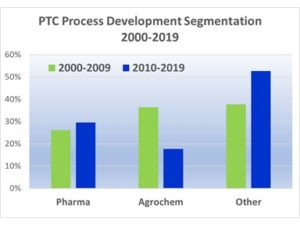
First, we have a qualitative idea of shifts in the market segments and location of PTC process development efforts that we observed by our market presence as the leader in PTC process development in the past quarter century. Personally, I have been a full-time industrial phase-transfer catalysis entrepreneur with PTC Organics Inc. (and its predecessor PTC Communications Inc.) since 1995 and I have seen structural changes in the organic chemical industry like many of you have seen. With PTC Organics Inc. (and previously PTC Communications Inc.), I have attended and/or exhibited at tradeshows such as Informex, CPhI and Chemspec in each of the past 25 years and I have witnessed the shifts in industrial organic chemical activity on a qualitative basis. In addition, we analyzed the sales of PTC Organics’ over the past 20 years since companies that actively develop PTC technology turn to PTC Organics Inc. to address their most challenging phase-transfer catalysis projects to achieve lower cost higher performance green chemistry. When companies invest real money in PTC technology development, that shows commitment to the technology.

Early Days of Phase-Transfer Catalysis

When I first entered phase-transfer catalysis in 1976, five years after Charles Starks’ classic paper in which he coined the term phase-transfer catalysis, the majority of the breakthrough work in PTC was published by researchers in the US and Europe, mostly by academics, though Starks was an industrial chemist himself and there were already industrial PTC processes in Europe.

The manufacture of tetrabutylammonium bromide (TBAB) started when DuPont had a commercial PTC process that needed TBAB and they turned to surfactant-quat producer, Hexcel in Zeeland, Michigan, to produce TBAB. Sachem (in Texas) were making high purity quats for a variety of applications (including tetramethyl ammonium hydroxide for the new semiconductor industry). In the early 1980’s, Sachem and Zeeland Chemicals were the main ammonium quat producers in the US for small quats with up to about 20 carbon atoms and Henkel and Witco were the producers of Aliquat ® 336 and Adogen ® 464 with an average of 27 carbon atoms. Cytec (Canada) made aliphatic quaternary phosphonium salts and still do. Parish Chemical was the first commercial producer of 18-crown-6 and dibenzo-18-croen-6 in the US. In Europe, Dynamit Nobel was the main producer of TBAB and related quats in the early days and Rhone Poulenc produced TDA-1 which was an excellent complexant phase-transfer catalyst. In 1988, Dishman in India became a major producer of quaternary ammonium phase-transfer catalysts and grew their business significantly over the next decade by aggressive marketing.

By the time I completed my Ph.D. work in phase-transfer catalyzed hydroxide ion reactions in 1983, PTC technology development in academia had a strong presence in the US, Germany, Israel, Sweden, Italy, Poland and India. When I started presenting industrial PTC lectures around the world in 1995, PTC was thriving in the global chemical industry with many commercial applications growing in all industrialized countries, notably adding Switzerland, Japan, the UK, the Netherlands, Austria and Spain that enjoyed strong growth using PTC to manufacture products in a wide variety of industries. Though not well known publicly, there was much industrial PTC growth in Russia, as Dr. Felix Sirovski shared in the journal Phase-Transfer Catalysis Communications in 1997. Dr. Sirovski wrote that the robustness of PTC technology for a very wide range of commercial applications was an excellent match for the chemical plants in Russia that did not always enjoy investment in plant maintenance that was common in the West.

In 1987, Catalytica commissioned a study about the past, present and future of industrial phase-transfer catalysis and gathered the experts, Charles Starks of Vista Chemical (formerly of DuPont and Conoco), the inventor of PTC and the extraction mechanism; Charles Liotta of Georgia Tech and top notch award winning consultant at companies such as DuPont and Milliken; Dan Brunelle of General Electric, inventor of many PTC patents for the manufacture of engineering thermoplastics and inventor of several thermally stable phase-transfer catalysts, Howard Alper of University of Ottawa who was the leader in transition-metal PTC technology and myself, Marc Halpern, then a process chemist at Dow Chemical that was already manufacturing hundreds of millions of dollars of polymers, agrochemicals and pharmaceuticals using phase-transfer catalysis. I authored the study sold by Catalytica that included a study of 125 PTC patents up to that point.

In 1994, Charles Starks, Charles Liotta and I published the authoritative 650-page book “Phase-Transfer Catalysis: Fundamentals, Applications and Industrial Perspectives.” A year later, I founded PTC Communications Inc. and in 1999, I founded PTC Organics Inc. and co-founded PTC Value Recovery Inc.

2000-2009

By the year 2000, I presented the lecture “Reducing Cost of Manufacture of Organic Chemicals Using Phase-Transfer Catalysis” at more than 100 industrial process R&D departments in North America, Europe and Asia. By the year 2000, it was clear that the penetration of phase-transfer catalysis reached every segment of the chemical industry, not just the classical pharmaceuticals and agrochemicals. A study on PTC published in 2019 by non-PTC experts still perceived (incorrectly) that pharma and agrochem were the major users of phase-transfer catalysts. PTC is a highly technical niche and it is hard for outsiders to understand the market by casual study.

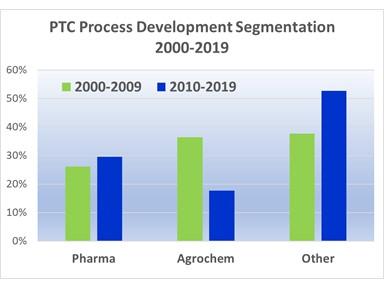
In the first decade of the 2000’s, large industrial PTC processes were growing or newly commercialized for a wide variety of monomers, polymers, fragrances, solvent, petrochemical applications and environmental applications in addition to the classical pharma, agrochem and specialty/fine organic chemicals. During the decade of 2000-2009, the investment of chemical companies in PTC process development for non-pharma/non-agrochem products was 38% of the total.

In the decade of the 2000’s, Asia-Pacific countries (most notably Japan, India and China) had great growth in PTC applications in all industrial segments. One of the greatest breakthroughs in all of phase-transfer catalysis is the family of “Maruoka chiral phase-transfer catalysts” invented by Keiji Maruoka in Japan starting just before the year 2000 and grew in patented applications in the 2000’s.

2010-2019

In the decade ending today (Dec 31, 2019), PTC process development continued to grow in all industrial segments and in all geographies. In fact, PTC Organics had a great year in 2019 in terms of sales for process development and contract research in a surprisingly wide range of applications including petrochemicals, commodity chemicals and veterinary products.

In this decade, non-pharma/non-agrochem investment in PTC process development grew to 53% from 38% in the previous decade.

In this decade, investment in PTC process development was led by European companies, followed by Asia-Pacific. Investment in PTC process development in North America remains strong, but not as strong as in Europe and Asia-Pacific. This confirms the qualitative shifts we have seen at chemical industry tradeshows over the past 25 years.

There has been a great proliferation of manufacturers of phase-transfer catalysts in India and China in the past two decades. I visited a plant in China in 2007 that produced and had in inventory nearly 50 different quaternary ammonium and phosphonium phase-transfer catalysts (many specialty phosphonium salts are used in the manufacture of epoxy resins). These days, when we obtain quotations for quaternary ammonium salts, there are many sources for these compounds, though we often have to sort through who are the actual manufacturers and who are the distributors (visits to actual manufacturing facilities).

In 2019, I conducted my 56th 2-day course “Industrial Phase-Transfer Catalysis.” That will likely be the last public PTC course I will conduct though demand for the in-house PTC course remains solid as companies recognize that phase-transfer catalysis delivers low-cost high -performance green chemistry for a very wide variety of strong base reactions, nucleophilic substitutions, oxidations, reductions, acid-catalyzed reactions and other applications in almost every industry that produces organic chemicals and polymers.

I have enjoyed a fascinating 43.5 years in phase-transfer catalysis (so far!) providing PTC services on-site at nearly 300 process R&D departments in 39 countries. Amazingly, we are now involved in what may become the largest PTC process.

The growth of industrial phase-transfer catalysis continues. Make sure that your company is not left behind. Now contact Marc Halpern of PTC Organics to explore how your company can achieve low-cost high-performance green chemistry to improve your company’s profitability and process R&D efficiency.

PTC-Sulfite for Polyurethanes

Burdeniuc, J.; (EVONIK DEGUSSA) US Patent 10,472,459, 12-Nov-2019

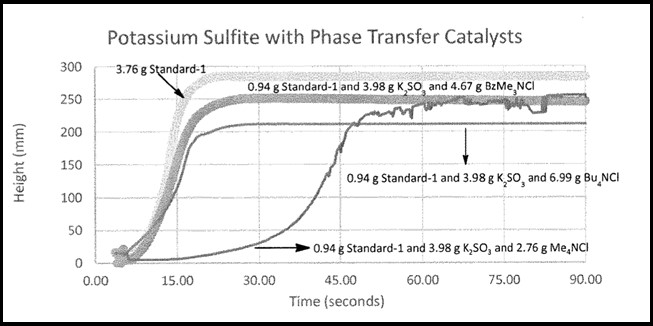
Polyurethanes are formed by reacting isocyanates with polyols in the presence of catalysts and other additives (e.g., blowing agent for polyurethane foam). Amine catalysts are effective but they have the disadvantage of odor and emissions. Other catalysts include transition metals that can be expensive and toxic. The amine and transition metal catalysts can be replaced by an inexpensive alkali metal sulfite (produced by passing sulfur dioxide through an alkaline solution) that is not volatile. The challenge of bringing the inorganic sulfite anion into contact with the organic isocyanates and polyols is solved by using a quaternary ammonium phase-transfer catalyst.

The use of tetrabutylammonium chloride (TBAC) with potassium sulfite could be used to totally replace amine catalyst and transition metal catalyst. Under the same conditions cetyl trimethyl ammonium chloride did not work. Neither did the surfactant sodium dodecylbenzenesulfonate. This suggests that a true phase-transfer mechanism for the sulfite is at work, not just reducing interfacial tension to promote reaction at an interface.

Also tested was the use of a mixture of amine catalysts (including DABCO) typically used to produce polyurethane foam. The amount of amine catalyst could be reduced by 75% by using potassium sulfite with TBAC or the very inexpensive benzyl trimethyl ammonium chloride.

We speculate (without data; not mentioned in the patent) that the inventors used expensive TBAC rather than the much less expensive than TBAB due to the potential suppression of sulfite extraction by the bromide. Chloride typically enables 10 times more extraction of hydrophilic anions (such as sulfite) relative to bromide.


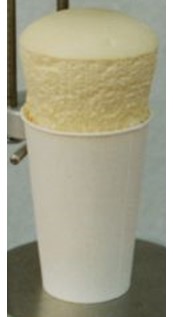
In 1989, I briefly served as a manager of isocyanate process research group at a major polyurethane company. One of the quality control methods used for making polyurethane foam was a “top of cup” rise test. The picture shows a typical test for rise of foam in a cup.

If your company wants to improve process performance for a reaction of any anion that is or may be reacted with an organic substrate, now contact Marc Halpern of PTC Organics to integrate highly specialized expertise in industrial phase-transfer catalysis with your commercial goals to achieve low-cost high-performance green chemistry.

Use of Aliquat 336 for Palladium Co-Catalyzed PTC Reactions

Aliquat 336 (registered trademark of BASF) is a mixture of 4 quat salts, described at http://phasetransfer.com/WhatisAliquat336andAdogen464.pdf, of which 33% is methyl trioctyl ammonium chloride. Aliquat 336 has been reported to enhance the activity of palladium catalysts for Suzuki and other reactions, for more than 20 years.

The point of this PTC Tip of the Month is that if you are using a palladium catalyst for Suzuki coupling or other reactions, you should probably screen Aliquat 336 (after first making sure that the reaction can be done safely such as by running a DSC first to assure no uncontrollable exotherms) to determine if you can achieve advantage using this phase-transfer catalyst. Advantages may be in reaction performance such as control of molecular weight, advantageous reaction conditions, using a less expensive form of palladium (choice of ligands) or even using less of the expensive palladium catalyst.

To illustrate the use of Aliquat 336 in Pd catalyzed PTC reactions, following is a sampling of US Patents that have used the Aliquat 336-Pd combination over the past year.

US Patent 10,403,822 (Sep 2019): Synthesis of thienothiophene isoindigo-based polymer semiconductors
US Patent 10,392,395 (Aug 2019): Synthesis of 4,7-bis-(2-bromo-4-methylpyridin-6-yl)-2,1,3-benzothiadiazole
US Patent 10,364,316 (Jul 2019): Synthesis of 2,5-diphenyl p-xylene
US Patent 10,340,457 (Jul 2019): Synthesis of dithiopentalenes
US Patent 10,290,809 (May 2019): Synthesis of polymer between dithiofluorene and thiobenzimidazole and US Patent 10,059,796 (Aug 2018)
US Patent 10,276,799 (Apr 2019): Synthesis of Iridium phenyl-isoquinoline phenyl-triazole compounds
US Patent 10,273,329 (Apr 2019): Synthesis of carbazole-divinylbenzene copolymers
US Patent 10,199,577 (Feb 2019): Synthesis of triphenyl derivatives and US Patent 10,134,988 (Nov 2018)
US Patent 10,158,079 (Dec 2018): Synthesis of polymers of benzodithiophene
US Patent 10,005,886 (2018): Synthesis of dimethyl 2,2”,4,4”,6,6”-hexamethyl-p-terphenyl-3,3”-diester

If you want to achieve high-performance low-cost PTC processes with efficient utilization of constrained R&D resources, now contact Marc Halpern of PTC Organics to integrate the highly specialized expertise of PTC Organics in industrial phase-transfer catalysis with your company’s commercial goals.

3 Common and Very Costly Misconceptions About PTC Cyanide Systems

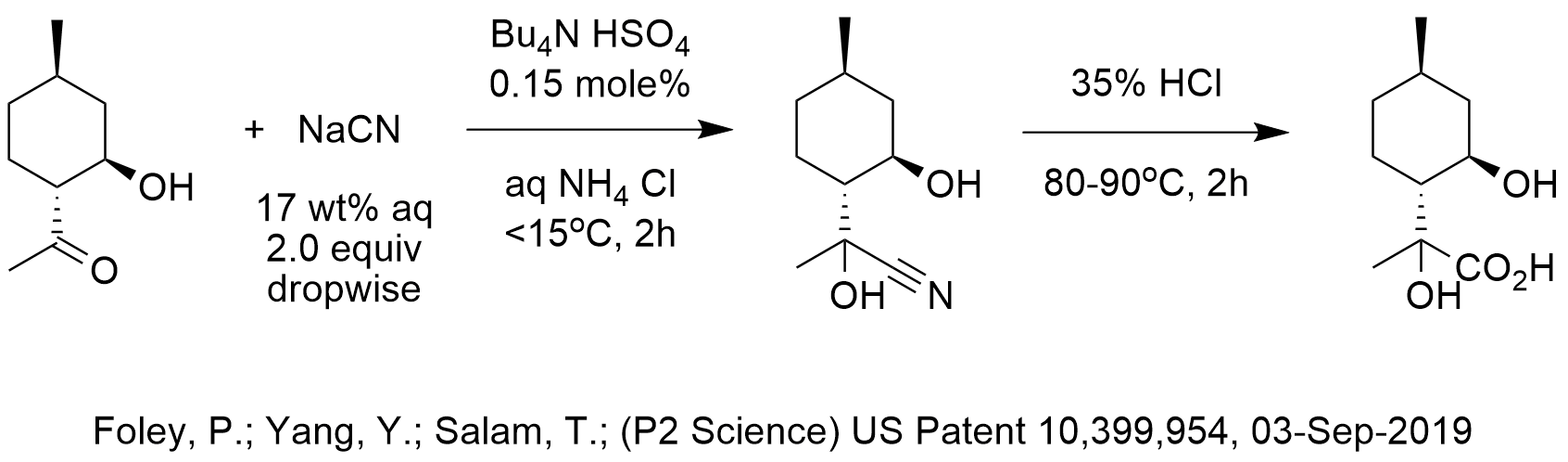
A patent issued last week that describes a PTC-cyanide reaction to form a cyanohydrin and reminded us of a few common misconceptions that we have seen over the years that have resulted in nuisance plant operability problems in mild cases and cost companies tens of millions of dollars per year in lost yield in severe cases! We will teach how to overcome these three misconceptions in our 2-day course “Industrial Phase-Transfer Catalysis” to be conducted in Prague next month (now register here for public PTC course in Prague). We will highlight these issues in the free PTC webinar to be conducted later this week on September 11, 2019 (now register here for free PTC webinar on Sep 11, 2019).

The first myth believed by some is that it is necessary to dissolve all of the alkali metal cyanide salt in water in order to carry out a PTC-cyanide reaction. In 2001, we visited a plant to identify opportunities to improve the performance of several large volume processes that used PTC or should use PTC. One of the large scale processes used cyanide as an aqueous solution. We pointed out that there may be a cause-and-effect relationship between the long and costly reaction time and the use of too much water in the system that hydrates the cyanide anion and reduces its nucleophilicity. The plant operators explained that they needed to dissolve the cyanide in water to facilitate the reaction.

We then explained that a phase-transfer catalyst is able to extract the cyanide anion from the surface of solid NaCN or KCN if it has a thin film of saturated cyanide salt, called “the omega phase” (discovered by Prof. Charles Liotta), that can be formed and optimized using small amounts of water. When we optimize the amount of water, usually at relatively low levels and using solid-liquid PTC conditions, reactivity greatly increases and we can achieve an increase in plant capacity, of an EXISTING plant, without capital investment!

Be sure to register for the free PTC webinar that will be conducted on September 11, 2019, in which we will discuss the effect of hydration in PTC systems.

A second misconception is that cyanide can only act as a nucleophile.

In the late 1990’s we received a non-confidential inquiry from a company that was suffering from a 35% yield loss (!!!) in a process that produced several hundred tons per year of a secondary nitrile from a secondary alkyl halide. I spoke with the plant chemist and said that I speculate that the yield loss is due to the cyanide anion partially acting as a base in addition to its predominant activity as a nucleophile. He confirmed that indeed the major side reaction was dehydrohalogenation. I told him that the solution is very simple and that he should submit a request for a PTC Process Consulting Agreement to his management so we could work together and recover the wasted value of about 100 metric tons per year of product!

The company did not engage us and used the poor excuse that they were not very profitable and did not want to invest in consulting! I replied that they would be a lot more profitable if they produced an extra 100 tons per year with no additional cost. That is when we learned that the real reason for declining our offer was organizational resistance to change. That was my incentive to write the article “5 Reasons that Companies Miss Process Improvement and Profit Opportunities using Phase-Transfer Catalysis.”  Unfortunately, the content of the article is still true today and is waiting for a champion (maybe YOU?!) in each company to take the initiative to stop wasting money on inefficient processes. If you want to contact us, please use THIS form and not the outdated Email address shown in the article.

We learned that several years later, the company figured out how to reduce the dehydrohalogenation in the cyanide-halide displacement using phase-transfer catalysis. They literally wasted millions of dollars of lost profit (!!!) because they didn’t want to admit that the relatively inexpensive PTC Process Consulting could show them technology that their technical team did not know. Is your company wasting lost profit right now due to resistance to change?!

The third misperception is that cyanide reactions are best performed using polar solvents.

As we show on page 109 of our 2-day PTC course manual, the product literature of one of the DMSO producers writes “DMSO is the best solvent for reactions involving cyanide and azide nucleophiles”. On page 215 of our PTC course manual, we compare 8 crucial process performance parameters for using PTC versus using PTC for reactions such as cyanide and azide reactions.

As always, the bottom line is that expert choice of PTC process conditions for cyanide reactions, can result in millions of dollars of added profit, which also saves a lot of jobs (maybe even YOUR job). Now register for the 2-day PTC course in Prague to be held on October 15-16, 2019 or bring the 2-day PTC course in-house to your company site to save millions of dollars, euros, etc.

PTC with Permanganate

Phase-transfer catalysis excels in transferring and reacting all kinds of oxidizing agents including permanganate and dichromate. Permanganate has a very high affinity for quaternary ammonium cations that enhances the extractability of this anionic oxidant. The first publication that launched the field of PTC, authored by Charles Starks, explicitly cited the use of Aliquat 336 with potassium permanganate (taught on page 197 of our PTC course manual). Another of the earliest PTC publications in the 1970’s was entitled “Purple Benzene” to describe what happens when you mix a quaternary ammonium salt with potassium permanganate and benzene (yes…we used benzene as a solvent in the 70’s!).

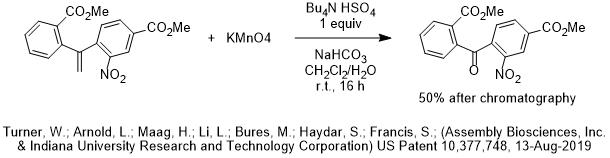
We don’t often see patents recently that cite the use of PTC with permanganate, but this August 2019 patent shows the reaction in the diagram that oxidizes a geminal alkene to a ketone using bicarbonate for pH control. A full equivalent of tetrabutylammonium hydrogen sulfate was used instead of catalytic quantity and it is not clear why so much was chosen to be used by the inventors.

PTC-permanganate oxidation of alkenes can produce a variety of products including diols, aldehydes, ketones, carboxylic acids and hydroxy-ketones depending on [1] the structure of the substrate [2] the pH of the aqueous phase in liquid-liquid PTC-permanganate systems and [3] and whether using aqueous workup or dry workup for solid-liquid PTC-permanganate systems. For more details, contact Marc Halpern of PTC Organics to explore PTC consulting to achieve your company’s process development goals.

One challenge of the use of PTC-permanganate reactions for commercial applications is the formation of manganese dioxide precipitate that is difficult to filter as a finely divided solid.

Tetrabutylammonium Bromide for Specialty Living Polymer Application

A patent was issued this month that used tetrabutylammonium bromide as a bromide source that can be used to carefully control at will not only the initiation of the polymerization of propylene oxide or epichlorohydrin, but also control the ratio of repeating units to a cationic end group at only one side of the polymer. This is useful for preparing an effective dispersion of a nanocarbon material in an aqueous phase.

The inventors of the patent Hoang, T.; Ohta, K.; Hayano, S.; Tsunogae, Y.; (Zeon Corporation) US Patent 10,344,124, 09-Jul-2019, found that a nanocarbon material is more favorably and more stably dispersed in a polyether-based polymer that contains a cation on only one terminal side. Examples of such polyethers that contain a cation on one side are polypropylene oxide or polyepichlorohydrin that has an onium salt on one side that can be produced by reacting an amine or a nitrogen heterocycle with a polypropylene oxide or polyepichlorohydrin that has a bromide at only one end.

For this purpose, in one example the inventors polymerized propylene oxide in the presence of a carefully chosen amount of tetrabutylammonium bromide (TBAB) as an organic soluble bromide source (21.5:1 molar ratio of PO:TBAB), triethylaluminum as polymerization catalyst and toluene as the solvent at 0 C for 2 hours. When the reaction was complete, the inventors added isopropanol to terminate the reaction and obtain polypropylene oxide with an average of 20 PO units, having a bromomethyl group at the polymerization starting terminal and a hydroxyl group at the polymerization terminating terminal.

The polypropylene oxide with bromomethyl at one end and hydroxyl at the other end was quaternized with 1-methyl imidazole or butyl dimethyl amine.

In other examples, the inventors reduced the amount of TBAB which increased the number of PO repeating units to 50, 100 and 200 at will and by design, in order to test for the optimal chain length for the stable dispersion of the nanocarbon material.

While this application is not strictly phase-transfer catalysis, it does leverage the concept of controlling a reaction by using a phase-transfer agent to introduce an anion into a reaction phase in a specific well-controlled quantity to achieve desired performance targets.

In our 2-day PTC course, we show other examples of using TBAB to initiate nucleophilic reactions induced by bromide that star with ring opening. Now register for the public PTC course in Prague in October 2019 or bring the PTC course in-house to your company to improve your personal performance, your department’s performance and your company’s performance. The increased profit your company will achieve from low-cost high-performance green chemistry using phase-transfer catalysis, may save jobs, perhaps your job.

Avoid Over-Agitation in PTC Systems!

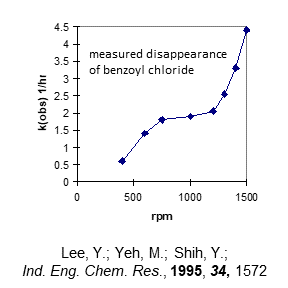
This PTC Tip of the Month has helped many of our customers save large amounts of money, mostly by reducing excess expensive and/or hazardous raw materials while maintaining high yield and high throughput. The diagram is taken from the group exercise on page 108 of the course manual of “Industrial Phase-Transfer Catalysis.”

This graph shows the disappearance of benzoyl chloride as a function of agitation speed (in a small lab reactor) for the reaction of aqueous sodium phenoxide with benzoyl chloride in the presence of tetrabutylammonium hydrogen sulfate.

At low rpm, this PTC reaction is transfer rate limited (“T-Reaction”). In the T-Reaction regime, more agitation increases mass transfer of the phenoxide from the aqueous phase into the organic phase and reactivity increases. At some point when increasing agitation efficiency, the rate of consumption of phenoxide in the organic phase by the intrinsic reaction is slower than the rate of phenoxide transfer. In other words, the rate determining step shifts from mass transfer (“T-Reaction”) to the intrinsic nucleophilic substitution in the organic phase (“I-Reaction”).

In the I-Reaction regime, further increase in agitation efficiency does NOT increase throughput since the rate determining step is not no longer limited by transfer.

The sharp increase in the disappearance of the benzoyl chloride at the right side of the graph represents non-catalyzed interfacial hydrolysis of the benzoyl chloride.

In other words, if you think that you must agitate 2 phases as much as possible and you have  water-sensitive reactant, all you are doing is causing you purchasing manager to waste money on more benzoyl chloride (in this case).

This exercise is taught in the 2-day PTC course to give you the ammunition to convince your engineers to reduce the agitation efficiency of your 2- or 3-phase PTC systems when you have water-sensitive reactants or products.

Now register for the 2-day course “Industrial Phase-Transfer Catalysis” in order to learn dozens of specialized PTC techniques, like this one, so you can improve your personal performance in process development and plant support. This rare public PTC course (most PTC courses are conducted in-house due to the obvious high value) will be conducted in Prague on October 15-16, 2019 and you can enjoy a 15% discount by registering and paying before June 30, 2019.

Still not sure if you want to attend? Examine the PTC course agenda and you will understand why this is such a powerful course that helps you improve profit performance and R&D efficiency!