The Industrial Phase-Transfer Catalysis Experts

PTC Tip of the Month E-Newsletter

Is ChatGPT a PTC Expert?

Is ChatGPT a PTC Expert?

No, not yet. Not even close, yet.

How do we know that? We conducted a simple test shown below.

First, let’s provide some background on what phase-transfer catalysis information is FREELY AND PUBLICLY AVAILABLE on the internet for any artificial intelligence bot to analyze.

PTC Organics alone has published 732 blog articles critiquing PTC reactions that are freely available to AI on the internet since 2002 of which 372 are easily found right here on this website, www.PhaseTransferCatalysis.com.

ChatGPT is an artificial intelligence program that has access to everything on the internet including more than 10,000 patents published by the US Patent and Trademark Office that use tetra butyl ammonium bromide as a phase-transfer catalyst for probably every conceivable PTC reaction one can imagine. There are many more patents that cite all the other phase-transfer catalysts.

So, there is a lot of information out there that describes phase-transfer catalysis reaction conditions and the corresponding results that a computer should be able to analyze then make recommendations to choose phase-transfer catalyst, solvent, base, temperature, agitation and other reaction and process conditions.

Not only that, I (Marc Halpern) personally and explicitly pointed out in these PTC Tip of the Month blog articles (fully available to ChatGPT), hundreds of cases in which PTC reaction conditions were chosen in a NON-OPTIMAL manner. In fact, part of my contribution and value to the global PTC community was to invest a lot of my personal time, money and expertise since 1994 to publish the Industrial Phase-Transfer Catalysis Newsletter (in print!) with an initial distribution list of 10,600. I even uploaded to the internet almost all of my print PTC newsletters, that again, provides large amounts of information about choosing PTC reaction conditions.

In light of the super ability of AI to absorb all of this publicly information about phase-transfer catalysis, I decided to ask ChatGPT two simple questions about phase-transfer catalysis.

As you will see below, ChatGPT did a nice job identifying whether PTC can be used to perform a nucleophilic substitution, but it didn’t do very well when asked to choose reaction conditions.

In fact, if a chemist used the recommendations of ChatGPT as a starting point for a PTC process development project, instead of using their own expertise and skills in general process development for organic reactions, the development project would take MORE time, not less time.

Following are the questions asked and the responses from ChatGPT. Let’s see if you can identify the problems with the recommendations from ChatGPT.

========================

Question #1 posed to ChatGPT

Can one use phase transfer catalysis to perform nucleophilic substitution of 2-bromoalkanes with cyanide?

ChatGPT Answer

Yes, phase transfer catalysis can be used to perform nucleophilic substitution of 2-bromoalkanes with cyanide. In this reaction, a phase transfer catalyst is used to transfer the nucleophile, which is typically a cyanide ion, from an aqueous phase to an organic phase, where it can react with the electrophilic 2-bromoalkane. This can help to increase the reaction rate and improve the overall efficiency of the reaction.

Question #2 posed to ChatGPT

What reaction conditions should be used to perform nucleophilic substitution of 2-bromoalkanes with cyanide using phase transfer catalysis?

ChatGPT Answer

To perform nucleophilic substitution of 2-bromoalkanes with cyanide using phase transfer catalysis, the following reaction conditions should be considered:

Temperature: The reaction should be carried out at a moderate temperature, typically between 0-50°C.

Solvent: The reaction is typically performed in a biphasic system, consisting of an aqueous phase and an organic phase. The organic phase can be any polar solvent, such as acetonitrile or tetrahydrofuran, which can dissolve both the substrate and the quaternary ammonium salt phase transfer catalyst.

Base: A strong base is typically added to the aqueous phase to generate the nucleophile (cyanide ion) from the corresponding acid. Potassium hydroxide or sodium hydroxide are commonly used bases.

Phase transfer catalyst: A quaternary ammonium salt, such as tetrabutylammonium bromide, is typically used as the phase transfer catalyst. The amount of phase transfer catalyst used is usually in the range of 0.1-1.0 mol%.

Stirring: The reaction mixture should be stirred to ensure good mixing and to facilitate mass transfer between the two phases.

Time: The reaction time can vary depending on the substrate and the reaction conditions, typically between 1-4 hours.

Workup: After the reaction is complete, the two phases should be separated and the organic phase can be dried over anhydrous sodium sulfate, and then evaporated to dryness. The crude product can be purified by column chromatography or distillation.

==========

There are several issues with these recommendations. Can you identify the issues?

Hint #1: See this month’s PTC Reaction of the Month.

Hint #2: There are issues related to the fact that the reactant is a secondary alkyl bromide.

The point is that we still need thinking human chemists to choose practical process conditions.

The best way to learn how to choose PTC process conditions like an expert is to conduct the 2-day course “Industrial Phase-Transfer Catalysis” in-house at your company site. Now inquire with Marc Halpern of PTC Organics about bringing the course “Industrial Phase-Transfer Catalysis” to train the chemists at your company!
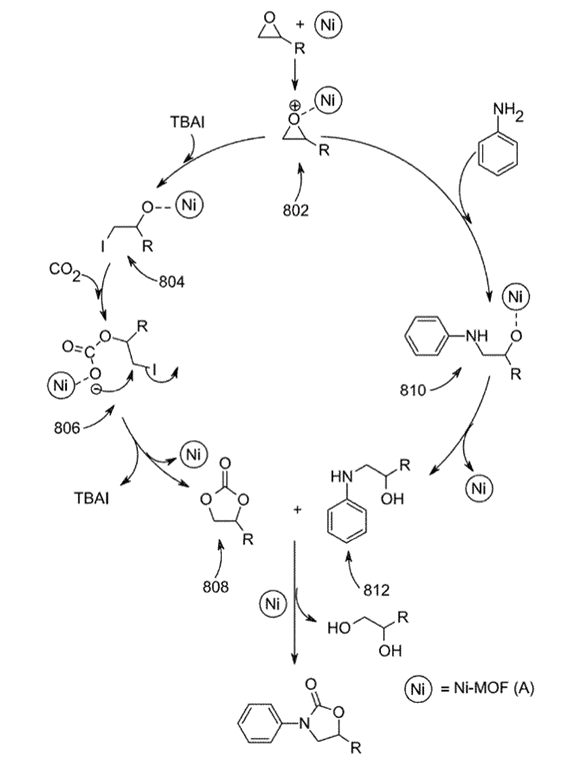
Effect of Hydration, Solvent and Quat Salt on Quat-Transition Metal Co-Catalyzed Reaction

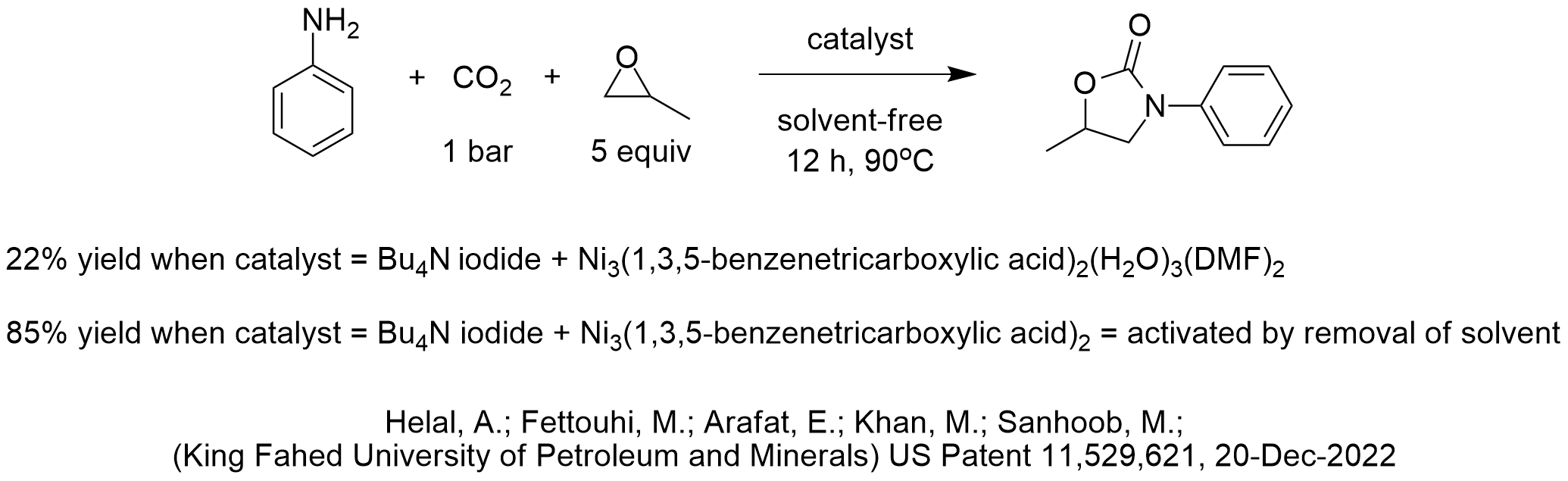
A patent was issued last week that has several interesting aspects. The reaction is shown in the diagram and is a cycloaddition of carbon dioxide, aniline derivatives and propylene oxide to form oxazolidinone.

The mechanism (shown in the second diagram) utilizes the iodide (or other halide) from tetrabutylammonium iodide (TBAI) for the nucleophilic attack on the epoxide to open the ring, aided by coordination of the oxygen to the nickel catalyst, to form the 1-iodopropyl-2-alkoxide coordinated to the nickel. The alkoxide oxygen attacks the electron-deficient carbon of carbon dioxide to form the iodopropyl carbonate anion, that performs the intramolecular displacement of the iodide to form the cyclic carbonate that also liberates the iodide leaving group to regenerate the TBAI catalyst.

In parallel, the aniline derivative reacts with the propylene oxide, aided by coordination with the nickel, to form N-hydroxypropyl aniline that couples with the cyclic carbonate to form the oxazolidinone while liberating the nickel catalyst for another cycle and forming propylene glycol.

One of the interesting finds in the patent is that tetrabutylammonium iodide performs much better (85% yield) than the corresponding bromide (45% yield), chloride (32% yield) or fluoride (21% yield). This is due to the fact that BOTH the order of nucleophilicity and the order of leaving group ability are iodide > bromide > chloride > fluoride. That makes the both the ring opening of the propylene oxide faster and the ring closing to cyclic carbonate faster.

In addition, it was found that the nickel catalyst is activated (notated in the patent by the addition of the letter A in Tables I and II) by removing the water and solvent from the catalyst complex. Activation of the nickel catalyst by removing solvent and water increases when using TBAI as co-catalyst from 22% to 85%. This is consistent with conventional thought processes for activating nucleophilicity of the anions such as iodide and the alkoxide.

Table III in the patent shows the application of this reaction to a wide variety of aniline derivatives. Electron withdrawing groups give higher yields (p-nitroaniline: 95% yield, p-chloroaniline: 90% yield) than electron donating groups (p-methylaniline: 81% yield, p-methoxyaniline: 79% yield).

In summary, the effects of solvent, hydration and halide counterion introduced with the quat salt, deliver the performance we expect in phase-transfer catalysis reactions, even though the tetrabutylammonium salts are acting as soluble sources of halide catalyst, not as true phase-transfer catalysts.

We teach these effects of hydration, solvent, choice of anions and other process parameters in our 2-day course “Industrial Phase-Transfer Catalysis.” Inquire now about bringing this course in-house to your company.

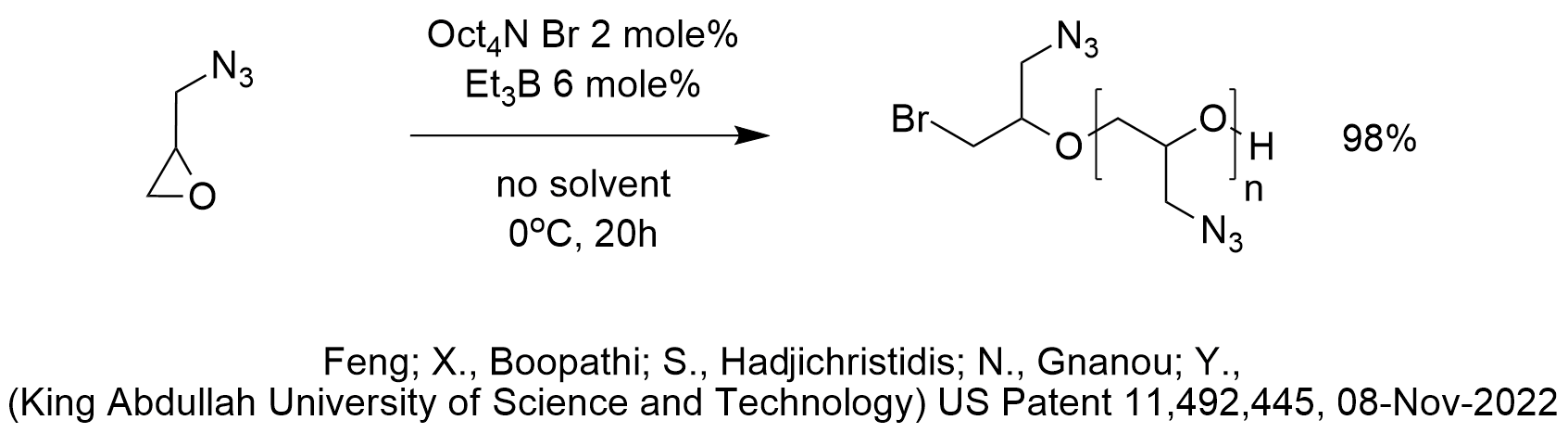
Anionic Ring Opening Polymerization of Glycidyl Azide

Glycidyl azide polymer (GAP) is a high energy material used in propellants. It can be formed by displacement of the chloride by azide in polyepichlorohydrin (PECH) using PTC. In this patent, GAP is formed safely under mild reaction conditions by the polymerization of glycidyl azide using a halide initiator in the presence of the Lewis acid triethyl borane. Polymerization of glycidyl azide assures 100% azide content since it does not depend on complete displacement of all of the chloride of PECH.

Quat salts are used to supply halides as initiators for anionic ring opening polymerization (AROP).
While this reaction is NOT phase-transfer catalysis, it leverages two characteristics useful in PTC systems which are [1] the ability of a quaternary ammonium cation to solubilize halides in an organic reaction phase and [2] activate the nucleophilicity of the halide by forming a loose ion pair between the quat cation and the halide.

In the reaction shown in the diagram, the larger ionic radius of tetraoctyl ammonium relative to tetrabutyl ammonium results in higher conversion under comparable reaction conditions.

This reaction must avoid displacement of the azide by bromide or chloride since that is a known PTC reaction. This might be one reason that the polymerization is performed at a temperature of 0 C (sometimes at -10 C).

Triethyl borane is used as a Lewis acid to enhance the reaction, possibly by associating with the oxygen atom of the epoxide to assist the ring opening at the lower temperature.

When the polymerization was performed in the presence of carbon dioxide, a polycarbonate copolymer was formed. That polymerization was performed at 25 C. In this case, tetrabutyl ammonium azide was used as the quat salt initiator. The inventors did not specify why the quat azide was preferentially used for the glycidyl azide polycarbonate while they preferentially used quat bromide for GAP without carbon dioxide. We might speculate that at the “higher temperature” of 25 C, the presence of halides might displace azide of the glycidyl azide or the azide on the polymer.

Celebrating 20 Years of PTC Tip of the Month Online!

The first online PTC Tip of the Month newsletter was published here [http://phasetransfer.com/tip1.htm] in October 2002. This has been a labor of love for 20 years. (Please do not click on the links in the October 2002 issue since most of the links are inactive or go to expired Email addresses.)


An index of the first two years of the PTC Tip of the Month is shown here: [http://phasetransfer.com/tipmain.htm].  Most of the links on this page work and they include information that is valuable today!

We started the 16-page Phase-Transfer Catalysis Communications Newsletter in print, published and mailed quarterly at significant expense in September 1994, 28 years ago.

In one of the print newsletters in the early 2000’s, the back page promoted the “PTC Webinar Series” and had written in big letters “What is a Webinar” since that was a new term. In those days, the PowerPoint presentation was shown on the internet and chemical company customers had to hear the audio by phone on a special line that could handle 100 lines at significant expense to PTC Organics.

Times have changed!

What has stayed constant over the past 20 years is that Phase-Transfer Catalysis delivers LOW-COST HIGH-PERFORMANCE GREEN CHEMISTRY and that Marc Halpern of PTC Organics Inc. will continue to provide PTC process development services “forever.” Contact us to inquire about PTC training, PTC consulting, PTC contract research or PTC licensing.

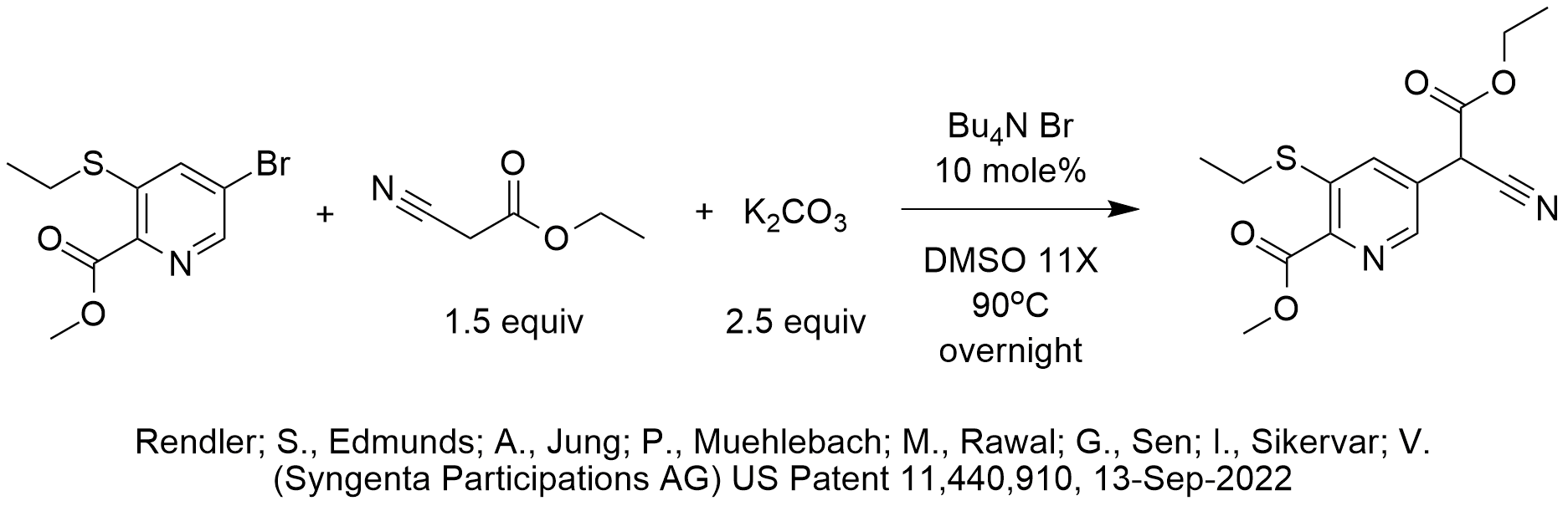
Why DMSO?

There are several interesting choices of reaction conditions for the reaction shown in the diagram.

Potassium carbonate was successfully chosen for this reaction. This suggests a rather acidic pKa (10 or less) of the methylene group activated by the ester and nitrile of the ethyl cyanoacetate. The potassium carbonate likely also served as desiccant to avoid hydrolysis of the ester.

The nucleophilic aromatic substitution of the bromide on the pyridine ring must have been sufficiently activated by the electron withdrawing group in the 2-position to be displaced at 90 deg C. It is not uncommon for nucleophilic aromatic substitutions to be performed at significantly higher temperatures, especially with the bromide located in the 5-position to the pyridine nitrogen.

The phase-transfer catalyst chosen was the standard tetrabutylammonium bromide. The tetrabutylammonium cation is not effective for transferring carbonate into any organic solvent, but it is effective in transferring the carbanion (enolate) of deprotonated acidic methylene compounds into almost organic solvent and activating the nucleophilicity of the anion for effective nucleophilic attack.

Indeed, the procedure reports that the reaction mixture was a suspension, which is not surprising due to the potassium carbonate and potassium hydrogen carbonate byproduct.

That begs the question, why did the inventors choose DMSO as the solvent? The phase-transfer catalyst could transfer and activate the carbanion (enolate) from the solid phase into a non-polar phase such as toluene that does not solvate the anion = not interfere with the nucleophilicity of the carbanion.

Of course DMSO is a good solvent for the reaction. But the workup used large volumes of aqueous phase and extractant solvent (ethyl acetate) before recrystallization to isolate the product.

The yield was not reported so we don’t know the extent of the handling losses from the workup that often result from choosing DMSO as the solvent. This is likely an important issue in this process since the is the first reaction of five reactions in the sequence and yield losses in early stages require a lot more starting materials to achieve the final product in sufficient quantity.

The inventors obviously were familiar with phase-transfer catalysis because they chose to use TBAB. It is always puzzling why chemists use PTC with DMSO instead of using PTC with a classical water-immiscible solvent that makes workup easier.

When you need to choose optimal conditions for a PTC process to achieve low-cost high-performance green chemistry, it is usually cost effective to engage PTC Organics to help develop the most advantageous process in the shortest development time. Now contact Marc Halpern of PTC Organics to explore improving your R&D efficiency, especially for PTC-base reactions.

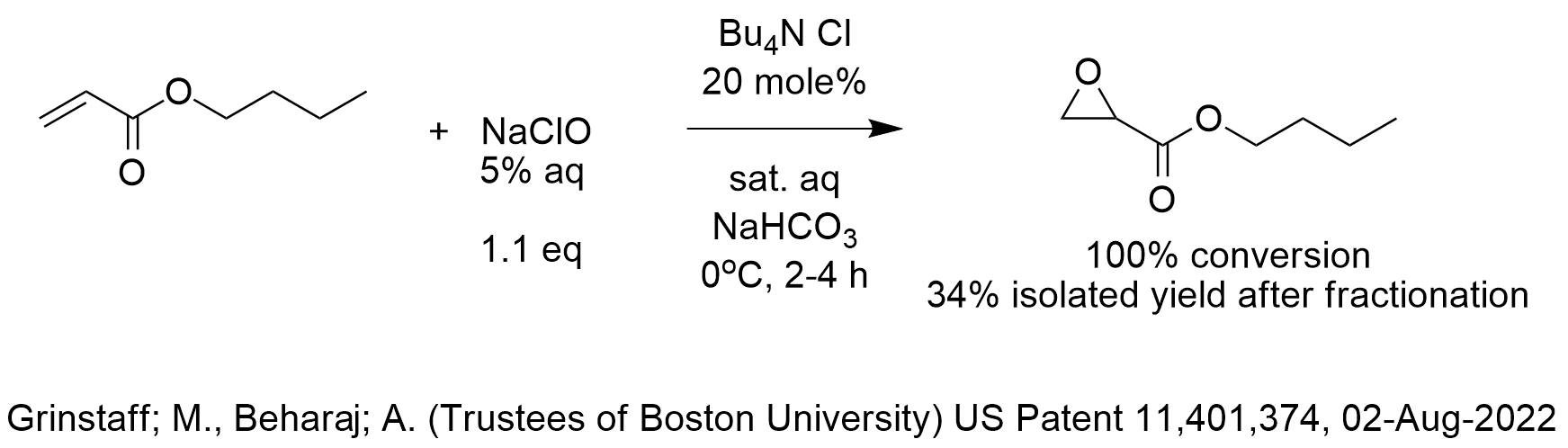
PTC-Hypochlorite is Effective for Epoxidation

As we teach in our 2-day course “Industrial Phase-Transfer Catalysis”, PTC works well for a variety of oxidations and epoxidations. Such reactions are typically performed under mild conditions and short reaction time. The reaction shown in the diagram was indeed performed under mild reaction conditions of time and temperature with an appropriate pH adjustment until complete conversion of the starting material was achieved.

Why was the isolated yield low? Was it due to the choice of fraction collected during the fractional distillation on the 20 g scale? Was it due to hydrolysis of the ester or ring opening of the epoxide? We don’t know. The reaction conditions appeared to be chosen well. The next process parameter we would screen that might be worthwhile would be a higher hypochlorite concentration.

The authors noted that they synthesized methyl glycidate and ethyl glycidate by following the same procedure, taking more caution with the evaporation stages as the boiling points of these products are low.

PTC Organics has developed highly selective epoxidations with very high throughout. If your company would like to explore licensing PTC Organics’ high-performance epoxidation technology, now contact Marc Halpern at PTC Organics.

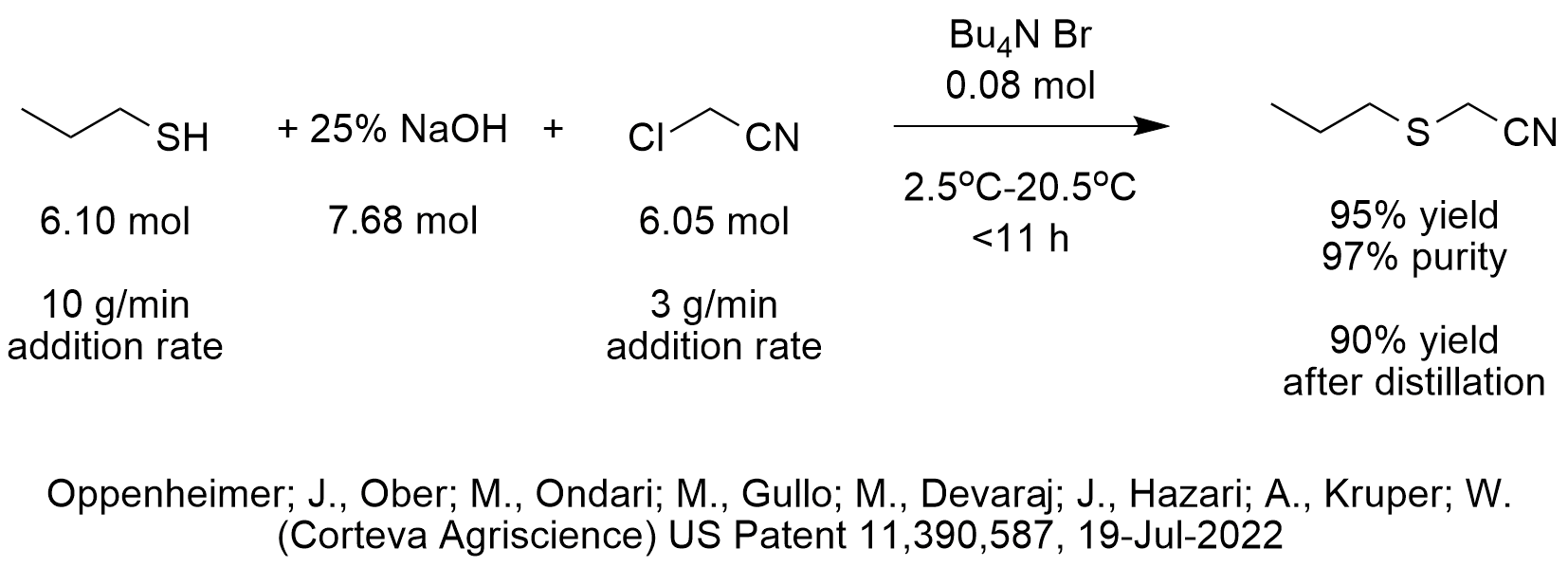
Solvent-Free PTC S-Alkylation

A solvent-free PTC S-alkylation was reported this month by Corteva, the agrochemical company formed in 2019 by Dow and DuPont (apparently in Dow’s Zionsville, IN facility).

Solvent-free PTC conditions are chosen when the reaction can be performed at a temperature at which at least one of the reactants and the product are liquids at the reaction temperature and there are no stirring challenges. This is the case for the reaction shown in the diagram. The use of 25% NaOH (as opposed to more dilute or more concentrated aqueous NaOH) likely assured two liquid phases even after liberation of the chloride leaving group when taking into account the solubility of NaCl in water. If there are no solids, stirring should not be a problem. Even when solids are present in solid-liquid solvent-free PTC systems, slurries are often stirrable.

Advantages of solvent-free phase-transfer catalysis include high reactor volume efficiency, faster kinetics for PTC I-Reactions and avoiding the need to store, handle, recover and separate the solvent form the product.

The inventors chose to perform the neutralization by adding the propane thiol to the aqueous NaOH, presumably at a rate to control the exotherm. The phase-transfer catalyst was present during the neutralization, though probably not yet needed until the S-alkylation. The neutralization was likely instantaneous based on the relative pKa’s of the thiol and water (conjugate acid of hydroxide), though the inventors stirred the thiol, base and TBAB for 1 h 45 min before adding the chloroacetonitrile, again presumably at a rate to control the exotherm.

It is possible that the bromide of the TBAB co-catalyzed the reaction by forming bromoacetonitrile in-situ, though the thiolate nucleophile is likely more nucleophilic than the bromide.

The important point in this reaction is that solvent-free PTC conditions are often advantageous when the at least one reactant and the product are liquid at the reaction temperature and there are no stirring problems.

About half the phase-transfer catalysis processes developed by PTC Organics are solvent-free (liquid-liquid, solid-liquid or liquid-liquid-solid). Now contact Marc Halpern of PTC Organics to explore collaboration when your company can benefit from more than four decades of experience and specialized expertise in solid-liquid PTC systems.

Tetrakis(hydroxymethyl)phosphonium Sulfate – Analytical

As we teach in the 2-day course “Industrial Phase-Transfer Catalysis,” quaternary ammonium and phosphonium salts used as phase-transfer catalysts sometimes contain hydroxy alkyl groups, including hydroxymethyl, 2-hydroxyethyl and 2-hydroxypropyl groups. One of the practical challenges when using quat salts is analytical detection of residual quat salt in the product or aqueous waste stream.

A patent was issued this month (Zhu; X., Moniee; M., Al-Saleh; M. (Saudi Arabian Oil Company) US Patent 11,385,171, 12-Jul-2022) that describes the analytical determination of tetrakis(hydroxymethyl)phosphonium sulfate (THPS) in the range of 2-500 ppm. The analytical method described in this patent may be applicable to other quat salts that contain hydroxyalkyl groups and that is why we chose to highlight this patent in our monthly newsletter.

The method involves reacting the hydroxymethyl phosphonium quat with potassium permanganate and measuring the reduced intensity of the absorption measured at a wavelength of 525 nm due to permanganate consumption. The measured intensity is normalized by subtracting a background intensity at a wavelength of 650 nm. The presence and concentration of THPS in the water sample can then be determined by comparing the normalized intensity with intensity values of the absorption in calibration samples comprising potassium permanganate and known THPS concentrations.

Quaternary phosphonium salts are used as phase-transfer catalysts, biocides, ionic liquids, surfactants or flame retardants. In this patent, THPS is cited for its use as a biocide. Again, the value of this patent to PTC chemists is likely to be when developing analytical methods for hydroxyalkyl quats used as phase-transfer catalysts.

PTC for Polymer Modification

As we teach in our 2-day course “Industrial Phase-Transfer Catalysis”, phase-transfer catalysis has been used for the modification of polymers with reactive sites. One reference that we cite for nucleophilic substitutions on polychloromethylstyrene with KOAc, KOBz, KSAc, KSCN, NaN3, KNPht is Nishikubo, T. “Phase-Transfer Catalysis: Mechanism and Syntheses”, ACS Symposium Series 659, Halpern, M. editor, 1997, Chapter 17.

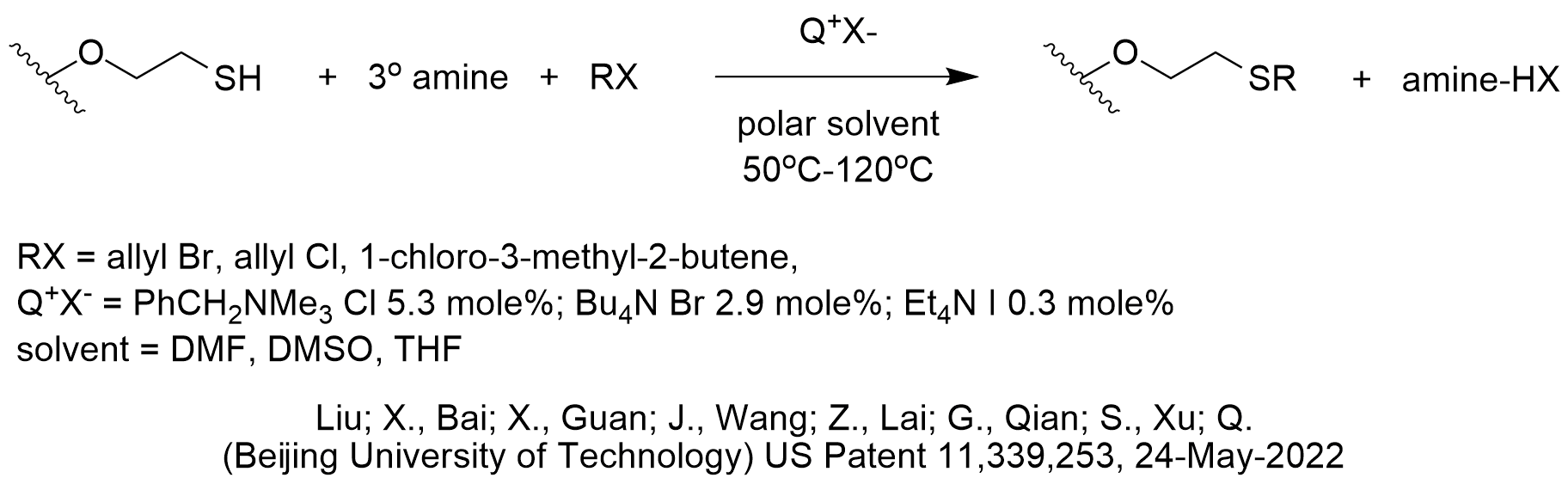
A recent patent (reaction shown in the diagram) described the use of PTC for modification of a variety of polyacrylamides functionalized with pendant mercapto alkyl ethers (mostly mercapto ethyl ether, mercapto propyl ether and mercaptohexyl ether). The mercaptan SH was deprotonated by a variety of trialkyl amines and reacted with several alkylating agents.

It is interesting to note that the inventors used a lot less phase-transfer catalyst with an iodide counterion than with chloride or bromide counterions. Perhaps that was due to iodide co-catalysis to activate the alkyl halide alkylating agents.

The inventors did not explain why they used quaternary ammonium phase-transfer catalysts for all 12 examples. We speculate that the reason may have been to create a loose ion pair between the mercaptide anion and the quat cation. The ammonium cation R3NH+ (before it turns into the amine hydrohalide) would likely not form a very loose ion pair and the relatively close pKa’s of the neutral mercaptan and the cation from the tertiary ammonium-H species doesn’t help in keeping the mercaptan completely deprotonated (which is likely why the inventors used an excess of trialkylamine).

By the way, this patent focused on temperature-responsive macromolecules that are effective in improving the shrinkage and crack resistance of concrete. It is always interesting to learn of the diverse applications upon which phase-transfer catalysis brings benefit.

PTC Useful for Ring Closure to Epoxides

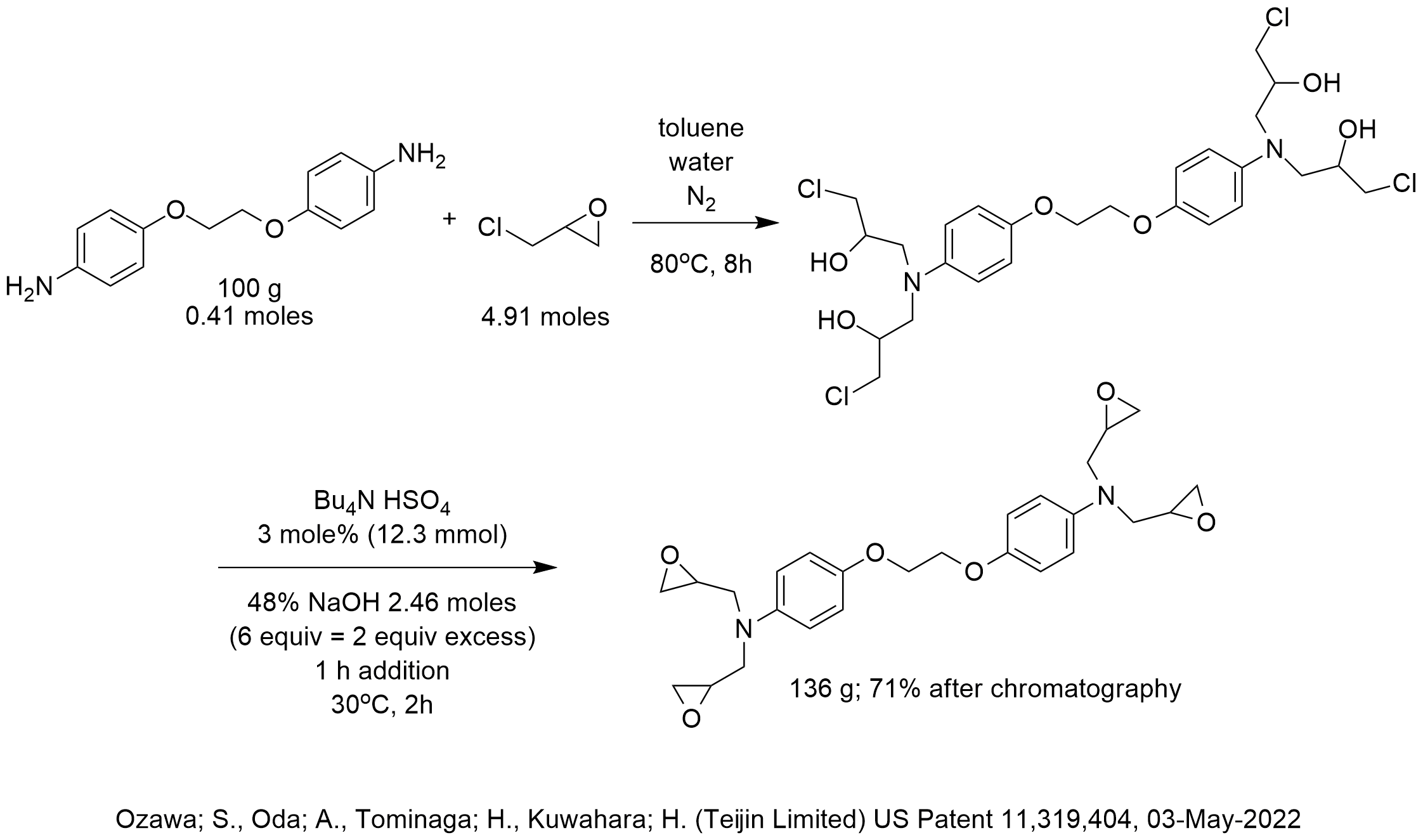
Several tetraepoxides were synthesized in this patent for the production of cured resin products with many advantages (high water absorption resistance, high elastic modulus, high impregnation property into a reinforcing fiber base material, excellent handleability). The diagram shows one of the tetraepoxides produced.

The epoxides were formed in 2 stages. In the first step, the diamine was reacted with epichlorohydrin to form the tetrachlorohydrin. In the second step, PTC was used to close the chlorohydrin back to the epoxide ring.

In other PTC reactions of epichlorohydrin, such as in the production of glycidyl ethers and glycidyl esters, one can perform the reaction in one step. In those cases, the base can first deprotonate an alcohol to an alkoxide or deprotonate a carboxylic acid to a carboxylate anion, then the anions attack the epichlorohydrin. In the case of the reaction of amines with epichlorohydrin, it is speculated that since the N-H group is not easily deprotonated, the nucleophilic attack of the nitrogen on the epichlorohydrin may need to be performed first, regardless of the presence of base. If so, then PTC is useful only for the ring closure with base in the reaction shown in the diagram.

PTC Organics has specialized expertise in performing reactions with epichlorohydrin (including PTC Organics’ trade secret technology for certain applications). If your company needs to achieve low-cost high-performance green chemistry reactions using epichlorohydrin, now contact Marc Halpern of PTC Organics to explore collaboration for commercializing advantageous PTC technology.