In last month’s PTC Tip of the Month, we showed how using PTC can save money by reducing the excess amount of borohydride for the reduction of a ketone to a secondary alcohol shown in the figure. We promised to highlight another clever aspect of this patent, so here it is.
When performing the reduction of terfenadone to terfenadine using ethanolic borohydride, the product is obtained as the low melting polymorph. The product must be recrystallized from xylene to obtain the high melting polymorph for formulation. The clever inventor, Dr. Magni, decided to use xylene as the solvent for the reaction when shifting to the PTC system. He knew that he could transfer borohydride into a variety of organic solvents when using a quaternary ammonium phase-transfer catalyst, so he chose to use the recrystallization solvent as the reaction solvent! It worked and he eliminated a solvent exchange unit operation, thereby obtaining the desired polymorph directly from the reaction solvent.
The flexible choice of solvent is one of the many great advantages that you enjoy when using phase-transfer catalysis.
If you have any chance of streamlining a process using PTC and you’re not sure if it will work, feel free to contact Marc Halpern to get an estimate of the probability of success of your potential PTC application. Don’t let your company waste precious money that could be turned into profit by using phase-transfer catalysis!

If you are using ethanolic borohydride for reductions, like almost everyone does (including me until Y2K), your company is probably wasting a lot of money on excess borohydride. You can often greatly reduce the excess borohydride you are using by using phase-transfer catalysis with aqueous borohydride. There are two reasons for this and you have to get them right. One is that borohydride is more stable in water at the right pH than it is in ethanol. The other is that we don’t need ethanol to co-dissolve the borohydride and the reactant to be reduced. We can use any organic solvent that will dissolve the reactant and use a phase-transfer catalyst to transfer the borohydride into that solvent and activate it for the reduction of the substrate.
The diagram shows a borohydride reduction of terfenadone to terfenadine (the first non-drowsy antihistamine in the market years ago). The patent [Magni, A. (Gruppo Lepetit) 1989 Eur. Pat. EP 0 346 765] states that when using ethanolic borohydride, the inventor needed a 30 mole% excess of borohydride. When switching to using the inexpensive methyl tributyl ammonium chloride phase-transfer catalyst with 1M NaOH in water, the inventor was able to reduce the borohydride excess to just 4 mole% (based on using all 4 hydrides) and still achieve a yield of 97.7%.
Are you still using ethanolic borohydride? If you answered yes, then the time has come to start switching to phase-transfer catalysis and save your company money.
Next month we will highlight another very important aspect of this patent and it relates to choice of solvent in commercial PTC applications.

PTC Organics is now launching its new website http://phasetransfercatalysis.com to supplement its two older PTC websites established in 1996 and 1999.
The new industrial PTC website currently provides more than 100 pages of free industrial PTC technology including previous issues of the PTC Tip of the Month, PTC Reaction of the Month, PTC Catalyst of the Month and many archived articles from the print journal “Industrial Phase-Transfer Catalysis”. By the end of 2014, we expect that the new PTC website will exceed 400 pages of valuable information about industrial phase-transfer catalysis.
On the new PTC Website, you can also register for individual PTC Webinars in the quarterly industrial PTC Webinar series, PTC Public Seminars, PTC Public Courses and have the PTC Tip of the Month E-Newsletter delivered to you monthly.
From the new PTC Website’s Contact form, you can send inquiries directly to Dr. Marc Halpern about your industrial phase-transfer catalysis needs for PTC Process Development Training, PTC Process Consulting, PTC Contract Research and a variety of PTC Manufacturing Services. PTC Manufacturing Services include requesting that PTC Organics develop and commercialize low-cost high-performance green chemistry processes for organic chemicals that your company currently purchases or may in the future purchase.
In short the new PTC Website http://phasetransfercatalysis.com is the one stop shop for industrial phase-transfer catalysis technology that brings to you valuable information in any manner that will best meet the needs of your company.
The Industrial PTC Website at http://phasetransfercatalysis.com is intended for the use of the industrial customers and potential industrial customers of PTC Organics Inc. PTC Organics Inc. reserves the right to provide access to the information and services described on http://phasetransfercatalysis.com to customers with a valid and current Email address at a valid and current industrial organic chemical company.
Last week at Informex, I had the pleasure of meeting with Steel Hutchinson, the president of GFS Chemical. We discussed lithium perchlorate and magnesium perchlorate and the stigma perchlorates have that prevents chemists from screening them for a variety of organic chemical reactions.
It turns out that LiClO4 can be used for Diels-Alder, Glycosylations, Friedel-Crafts acylations, transesterifications and other reactions. You can get a 44-page monograph with more than 200 references about perchlorate reactions by contacting GFS and asking for “GFS publication #495 – Practical Use of Anhydrous LiClO4 and Mg(ClO4)2 in Organic Synthesis”
Some of the publications use ether as solvent. One could speculate whether polyethylene glycols (e.g., PEG-400) could serve as complexing phase-transfer catalysts to transfer Li perchlorate into organic solvents and activate the “naked” ions to perform the reactions at shorter reaction times than those shown in the monograph. Of course, one would need to perform hazard operations analysis before running any such reactions and GFS has expressed commitment to provide technical and safety data for perchlorates.
If your company can benefit from achieving higher process performance in a shorter development time by having access to the best PTC expertise available, now contact Marc Halpern by E-mail to inquire about using phase-transfer catalysis to achieve low-cost high-performance green chemistry.
If you’re not sure if PTC can help your reaction, now fill out the form shown at http://phasetransfer.com/projectform.pdf and send it to Marc Halpern by fax at +1 856-222-1124 or by E-mail of a scanned copy. If we do not have a secrecy agreement already in place, please use “R-groups” instead of the exact chemical structures.
Lithium Perchlorate Info
Most of us recognize that when you run PTC reactions using solid salts as the source of a nucleophilic anion (e.g., solid NaCN for nucleophilic cyanide) or a basic anion (e.g., solid NaOH for hydroxide base), you almost always get much higher reactivity than if you use the same salts dissolved in water (e.g., 25% aq NaCN or 50% aq NaOH).
From time to time, though not often, someone will say that using a solid salt in their company’s process as the source of their reacting anion is not feasible since during work up they cannot tolerate a filtration to remove the solid salt byproduct. In other words, if they are performing a cyanide/chloride exchange for example, RCl + NaCN => RCN + NaCl, they do not want to remove the NaCl byproduct by filtration, so they argue that they need to use 25% NaCN so the reaction will be liquid-liquid and then at the end of the reaction they simply separate the liquid phases and avoid filtration.
Even though these people usually have a degree in chemistry or engineering (indicating a reasonably high IQ), sometimes I have to point out that we can do the reaction using a solid salt as the anion source and when the reaction is over, we then add enough water to dissolve all the byproduct salts for a relatively easy liquid-liquid phase separation.
If the person is not familiar enough with PTC, they will sometimes say that it is more convenient to have the water in the reactor from the beginning. That’s when they need to be reminded that over-hydration of an anion reduces the reactivity of the anion, often by orders of magnitude in PTC systems.
If we run the reaction under solid-liquid PTC conditions, then add water during workup to dissolve the salts, the result is then that we are able to achieve desired productivity with an activated anion under solid-liquid PTC conditions, then still have a feasible liquid-liquid separation during work by adding enough water after the reaction is over.
Sometimes they will say that the productivity is not really that high because we have to leave enough empty space in the reactor for all the water that we will add at the end of the reaction, so we will not be utilizing all the volume of the reactor efficiently. I then tell them that the net result will be higher productivity if, for example, the use of solid-liquid PTC conditions during the chemical reaction increases reactivity 10-fold but we have to leave an extra 30% of the reactor volume empty to allow for the addition of water during work up.
In other words, it seems obvious to leave enough room in the reactor during the chemical reaction stage to add water during work up, but I have had to use this argument on several occasions.
When dealing with people who have never done PTC before, I sometimes encounter the argument against solid-liquid PTC when people say “if I use solid NaCN to react with RCl that is dissolved in toluene, the solid inorganic salt in the strong ionic crystal lattice will not interact with the non-polar organic phase and there will be no reaction.” That is a good time to explain that the phase-transfer catalyst will do the work of transferring the anion from the surface of the solid salt into the bulk organic phase and that the chemical reaction is not interfacial. We also explain that sometimes we need to add just a tiny bit of water (or MeOH or even DMSO) to create a thin film of saturated NaX at the solid surface to loosen up a few anions for transfer by the phase-transfer catalyst.
The only objection to solid-liquid PTC that is sometimes hard to overcome is when we encounter systems that create slurries that are simply too hard to mix. Sometimes slurries are easy to mix, sometimes they are hard to mix. Sometimes, agitation engineering expertise is required to solve the problem, but the only way to find out is to try sold-liquid PTC (after performing a thorough hazard operations analysis to make sure it is safe to do so) and see if agitation is OK.
If your company can benefit from achieving higher process performance in a shorter development time by having access to the best PTC expertise available, now contact Marc Halpern by E-mail to inquire about using phase-transfer catalysis to achieve low-cost high-performance green chemistry.
If you’re not sure if PTC can help your reaction, now fill out the form shown at http://phasetransfer.com/projectform.pdf and send it to Marc Halpern by fax at +1 856-222-1124 or by E-mail of a scanned copy. If we do not have a secrecy agreement already in place, please use “R-groups” instead of the exact chemical structures.
Azeotropic drying is a common method for drying solvents and other liquids in industry. The same is true for drying phase-transfer catalysts that are shipped as an aqueous solution from the manufacturer.
Common phase-transfer catalysts that are shipped in water include methyl tributyl ammonium chloride (MTBAC) that is usually shipped as a 75% solution in water (25% water), tetrabutyl ammonium bromide (TBAB) that is sometimes shipped as a 50% solution in water (though more often as a solid) and hexaethylguanidinium chloride (HEG Cl) that is shipped as a 35% solution in water that also usually includes about 10-15% NaCl.
When you use azeotropic drying to remove water from aqueous solutions of phase-transfer catalysts, you must be aware of the thermal stability limitations of each catalyst and plan your heat history accordingly. MTBAC is less thermally stable than TBAB while HEG Cl is stable even above 215 C.
A patent dedicated to the azeotropic drying of HEG Cl in ODCB was issued in 2010 and can be read at US Patent 7,772,435. Most of the drying is done at 120-140 C and some up to 170 C.
A good example of using dry of HEG Cl in a 500 gallon reactor was described in US Patent 8,592,548 that was issued four days ago. o-Dichlorobenzene (ODCB) was used as the solvent for two consecutive reactions, an amidation and a nucleophilic aromatic substitution. HEG Cl was introduced into the reaction dissolved in ODCB as well. Since HEG Cl is stable at high temperature, the high boiling ODCB (b.p. 180 C) was able to be used. Azeotropic distillation was used to remove water in the first step of the reaction before the HEG Cl was added and azeotropic solvent stripping was used after the addition of the phase-transfer catalyst to “assure a dry slurry” before the next reactant was added.
Since HEG Cl is soluble in water, it was removed from the product by water washing after the chemical reactions.
MTBAC and TBAB are typically dried with much lower boiling azeotropes, such as with toluene. Note that the toluene-water azeotrope has a lower water content than chlorobenzene-water for example, but toluene is used more often because it is more commonly used as a solvent for the subsequent PTC reactions, so no solvent exchange is required after the drying.
HEG Cl is a catalyst that should be screened for PTC reactions at high temperatures for which the common quaternary ammonium phase-transfer catalysts are not stable enough (after performing a safety analysis of course). HEG Cl is commercially available from VanDeMark Chemical. If you don’t have a sample of HEG Cl in your lab, get one today.
If your company can benefit from achieving higher process performance in a shorter development time by having access to the best PTC expertise available, now contact Marc Halpern by E-mail or by phone at + 1 856-222-1146 to inquire about using phase-transfer catalysis to achieve low-cost high-performance green chemistry.
If you’re not sure if PTC can help your reaction, now fill out the form shown at http://phasetransfer.com/projectform.pdf and send it to Marc Halpern by fax at +1 856-222-1124 or by E-mail of a scanned copy. If we do not have a secrecy agreement already in place, please use “R-groups” instead of the exact chemical structures.
If you have been reading the PTC Tip of the Month for a few years or more (started more than 12 years ago!), you have undoubtedly heard us mention PTC T-Reactions and I-Reactions and how crucial they are to choosing optimal reaction conditions to achieve the highest process performance.
If you are developing PTC processes, it really is important to be aware that different PTC reactions can achieve optimal performance under extremely different PTC process conditions that depend on the identity of the rate determining step. PTC I-Reactions are best performed with opposite catalyst structure, opposite solvent polarity and opposite agitation efficiency compared to PTC T-Reactions. Make sure you don’t waste good profit by not being aware of these differences. Read this article.
If your company can benefit from achieving higher process performance in a shorter development time by having access to the best PTC expertise available, now contact Marc Halpern by E-mail or by phone at + 1 856-222-1146 to inquire about using phase-transfer catalysis to achieve low-cost high-performance green chemistry.
If you’re not sure if PTC can help your reaction, now fill out the form shown at http://phasetransfer.com/projectform.pdf and send it to Marc Halpern by fax at +1 856-222-1124 or by E-mail of a scanned copy. If we do not have a secrecy agreement already in place, please use “R-groups” instead of the exact chemical structures.
An idea hit me when visiting an exhibit of a microreactor supplier at a trade show this month. More information on these microreactors is shown here.
In these microreactors, there were static mixers built in to the channel through which the reactants flow. As you increase the flow rate, you increase the agitation efficiency.
Most liquid-liquid PTC reactions show increased reactivity with increased agitation at low agitation efficiencies and then reactivity levels off as the reaction transitions from transfer rate limited (“T-Reaction”) to intrinsic reaction rate limited (“I-Reaction”). In other words, most PTC reactions achieve a maximum in productivity at some agitation level. Figuring out what that agitation efficiency is sometimes a crucial factor in developing the most effective industrial PTC process.
In classic stirred PTC systems, one examines effect of agitation by increasing the stirring speed of the agitator typically centered in the reactor and measuring the rate constant on the Y-axis and rpm on the X-axis. Using a microreactor, one can simply change the flow rate and observe at what flow rate the maximum reactivity is reached.
This is particularly important when working with water-sensitive compounds. Let’s say, for example, that we are reacting benzoyl chloride with a nucleophile. The benzoyl chloride can undergo non-catalyzed interfacial hydrolysis at high agitation efficiencies. In these cases, it is essential to determine the maximum reactivity while minimizing agitation in order to avoid the wasteful hydrolysis.
In this case, it might be useful to use a microreactor to perform this reaction and change the flow rate to determine the maximum ratio of the desired phase-transfer catalyzed nucleophilic substitution to the undesired hydrolysis side reaction.
In fact, if the results are very good, you might want to use the microreactor to actually do the commercial scale reaction and achieve high productivity with short heat history and realize other benefits.
If your company can benefit from achieving higher process performance in a shorter development time by having access to the best PTC expertise available, now contact Marc Halpern by E-mail or by phone at + 1 856-222-1146 to inquire about using phase-transfer catalysis to achieve low-cost high-performance green chemistry.
If you’re not sure if PTC can help your reaction, now fill out the form shown at http://phasetransfer.com/projectform.pdf and send it to Marc Halpern by fax at +1 856-222-1124 or by E-mail of a scanned copy. If we do not have a secrecy agreement already in place, please use “R-groups” instead of the exact chemical structures.
PTC sometimes helps reactions that surprise you, like the one shown in the diagram. In this reaction, the addition of 1.2 mole% TBAB to a zinc-induced dechlorination of CFC-113 increases the conversion and selectivity for a given reaction time and temperature.
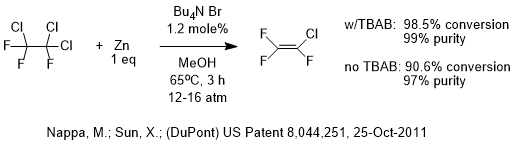
The inventors enable the opportunity to determine whether the incremental cost of 1.2 mole% TBAB is justified in light of the added conversion and selectivity at a set cycle time.
The point of highlighting this 2011 patent is to spark your thought that the next time you see a reaction for which you are not sure whether phase-transfer catalysis can make an economic impact, you should consider PTC for even just a moment. Make sure you don’t walk away from process improvement opportunities.
If your company can benefit from achieving higher process performance in a shorter development time by having access to the best PTC expertise available, now contact Marc Halpern by E-mail or by phone at + 1 856-222-1146 to inquire about using phase-transfer catalysis to achieve low-cost high-performance green chemistry.
If you’re not sure if PTC can help your reaction, now fill out the form shown at http://phasetransfer.com/projectform.pdf and send it to Marc Halpern by fax at +1 856-222-1124 or by E-mail of a scanned copy. If we do not have a secrecy agreement already in place, please use “R-groups” instead of the exact chemical structures.
Quat tribromides are used for bromination of aromatic rings and activated alkyl groups. These are not PTC reactions (yet!) because they use stoichiometric quantities of quat salt, but we still think that these brominations are of interest to our audience.
The figure shows the bromination of the alpha position of an acetyl group that was described in a patent that issued yesterday. The PT Catalyst of the Month below shows the use of another quat tribromide in a patent from earlier this month.

Next month, we will show the use of a quat tribromide in catalytic quantity for esterification by dehydration.
If your company can benefit from achieving higher process performance in a shorter development time by having access to the best PTC expertise available, now contact Marc Halpern by E-mail or by phone at + 1 856-222-1146 to inquire about using phase-transfer catalysis to achieve low-cost high-performance green chemistry.
If you’re not sure if PTC can help your reaction, now fill out the form shown at http://phasetransfer.com/projectform.pdf and send it to Marc Halpern by fax at +1 856-222-1124 or by E-mail of a scanned copy. If we do not have a secrecy agreement already in place, please use “R-groups” instead of the exact chemical structures.