Imagine a systematic method to rapidly develop and optimize process conditions for low-cost high-performance phase-transfer catalysis reactions! Would you use the systematic method? Of course!
That systematic method exists and it’s called the “PTC pKa Guidelines” (Halpern, M.; Ph.D. Thesis, Hebrew University of Jerusalem, 1983). The full details of the PTC pKa Guidelines will be taught at the 2-day course in Cologne, Germany entitled “Industrial Phase-Transfer Catalysis” in less than 2 months on April 21-22, 2015. Now register here for the 2-day PTC course in Germany.
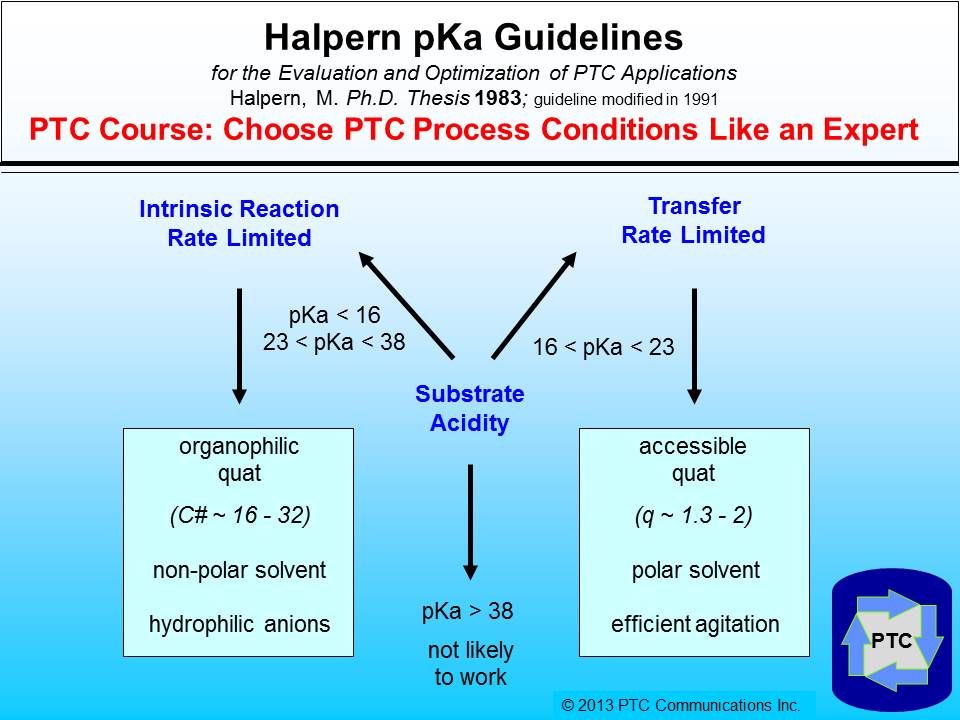
The PTC pKa guidelines direct you to first consider the pKa of the substrate you are reacting. There are 4 categories: pKa < 16, pKa from 16 to 23, pKa from 24 to 38 and pKa > 38.
If the pKa of the conjugate acid of the reacting anion is below 16, such as phenoxide, acetate, cyanide, mercaptide or hundreds of other inorganic and acidic organic nucleophiles, the rate determining step is likely to be the intrinsic reaction occurring in the organic phase (I-Reaction) and you should choose quaternary ammonium phase-transfer catalysts with 16-32 carbons, non-polar solvents and avoid soft leaving groups (unless the nucleophile is organophilic itself). Details of I-Reactions will be taught at the 2-day course “Industrial Phase-Transfer Catalysis” to be conducted in Germany on April 21-22, 2015 or in-house anytime at your company.
If the pKa of the substrate is 16-23, such as phenyl acetonitrile, cyclohexanone, fluorene or hundreds of organic compounds with diactivated methylene groups, then the rate determining step is likely to be the transfer of the hydroxide as base into the organic reaction phase (T-Reaction) and you should choose quaternary ammonium phase-transfer catalysts with a “q-value” between 1.0 and 2.0 (preferably close to 1.75), use polar solvents that are immiscible with water and use efficient agitation. The q-value is taught in the 2-day course “Industrial Phase-Transfer Catalysis” to be conducted in Germany in April 21-22, 2015 or in-house anytime at your company.
PTC I-Reactions rarely need extremely efficient agitation unless exothermic reactions require the agitation for effective heat transfer.
Every PTC reaction needs to be optimized and studied for safety before determining final process conditions for scale up. But the PTC pKa Guidelines will often reduce the development cycle time in the lab by weeks which is crucial if, like most process chemists, you face tight project deadlines. In fact, using the pKa guidelines may be the difference between achieving a profitable process using PTC or compromising with a less profitable process without PTC since you have limited R&D time to complete process development.
If your company wants to benefit from low-cost high-performance green chemistry using phase-transfer catalysis, contact Marc Halpern of PTC Organics to explore the path forward for the most efficient use of your R&D resources to achieve your commercial goals.
Selected slides from the 2-day PTC course, including an overview of the PTC pKa Guidelines, will be presented by Dr. Marc Halpern in a free PTC Webinar on March 12, 2015 at 9:00 am Eastern US time, 3:00 pm Western Europe time. Now register here for the 1-hour free PTC Webinar.
Although phase-transfer catalysis usually enables the advantage of avoiding the use of water-miscible polar aprotic solvents that make workup and handling losses a problem, sometimes it is preferable to combine PTC with the strengths of a polar aprotic solvent.
The patent shown in the diagram (published this week) uses PTC with polar aprotic solvents like acetonitrile (Example 1) and DMF (Example 3). The inventors likely used PTC with acetonitrile or DMF because the starting materials or products are very polar, likely so polar that they don’t dissolve well in non-polar solvents. So, instead of choosing between PTC and polar solvent, the inventors get the benefits of both.
In this reaction with chloroacetonitrile and ring closure, they use the product as the intermediate in the next step without further purification, so the use of acetonitrile streamlines the process for the next step.
One reason that phase-transfer catalysis excels in streamlining processes is that you can choose almost any solvent you want for PTC applications since quats or complexants can transfer almost any anion into almost any organic liquid where it can react with enhanced reactivity.
If your company wants to streamline processes to achieve low-cost high-performance green chemistry, contact Dr. Marc Halpern of PTC Organics to explore integrating highly specialized expertise in industrial phase-transfer catalysis with your commercial goals and additionally benefit from higher R&D efficiency.
The flavor & fragrance industry uses phase-transfer catalysis extensively and all major F&F companies have PTC patents. Two of the top three F&F companies have conducted the 2-day PTC course in-house taught by PTC Organics.
Some find this surprising since the decomposition products of quaternary ammonium phase-transfer catalysts are tertiary amines that have characteristic amine odors that could potentially contaminate odor-sensitive products. You can use PTC with flavors and fragrances because fractional distillation used in the F&F industry is effective for separating potential residual amines from fractionated products streams.
Selected examples of the use of PTC in the flavor and fragrance industry with fractional distillation are shown in the following US patents: 8,809,256, 7,141,699, 6,252,120, 5,288,701, 5,288,702 (funny that two consecutively numbered patents use PTC for F&F), 5,066,640, 4,582,634, 4,490,284, 4,430,354, 4,173,543.
If you have questions about achieving low-cost high-performance PTC applications for your company, please send your inquiry to Marc Halpern of PTC Organics to explore integrating PTC Organics highly specialized expertise in industrial phase-transfer catalysis to improve process performance and process R&D efficiency.
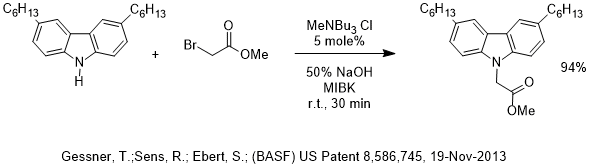
Example 1 of this patent is interesting because it compares the use of PTC with DMF for an N-alkylation using a potentially hydroxide-sensitive methyl bromo acetate and acetate product. In the DMF system, potassium carbonate was used as the base. It is possible that carbonate was used instead of NaOH to protect the esters from hydrolysis since NaOH might dissolve in DMF and hydrolyze the esters. In contrast, when using PTC, one can work with a water-immiscible solvent that keeps the NaOH separated from the organic soluble ester starting material and product.
The DMF system required a lot more workup unit operations, mostly extractions (as usual…due to water miscibility) and gave 66% yield after chromatography. The DMF system used 3 equiv of the methyl bromo acetate and also took 24 hours and 50 deg C. The PTC system achieved 94% yield using only 10 mole% excess of methyl bromo acetate, after 30 min at room temperature and workup required no extractions or chromatography to provide the product identical to that from the DMF process.
If your company can benefit from lower cost and higher performance alkylation reactions, now contact Marc Halpern to inquire about integrating the best PTC technology available provided by PTC Organics with your company’s technical and commercial goals.
When process chemists receive procedures from discovery chemists, they often get extremely non-optimal procedures that were performed by the discovery chemists who just want to get to the next intermediate quickly and reliably without regard to the cost of the chemicals. That’s OK, discovery chemists are often rated on the number of new compounds they generate, not the potential cost. That’s why process chemists have job security.
The procedure shown in the diagram was described in US Patent 8,846,946 for an agricultural chemical that issued last week (30-Sep-2014). This is a classic case of opportunity for the process development group to improve a non-optimal procedure inherited from the discovery research group by replacing expensive and hazardous NaH with PTC-NaOH, reducing excess of expensive reagents, choosing a better solvent and choosing a better phase-transfer catalyst for an etherification.
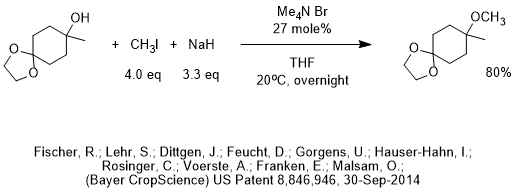
The acetal should be stable in the presence of base, so we might start screening this reaction with 50% NaOH, whatever methylating agent is acceptable from cost/handling (MeCl or dimethyl sulfate less exoensive than MeI), using whatever phase-transfer catalyst is on the shelf (TBAB could be a start) and using a solvent that the on-site engineers prefer (toluene for example). We would expect to achieve excellent results for this etherification using PTC-NaOH within 3-5 experiments using the methodology taught in our 2-day PTC course “Industrial Phase-Transfer Catalysis”
Whenever you see NaH or other expensive and hazardous strong bases in the literature, you should always consider improving the process by using phase-transfer catalysis with inexpensive inorganic base like NaOH.
Attend the 2-day course “Industrial Phase-Transfer Catalysis” to learn how to achieve low-cost high-performance green chemistry in the minimum number of experiments or contact Marc Halpern for PTC Process Consulting or PTC Contract Research for faster and better results.
During my 30 years of developing PTC processes in industry, I have witnessed many wasteful cases in which companies missed or nearly missed opportunities to achieve low-cost high-performance green chemistry processes using phase-transfer catalysis. It’s a shame, because less profit for your company means less job security for the chemists and engineers developing the processes. While PTC is not feasible for ALL organic chemical processes, it can improve profit and process performance for hundreds of commercial applications in which PTC is not currently used.
The #1 most common reason that companies miss profit opportunities using phase-transfer catalysis (for example, 85% yield without PTC versus 95% with PTC) is that process development chemists, who often suffer from project overload, don’t always have the confidence that they can achieve their process performance goals using PTC within the project development deadline. When this happens, they often choose to use the lesser technology they are already sure will work with acceptable performance(not the best performance) based on familiarity or quickly found literature precedent. If so, then there are two crucial questions. 1. How much profit is being lost due to this decision? 2. What can be done to avoid missing the profit opportunity using PTC? Although this sounds self-serving, the obvious answer to the second question is to get the expertise, either by training process chemists with the best PTC training course available or by adding highly specialized PTC expertise to a specific project through PTC consulting or PTC contract research.
Surprisingly, the second most common reason that companies miss profit opportunities using PTC is that the process development chemist simply didn’t think of the PTC option during the crucial initial screening stage of the process development project. This is usually not the case for long time readers of the PTC Reaction of the Month (like you), but process R&D managers could better assure their department’s high performance by sending their process development chemists and engineers to the 2-day PTC course “Industrial Phase-Transfer Catalysis” or better yet, bring the course in-house. Every process R&D department has a training budge for an important purpose of assuring high performance, so you might as well use that budget to directly target improving profit with the most relevant technology that is applicable to such a wide variety of organic chemical processes, which is industrial PTC. Process R&D managers enjoy very high return on investment for conducting the in-house course “Industrial Phase-Transfer Catalysis” for the first project for which a PTC breakthrough is achieved.
The third most common reason that companies miss PTC opportunities that would be feasible in reality is when PTC is actually screened for the application, but promising results are not achieved in the first 3-5 screening experiments. In these cases, the PTC option may be dropped in favor of a known process option with lower performance due to project development deadlines. These unfortunate wasteful situations are again usually due to lack of highly specialized PTC expertise that can be acquired in the PTC course or through PTC process consulting. PTC Organics developed a systematic methodology taught in the course “Industrial Phase-Transfer Catalysis” that shows a resource-efficient decision tree for screening new potential PTC applications in 3-5 experiments.
If your company can benefit from higher process performance and/or improved process R&D efficiency, please now contact Dr. Marc Halpern of PTC Organics to explore the best path forward to help you and your company.
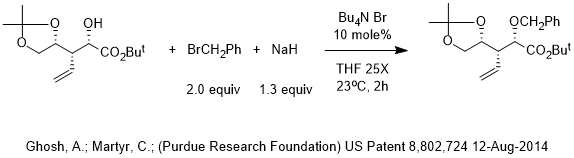
It’s not often that you see NaH used with phase-transfer catalysis. US Patent 8,802,724 uses PTC-NaH for an etherification! That is even more unusual since PTC-NaOH etherification is one of the most classic PTC reactions for more than 40 years and anyone who knows about PTC already knows about PTC-NaOH for such reactions. We speculate that NaH was used to avoid racemization in the alpha position to the ester. We’re not sure of that since that C-H has a pKa of about 24 whereas the pKa of the hydroxyl is about 16. We further speculate that the inventors could have used PTC-NaOH but since this reaction was not the focus of the patent, they may not have had the time to explore this reaction in more detail.
It should be noted that the inventors of the patent shown in the August 2014 PTC Reaction of the Month, should have thought to use PTC with NaH since they were also concerned about racemization during an etherification.
If your company has any potential to benefit from choosing the best process conditions to achieve low-cost high performance green chemistry using phase-transfer catalysis, contact Marc Halpern of PTC Organics to explore your options.
PTC dehydrohalogenation often needs to use a different phase-transfer catalyst to achieve optimal performance than is needed for other PTC-OH reactions such as C-alkylations. If you aware of the “Halpern pKa Guidelines for Evaluation and Optimization of New PTC Applications” (taught in the 2-day PTC course), you already know that the optimal conditions for a given PTC application depend on the structure of the substrate. That is why different PTC-OH reactions can require different phase-transfer catalyst structures. More specifically, PTC dehydrohalogenations often prefer more organophilic quats than smaller quats.
Since the biggest segment of PTC applications involves NaOH, it is very worthwhile to be knowledgeable about how to achieve the highest performance of PTC-strong base reactions. This month’s Tip will help you refine your understanding of PTC-OH systems. Understanding mechanism is often the most effective first step to optimizing performance.
The first mechanistic study of PTC-OH dehydrohalogenation (Halpern, M.; Ph.D. Thesis, Hebrew University of Jerusalem, 1983) showed that PTC dehydrobromination has an E2 mechanism. This means that an organic anion is not formed during the reaction (in contrast to most other PTC reactions) or transition state. If so, then according to the pKa Guidelines, dehydrohalogenation of a non-activated substrate should be an I-Reaction and prefer organophilic quats over smaller quats.
In fact, I used the pKa Guidelines to predict then show that tetraoctyl ammonium gives 98% dehydrobromination of substituted phenethyl bromide while TEBA (triethyl benzyl ammonium) only gives 33% conversion under the same conditions of base, catalyst loading, time and temperature (Halpern, M.; Zahalka, H.; Sasson, Y.; Rabinovitz, M.; J. Org. Chem., 1985, 50, 5088). Back in those days (1980’s), organophilic quats like tetraoctyl ammonium were rarely considered for dehydrohalogenations.
It is very important to know this in order to avoid wasting precious R&D resources and avoid performing unneeded experiments using less optimal catalysts.
Indeed, if you search the literature for PTC-NaOH reactions, you will find that many of the early publications and patents in the 70’s and 80’s used small phase-transfer catalysts, most notably TEBA (triethyl benzyl ammonium chloride). These small quats were usually ineffective for non-hydroxide applications using PTC and that is why I decided to focus my Ph.D. thesis work in the late 70’s to understanding why PTC-OH applications were different than non-NaOH PTC reactions until that time on the literature. The title of my thesis was “Hydroxide Ion Initiated Reactions Using Phase-Transfer Catalysis: Mechanism and Applications”, much of which was co-published in 15 peer reviewed publications.
In any case, even though PTC dehydrohalogenations can work with smaller quats, you might want to start screening new PTC dehydrohalogenations using more organophilic quats than smaller quats.
This is what the inventors did in the July 2014 PTC Reaction of the Month.
If you want to the best expertise available to evaluate and optimize PTC-strong base reactions to enhance your company’s profit and R&D effectiveness, now contact Dr. Marc Halpern.
US Patent 8,357,822 addresses an issue rarely discussed in PTC systems which is separation of the phase-transfer catalyst from the product when the organic phase is run through a thin film evaporator at the end of the reaction.
The key point in the patent is that when the catalyst is chosen to be an ionic liquid, such as certain tetraalkyl phosphonium salts, “no adhesion of the catalyst due to the solidification thereof was observed in the thin film distillation unit”. Conversely, when the catalyst chosen has a melting point higher than the wall temperature of the thin film evaporator, then it will obviously solidify on the wall and cause problems.
The reaction discussed was the equilibration of triethyl phosphite with phosphorous trichloride to form diethyl chloro phosphite (homogeneous, not PTC). At the end of the reaction, the reaction liquid was fed continuously into the thin film distillation unit with a wall surface maintained at 80 deg C. Several phosphonium salts were screened. Those that were liquids at 80 deg C (they measured and reported their viscosities at this temperature) gave high yield. In one case, tetrabutyl phosphonium bromide was used which is a solid at 80 deg C. The yield dropped from 96% when using three ionic liquid phosphonium salts to 74% when using tetrabutyl phosphonium bromide since “adhesion of the catalyst due to the solidification thereof was observed in the thin film distillation unit.”
If you would like to learn about effective separation of the phase-transfer catalyst from the product, be sure to attend our 2-day course “Industrial Phase-Transfer Catalysis” that describes in detail the various methods of separation. If you have a more immediate need for expertise in catalyst separation, inquire about PTC Process Consulting.
Methyl THF is sometimes used when one wants some of the solubility properties of THF but also needs to make two phases with water, like in liquid-liquid PTC reactions. Methyl THP (4-methyl tetrahydropyran) takes this concept one step further by having one extra carbon atom.
According to Kuraray, a supplier of methyl THP, methyl THP can contain up to 1.4 wt% water versus 4.4 wt% water for methyl THF. The amount of water that can hydrate anions when transferred into the organic phase in PTC systems is often crucial, so Me THP may make a difference in hydration-sensitive PTC systems. Methyl THP boils at 105 C versus 80 C for Methyl THF which is good when higher temperature reactions are needed. The azeotrope of Methyl THP with water contains 19% water versus 15% for methyl THF which means that Me THP systems can be dried faster by azeotropic drying. Methyl THP is more stable to auto-oxidation than methyl THF and THF.
The tradeoff is that methyl THP is more expensive than methyl THF. The tradeoff between price and performance should always be analyzed on a case by case basis.
One of the greatest advantages of phase-transfer catalysis is the ability to have flexibility when choosing solvent. If you have special needs or constraints for using certain solvents or avoiding certain solvents, please contact Dr. Marc Halpern of PTC Organics to discuss improving your process performance, including choice of solvent in phase-transfer catalysis systems.