When using phase-transfer catalysis to make a phosphate ester, usually the reaction is between an alcohol (alkoxide) or phenol (phenoxide) and a phosphoryl chloride. US Patent 9,242,941 describes the formation of a phosphate ester from an alkyl bromide and the tetrabutylammonium salt of a dialkylphosphate in the presence of DMF. This procedure is not phase-transfer catalyzed and could be improved if performed using true PTC conditions. If this reaction needed to be optimized for cost on a commercial scale, costs could be reduced by using catalytic phase-transfer catalyst and making workup much easier by replacing DMF with an easily recoverable solvent that forms two phases with water.
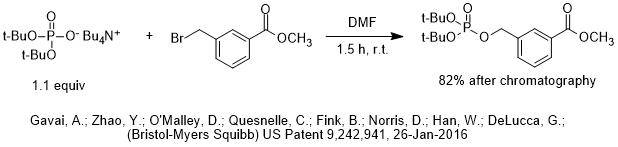
Specifically, we would recommend using actual PTC conditions with potassium di-t-butylphosphate (or the sodium salt if available or the free acid with a base), a catalytic quantity of tetrabutylammonium bromide and an easily recoverable solvent such as toluene. Additional cost reduction may be able to be achieved if one uses the benzyl chloride derivative instead of the benzyl bromide derivative shown in the diagram.
Before locking in a process for a nucleophilic substitution, contact Marc Halpern of PTC Organics to avoid missing an opportunity to reduce the cost of manufacture that phase-transfer catalysis can help you achieve.
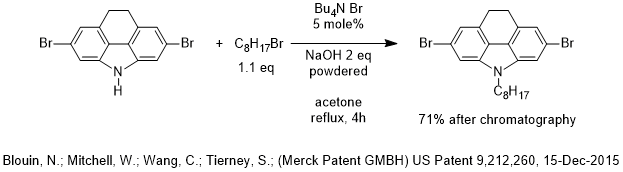
PTC strong base reactions constitute more than half of PTC commercial applications. PTC-NaOH routinely alkylates substrates with a pKa of up to about 23. The pKa of carbazole is 20 (in water). The substrate shown in the diagram has a higher pKa due to the strained out-of-plane nature of the ring system that is problematic for the aromaticity of the anion.
When the pKa of the substrate to be deprotonated is high enough to be close to the limits of PTC-alkylation, solid powdered NaOH is often used. The presence of even small amounts of hydration reduces the basicity of the hydroxide and also reduces the nucleophilicity of the low concentration organic anion.
In this case, 2 equivalents of powdered NaOH were used, of which some of the excess likely absorbed the equivalent of water that was generated.
Now contact Marc Halpern to improve your strong base processes using the unmatched specialized expertise of PTC Organics in PTC-strong base reactions.
The most frustrating aspect of being a PTC expert is when I see obvious examples of reactions that should use phase-transfer catalysis that do not use phase-transfer catalysis. The reason it is so frustrating is that when process development chemists don’t use PTC for commercial applications when they should, the result is that their companies are not making as much profit or achieving the environmental performance they should be enjoying. That often results in less job security for the same process chemists who develop the process and lost green chemistry for society. Fortunately, you are a loyal reader of the PTC Tip of the Month, so this will probably never happen to you. From my experience in visiting more than 260 companies in 37 companies, I estimate that about 5%-10% of the processes that should use PTC actually do use PTC. The rest are missed opportunities for lower cost higher performance green chemistry. What a waste!
An example of a missed PTC opportunity reaction was reported this month in US Patent 9,190,493.
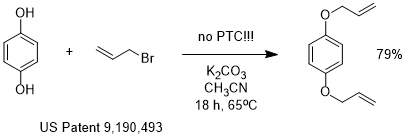 Even people who are not PTC experts know that one of the highest performance phase-transfer catalysis reaction categories is etherification (Williamson ether synthesis) of alcohols or phenols. Step 2a in the patent reacts hydroquinone with allyl bromide in acetonitrile using K2CO3 as base WITHOUT PTC (!!!) to produce diallyloxy benzene in 79% yield.
There are at least two compelling reasons to use PTC for this reaction. The first is that PTC always provides the opportunity to etherify phenols with alkyl halides using the lowest excess allyl halide and the shortest reaction time to achieve the highest yield with either no solvent or an easily recoverable solvent that makes two phases with water to achieve easy less expensive work up. Those multiple simultaneous benefits are enough to always consider PTC for etherification of phenols in all cases.
The second reason has to do with selectivity and may be less obvious. PTC excels in dietherification of diphenols like hydroquinone. Let’s understand why.
When PTC is used to etherify hydroquinone with allyl bromide (by the way, allyl chloride would be less expensive, though one must be set up to handle the safety issues) in the presence of potassium carbonate, the phase-transfer catalyst transfers the hydroquinone anion from the surface of the potassium carbonate to the bulk organic phase where it forms the allyl ether. Once the monoallyl ether is formed, the phase-transfer catalyst “has a choice” between transfering a non-allylated hydroquinone dianion or the monoanion of hydroquinone monoallyl ether. The phase-transfer catalyst will always choose the more organophilic anion which in this case is the monoanion of hydroquinone monoallylether since it has more carbons and only one negative charge whereas the hydroquinone dianion is more polar and less organophilic.
As a result, when etherifiying hydroquinone under PTC conditions, only a very small steady state concentration of hydroquinone monoallyl ether is present and the diallyl ether is very selectively formed. In fact, the etherification of hydroquinone with allyl halide using phase-transfer catalysis should proceed to 100% completion under mild conditions with very high atomic efficiency (low excess of allyl halide) and provide the opportunity to choose any convenient organic solvent, including solvent free.
It is possible that the chemists who reported this etherification in US Patent 9,190,493 did not need the absolute best reaction conditions. But even so, whenever chemists do not leverage the most well-known advantages of phase-transfer catalysis for obvious applications, you have to wonder what else they are missing for the benefit of their employers that could save their jobs.
To assure that your company does not miss PTC opportunities to increase profit, process performance and R&D efficiency, now contact Marc Halpern of PTC Organics to inquire about integrating highly specialized expertise in industrial PTC with your process development programs.
The essence of the recent interesting US Patent 9,120,687 (01-Sep-2015) is that Aliquat 336 is an excellent extractant for the thiocyanate anion. In this patent two actions are described: [1] Aliquat 336 is immobilized on a “polymer inclusion membrane” (“PIM”) at a level of 10%-20% and then [2] the PIM is contacted with an aqueous solution containing thiocyanate for the purpose of removing this toxic contaminant from water streams. As we teach in our 2-day course “Industrial Phase-Transfer Catalysis” quaternary ammonium phase-transfer catalysts are highly selective for associating with polarizable anions. Thiocyanate, iodide, perchlorate and permanganate are among the anions with the highest selectivity for quats as shown on this page from our course manual. This is the basis for another patent, US 6,846,946 that extracts these anions from aqueous waste streams and converts them into value added products in one step using phase-transfer catalysis.
The take away message here is that if your company generates or needs to remove polarizable anions from aqueous waste streams, you can use phase-transfer catalysis to very efficiently extract and react these anions to clean up these waste streams and if they are in sufficient quantity, create a valuable marketable product.
If your company has the need to remove byproduct anions from waste streams, now contact Marc Halpern to explore how to integrate the best expertise in industrial phase-transfer catalysis with your requirements.
Phase-transfer catalysis is very often used to achieve the advantages of high yield, short cycle time and easy workup while avoiding the disadvantages of separating polar aprotic solvents from the product such as handling losses, high boiling points, need to dry the solvent before reuse, etc.
However, this month two patents were issued that report the use of PTC with the high boiling polar aprotic solvents NMP and DMSO. In one patent (US 9,139,869), the inventors surprisingly perform three C-alkylations of dibromofluorene in DMSO (using TBAB as the phase-transfer catalyst) with yields of 70, 75, and 79%. This is surprising because in our 2-day industrial PTC course we teach the same PTC-alkylation of dibromofluorene in 96% yield using toluene as the solvent. Fortunately, in the same patent, the inventors used PTC with toluene for a Michael addition to an acrylate ester that is the subject of the PTC Reaction of the Month.
In another patent (US 9,126,975) shown in the diagram, NMP is used as the solvent for a PTC S-alkylation of mercapto benzothiazole. In that case, the use of NMP is less surprising since the polar reactant may require a very polar solvent for dissolution. It still may be possible to perform this PTC S-alkylation with a less polar solvent and allow the organophilic quat transfer the mercaptide anon into the organic phase, but sometimes stirring of the slurry is difficult, especially when sodium bicarbonate is the base. In addition the mercapto benzothiazole is used in 20 mole% excess, so a polar solvent may be needed to recover that material. Since one of the inventors is a long time subscriber to the PTC Tip of the Month, we may be able to get a comment on that if not restricted by confidentiality.
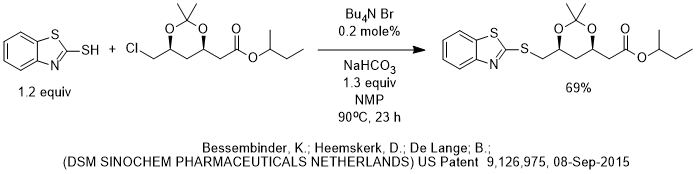
In most cases, we can replace high boiling polar aprotic solvents with much easier to recover lower boiling common solvents like toluene.
If your company can benefit from replacing high boiling hard-to-recover solvents with solvents like toluene that are easier to recover, now contact Marc Halpern of PTC Organics to integrate highly specialized expertise in industrial phase-transfer catalysis with your process development programs to improve your process performance, process R&D efficiency and profit.
There is growing interest in publications and patents that describe imdiazolium chloroaluminates, pyridinium chloroaluminates and quaternary ammonium chloroaluminates (Q+ AlCl4-) to promote the oligomerization and alkylation of alkenes. The reaction is essentially an acid catalyzed alkylation with some similarities to how gasoline alkylate is made but for higher molecular weight oils (gasoline alkylate is made from isobutane and butene using sulfuric acid or HF as the catalyst).
Of course, inorganic sulfuric acid and HF are not soluble in nonpolar hydrocarbons. So, there is an industry with smart engineers who design contactors to make this reaction work for gasoline alkylate.
Technology has been developed to oligomerize and alkylate higher molecular weight alkenes that seems like phase-transfer catalysis though PTC is not mentioned in the publications or patents. The pyridinium or quaternary ammonium chloroaluminates are referred to as ionic liquid solvents for the alkylation or oligomerization or ionic liquid catalysts and indeed are used in catalytic quantities.
Maybe we are just dealing with semantics, but the essence of the technology is to bring the reactants and catalyst together in an organic phase where the reaction takes place. When using catalytic amounts of [Q+ AlCl4-] to solubilize both the inorganic Lewis acid and the alkene in the same phase, it sure sounds like PTC to me.
Examples can be found in US Patent 8,198,500, that uses methyl tributyl ammonium chloroaluminate and butyl pyridinium chloroaluminate. Another interesting article on this topic is A.S. Berenblyum et al. , Applied Catalysis A: General 315 (2006) 128–134
Methyl tributyl ammonium chloroaluminate is made from AlCl3 and methyl tributyl ammonium chloride.
Glycidyl esters are an important class of compounds used in a variety of applications from pharmaceuticals to automotive.
The patent cited in the diagram describes the synthesis of glycidyl esters using phase-transfer catalysis, though yields are not reported. The inventor used excess epichlorohydrin as the solvent and tetrabutyl ammonium bromide as the phase-transfer catalyst in this solid-liquid PTC esterification.
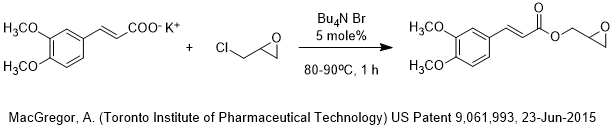
It is possible that the bromide of TBAB is forming epibromohydrin in-situ which is co-catalyzing the reaction. The inventor used a reaction time of only 1 hr which is short for this type of esterification. He did not report optimization of moisture level in this system which we speculate would be crucial to achieve the highest productivity at low levels.
The inventor also used PTC for condensations of the glycidyl esters such as that described in Example 5 of the patent.
If your company could benefit from the highest performance esterification technology when reacting carboxylic acids (salts) with alkyl halides, now contact Marc Halpern of PTC Organics to access the best available expertise in PTC nucleophilic esterifications to improve your process performance.
PTC excels in enabling high-performance reactions of water-sensitive compounds in the presence of water. The underlying concept that is leveraged to achieve this valuable benefit is to protect the water-sensitive compound from water by dissolving it in a water-immiscible (“water-rejecting”) organic phase using the phase boundary as a barrier, then using the phase-transfer catalyst to transfer a reactant from the aqueous phase (or solid phase) into the reaction phase in which the water-sensitive compound is dissolved.
The Si-OEt group is susceptible to hydrolysis. Reactions of chloropropyltriethoxysilane (CPTES) are often performed under anhydrous conditions to avoid hydrolysis of the ethoxysilane group. The patent described here illustrates how careful choice of reaction conditions can increase the conversion of a water sensitive silane to desired product while minimizing hydrolysis.
In a patent issued earlier this week, the inventors reacted sodium sulfide and sulfur with CPTES to produce a tetrasulfide bridged bispropyltriethoxy silane (TESPT). Sodium sulfide obviously doesn’t readily dissolve in organic solvents that are easy to recover, so one would like to add some water to the system to dissolve some sodium sulfide and use a phase-transfer catalyst to transfer and react the sulfide anion from a small aqueous phase into an organic phase in which CPTES is located and protected from the water.
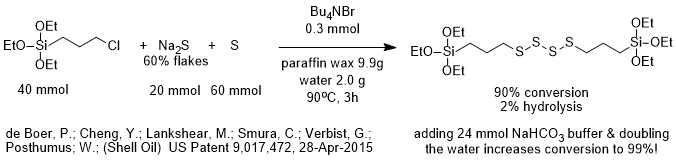
The inventors examined several process parameters to maximize the desired reaction and minimize hydrolysis and the results are shown in Table 3 in the patent. In all cases, they chose to use paraffin wax as the solvent, presumably to serve as a highly non-polar solvent that would be very effective in rejecting water from the reaction phase and protect the CPTES from hydrolysis.
The baseline conditions for the PTC reaction are shown in the diagram. They include using 0.8 mole% TBAB as phase-transfer catalyst, 1 part paraffin wax per part of CPTES by weight, 0.2 parts water per part of CPTES by weight and a temperature of 90 deg C. Under these conditions 90% of the CPTES is converted into bispropyltriethoxysilane tetrasulfide (TESPT) and 2% of the CPTES is hydrolyzed.
A conversion of 90% to TESPT was also observed at the higher temperature of 100 deg C while doubling the TBAB loading to 1.6 mole%. However, when increasing the temperature to 110 deg C, conversion to TESPT decreased to 80%.
A conversion of 90% to TESPT was also observed by reducing the paraffin wax loading by 60% to 0.4 parts paraffin wax to 1 part CPTES at 1.6 mole% TBAB loading. But when further reducing the paraffin wax “protecting solvent” by 73%, conversion to desired product decreased to 80%. In other words, there is a limit for how much you can reduce the solvent protection of the water-sensitive compounds.
These results suggest that process conditions must be carefully chosen to minimize hydrolysis and that means avoiding too high of a temperature and providing enough protecting solvent to minimize what may be assumed to be interfacial hydrolysis of the CPTES by water (and the Si-OEt in the product).
It is most interesting to read that when the inventors added sodium bicarbonate as buffer, they were able to achieve 99% conversion to TESPT even while doubling the amount of water to 0.4 parts water per part of CPTES by weight. This shows that it is extremely important to carefully choose reaction conditions when performing PTC reactions with water-sensitive compounds!
The inventors also tried to replace TBAB with tetraoctyl ammonium bromide and the conversion to desired product decreased into the 50’s.
At PTC Organics, we have nearly four decades of working with water-sensitive reactants under PTC conditions. Your company may be able to greatly benefit from this highly specialized expertise to increase yield of desired product and minimize excess expensive water-sensitive reactant by bringing in PTC Organics to work with you through PTC Process Consulting or PTC Contract Research. Now contact Marc Halpern of PTC Organics to explore a path forward for improving your process performance.
Several thousand US patents issued in the past couple of weeks including US Patent 9,000,000 marking another million patent threshold.
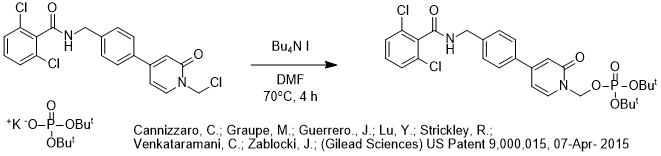
Out of curiosity, we searched the term “tetrabutylammonium” or “tetrabutyl ammonium” and found it appeared in 51 patents of the roughly 5,000 or so issued last week on April 7. While not all these patents relate to phase-transfer catalysis (toner patents, TBAF for desilylation, others), most of them do. This indicates that phase-transfer catalysis is alive and well, at least for industrial chemists.
The first tetrabutyl ammonium patent in the 9 millions is shown in the diagram. It is a phase-transfer catalyzed esterification to form a phosphate ester. What is interesting about this reaction is that most phosphate esters made using PTC react a phosphoryl chloride with a deprotonated hydroxyl (alkoxide or phenoxide). This procedure transfers and reacts a potassium phosphate salt with an alkyl hailde.
Forty four years after Starks published the first PTC publication in JACS, it is clear that when industrial chemists need high performance for their reactions, phase-transfer catalysis really does deliver. If it didn’t, PTC would have died a natural death as a passing curiosity a long time ago. There does seem to be a lot more industrially interesting patent literature than academic focus, but that just indicates how valuable PTC technology is to people like us who must develop profitable processes as our primary occupation.
I have been enjoying phase-transfer catalysis since US patents were in the 3 millions (almost 39 years) and I intend to enjoy reviewing PTC patents forever.
Now contact Marc Halpern to inquire about PTC Training or PTC Process Consulting at your company.
This PTC Tip is written in part as a response to a very good question by Larry Fertel of Islechem and very good follow up responses by several chemists posted on the OPRD LinkedIn discussion board on March 4, 2015, in particular one short but important comment by Tomas Vojkovsky at Intezyne Technologies.
When you closely examine all the advantages and powerful underlying fundamentals of phase-transfer catalysis, one of the most compelling is the unique ability of PTC to transfer and activate the reactivity of anions in nonpolar organic phases. That factor alone is often responsible for increasing the reactivity of nucleophiles and bases by orders of magnitude leveraging significant reductions in the energy of activation of the reactions.
The example shown in the diagram is taught in our 2-day PTC course to illustrate the point that you can use phase-transfer catalysis to “thread the needle” of selectivity by leveraging the reduced energy of activation.
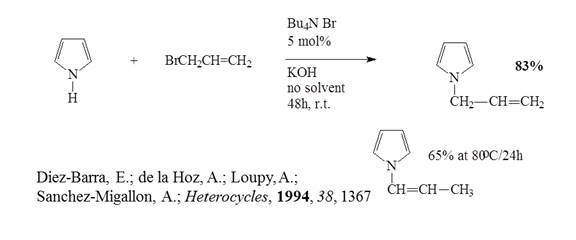
In this case, PTC was used to perform an N-alkylation, a reaction category in which PTC excels, which is the subject of hundreds of publications and patent. This N-alkylation is of pyrrole and allyl bromide. PTC enabled the authors to perform this solvent-free reaction under mild conditions, including working at room temperature. This is crucial for this particular reaction since the reactants and PTC itself have the potential to continue to a side reaction which is deprotonation of the allyl pyrrole that immediately isomerizes to conjugate the double bond from the allyl group to the aromatic heterocycle.
To prove the point, the authors then increased the temperature and showed that the possibility of the next step of isomerization is just around the corner.
There are numerous examples of “threading the needle” of selectivity by leveraging PTC’s ability to reduce energy of activation and in turn reduce the temperature of the desired reaction in order to avoid an undesired side reaction that would otherwise be likely to dominate performance in the absence of PTC.
PTC Organics has developed many such selective high performance applications and most of them include working at room temperature or slightly above, so that the desired reaction actually proceeds well and the side reactions are minimized or sometimes eliminated to non-detectable levels.
If your company’s profit and process R&D department’s efficiency can benefit from choosing optimal PTC reaction conditions in the smallest number of experiments to achieve low-cost high-performance green chemistry, now contact Marc Halpern of PTC Organics to explore a path forward to integrate your commercial goals with the highly specialized expertise of PTC Organics in industrial phase-transfer catalysis.