Demetallization of heavy oil petroleum fractions (asphaltenes) is required in order to eliminate undesirable metalloporphyrins present in these streams. The high level of metal contaminants in these fractions cause fouling, catalyst deactivation and other problems in downstream refining processes. Various metals are removed with varying degrees of difficulty using upgrading processes. Nickel and vanadium metalloporphyrins are more resistant to removal than other metals such as iron.
The inventors of US Patent 9,505,987 (29-Nov-2016) found that using Aliquat 336 as phase-transfer catalyst and tungstic acid with phosphoric acid as oxidation catalyst for hydrogen peroxide treatment, removes 99% of nickel and vanadium from the heavy oils and separates them into aqueous streams. Both the Aliquat 336 and the phosphotungstic acid are required to achieve 99% removal of nickel and vanadium. Only 28%-38% of nickel and vanadium are removed by hydrogen peroxide treatment without Aliquat 336 and phosphotungstic acid. That level of removal is not enough to sufficiently prevent fouling and catalyst deactivation in refining plants.
If your company wants to develop the most cost effective PTC process, now contact Marc Halpern of PTC Organics Inc. to explore collaboration by integrating the highly specialized expertise of PTC Organics with your company’s commercial goals for increased profit and process performance.
Two patents issued last week that use catalytic amounts of tetraalkylammonium salts. Such reactions usually mean phase-transfer catalysis, but in both cases, the role of the quats was to solubilize an anion that served in a catalytic capacity. One was tribromide and one was chloride.
Tetrabutylammonium tribromide (TBATB) is a known bromination agent for adding a single bromine at the alpha position of acetophenone (if not used in excess) while generating HBr and TBAB. TBATB is used at a level of 1.5 mole% relative to the iodoacetophenone. Reaction with triethylorthoformate, likely catalyzed by the HBr liberated from the bromination, produces the ketal shown in 85% yield.

In another patent, tetramethylammonium chloride was used to solubilize chloride in DMSO that acted as a catalyst for the esterification shown in the diagram. The chloride opened the epoxide of glycidyl methacrylate that produced an alkylating agent in situ. Esterification followed liberating the chloride for another cycle.

The concept of solubilizing anions in an organic reaction phase using quaternary ammonium salts is obviously useful. In phase-transfer catalysis, the quat transfers a reacting anion for consumption. In the two cases cited here, the quat solubilized anions used as catalysts themselves.
If you are working on organic reactions that require the use of anions as reactants or as catalysts, now contact Marc Halpern of PTC Organics Inc. to improve the process performance and profit of your company AND saving your company weeks or months of development cycle time due to the highly specialized expertise of PTC Organics in industrial phase-transfer catalysis.
US Patent 9,441,169 by Gargano and Halpern was issued this month to Ultraclean Fuel that uses phase-transfer catalysis to impressively remove sulfur from hydrocarbons to comply with the strictest standards for petrochemical products.
In particular, “ultralow sulfur diesel” (ULSD) containing only 10 ppm or less of sulfur was achieved in a single step from refinery diesel at about 4000 ppm sulfur, from transmix diesel at about 400 ppm sulfur and from jet fuel at about 1500 ppm sulfur using a phase-transfer catalyst, a phosphotungstate catalyst and hydrogen peroxide. The sulfur compounds in the diesel are mostly thiophene derivatives and they are oxidized to sulfones and separated from the diesel.
Phase-transfer catalysis enables this breakthrough that has the potential to revolutionize sulfur emissions from fossil fuels and make a huge impact on reducing acid rain.
If your company wants to achieve breakthroughs using phase-transfer catalysis, now contact Marc Halpern of PTC Organics Inc., as done by Ultraclean Fuel, to explore a path to make your mark on saving jobs (maybe your own), improving the environment or just plain increasing profit.
Last week, two patents that were published using PTC also used THF as solvent and both appear to use conditions that were somewhat disappointing. One will be described in the PTC Tip of the Month here and the other will be described in the PTC Reaction of the Month below.
US Patent 9,422,305 describes the etherification of a diol with epichlorohydrin to form the diglycidyl ether (bisepoxide). The disappointing warning sign is that the inventors used 14 equivalents of epichlorohydrin and 12 equivalents of NaOH when they needed only 2 equivalent in theory. Why would they need such huge excesses of reactants?

The inventors note “intense” stirring of a huge excess of the epichlorohydrin in the presence of the concentrated NaOH while dropping in the diol “slowly”. It may be speculated that the intense stirring could promote hydrolysis of the epichlorohydrin, especially since the diol is being added last leaving the epichlorohydrin open to attack before the diol is available to consume the epi. Addition of THF could also promote hydrolysis by co-dissolving some water/base with the epichlorohydrin and organic epoxide product.
Unless a PTC system is transfer rate limited (etherifications are typically intrinsic reaction rate limited not transfer rate limited), in cases in which there are water-sensitive reactants and products, it is usually preferable to reduce the agitation efficiency and allow the phase-transfer catalyst to bring the reactants together while minimizing non-catalyzed interfacial hydrolysis of the sensitive functional group (epoxide in this case). In addition, PTC enables us to use a less polar solvent that would reduce contact between hydroxide and the epoxide keeping them separated in different phases. All this would possibly reduce the huge excess of epi being used.
One impressive aspect of this reaction is that the etherification to the glycidyl ether takes place at room temperature. Many PTC etherifications with epichlorohydrin are reported at temperatures of about 80oC. The bromide of TBAB is likely forming epibromohydrin in situ that is more reactive than epichlorohydrin, thereby co-catalyzing the reaction.
In short, we expect that by using a non-polar solvent to separate the base from the epoxide starting material and product, avoiding over-agitation and better choice of base (perhaps with potassium salt to enhance the formation of an omega phase), the large excess of starting materials can be avoided.
To learn more about how to optimize PTC etherifications to improve process performance and profit, now contact Marc Halpern of PTC Organics.
In this patent, the inventors performed a simple esterification using a quat acetate, either tetrabutylammonium or tetramethylammonium. The solvent is acetonitrile. The yield is high at 95%-97%.
There are several interesting thoughts when reading this patent. First, they used stoichiometric quat acetate. They should have used catalytic quat salt and inexpensive sodium acetate. One would assume that the economics of recycling a full equivalent of tetrabutylammonium salt or tetramethylammonium salt would be expensive and required.

Secondly, they used acetonitrile as the solvent. If already one is using stoichiometric quat acetate, one would expect the reaction to proceed well using almost any organic solvent, preferably one that makes two phases with water for easy work up using water washes to separate the product from the waste salts. In fact, the inventors explicitly cite the use of water-immiscible solvents for the extraction step during workup. Performing a solvent exchange after reaction before isolation of product would add unnecessary and cost and complexity to the process.
The inventors do show that using ammonium acetate instead of a quaternary ammonium acetate gives no yield. This hints that true phase-transfer catalysis should work.
It should also be noted that an imidazolium ionic liquid was screened for this reaction and did not perform nearly as well as the classical much less expensive quaternary ammonium phase-transfer catalyst.
We would probably use stoichiometric sodium acetate and a few mole% tetrabutylammonium bromide that would form the bromomethyl furfural in-situ from the chloromethyl furfural to achieve bromide co-catalysis to enhance the phase-transfer catalysis by the tetrabutylammonium cation. Then again, the reaction works well in 5 minutes at room temperature homogenously in acetonitrile, so rate enhancement may not be needed. In any case, this process begs to be performed with catalytic phase-transfer catalyst in a properly chosen water-immiscible solvent.
Now contact Marc Halpern of PTC Organics to improve process performance and reduce cost if your company is developing or performing commercial specialty esterifications that must be irreversible, have very high conversion (i.e., nucleophilic esterifications using alkyl halides instead of dehydration using alcohols) and be performed in short reaction times. PTC Organics can show you how to achieve low-cost high-performance green chemistry using phase-transfer catalysis, including effective isolation of the ester product.
Example 14 of this 20-year old patent describes the high yield chlorination shown in the diagram on an 800 lb scale. PTC is used to deprotonate fluorene (pKa 23) with NaOH and the quat-fluorenyl anion ion pair attacks carbon tetrachloride to form 9-chlorofluorene. The 9-chlorofluorene is more acidic than fluorene and undergoes rapid chlorination by the same mechanism. One molecule of carbon tetrachloride provides one chlorine atom. The atomic efficiency is very high.
 The phase-transfer catalyst used was tetrabutylammonium hydroxide. The inventor did a nice job in showing that tetrabutylammonium bromide (TBAB) is NOT an effective phase-transfer catalyst for this reaction. Since this is not an academic paper, she does not speculate why but we speculate that the reason is that bromide hinders the extraction of hydroxide. As we teach in our 2-day PTC course, the affinity of the tetrabutylammonium cation for bromide is about 3,000 times more than for hydroxide.
We do not like to use the hydroxide form of tetraalkylammonium salts due to both high cost as well as the potential for decomposition by Hofmann Elimination during storage. The inventor concluded that quat hydroxides are better than quat bromides and that is a good conclusion, but there may be better alternatives.
We expect this reaction to be a T-Reaction based on the “Halpern pKa Guidelines for Evaluation and Optimization of PTC Applications.” Accordingly, we expect “accessible” quat cations with a q-value of about 1.75 to work better than tetrabutylammonium. If we had to do this reaction today, we would screen the use of methyl tributyl ammonium chloride (MTBAC) as the phase-transfer catalyst. It is possible that the chloride will also hinder hydroxide extraction, though to a much lower degree than bromide. We would be very curious about the combination of MTBAC with 50% NaOH for this reaction. MTBAC also washes into water more easily during workup which minimizes aqueous waste.
Now contact Marc Halpern of PTC Organics if your company wants to achieve higher profit and improved process performance for strong base reactions that you expect may be improved using phase-transfer catalysis.
This impressive new May 2016 patent highlights one of the most obscure though useful strengths of phase-transfer catalysis. Phase-transfer catalysis is known to excel in transferring anions into non-polar and moderately polar organic solvents and greatly enhance their reactivity in those solvents. Less known is that PTC can transfer polar neutral molecules with hydrogen bonding functional groups, into organic non-polar and moderately polar organic solvents and greatly enhance their reactivity in those solvents. In this case, urea is reacted with isobutyraldehyde.
Urea is highly polar and dissolves in water but doesn’t dissolve in most common organic solvents. Although not cited in the patent, we speculate that the role of the quaternary ammonium phase-transfer catalyst is to hydrogen bond with the urea and make it available to the less polar isobutyraldehyde reactant (which is also the organic phase). At the end of the reaction, the inexpensive quat remains in the aqueous phase for easy separation from the solid product.

Prior art for this reaction uses sulfuric acid and phosphoric acid added in an alternating manner at temperatures between 60 C and 100 C and requires an additional unit operation of neutralization with hydroxide. Materials of construction must resist corrosion. In contrast, the PTC process uses benzyl trimethyl ammonium chloride (though benzyl triethyl ammonium chloride is cited in the abstract) at a temperature of only 40 C and no corrosion. Compare these results described in US patents 3962329 and 9340495.
Using the same mole ratios of BTMAC catalyst as sulfuric/phosphoric acid catalyst and at 40C, the conversion with BTMAC was 100% at 20 min while the mixed acids gave 0% at 30 min.
PTC Organics has experience dissolving insoluble amines and other neutral molecules in organic reaction phases to achieve low-cost high-performance green chemistry.
Now contact Dr. Marc Halpern of PTC Organics to explore integrating PTC Organics’ highly specialized expertise in industrial phase-transfer catalysis with your process development goals to increase profit and R&D efficiency.
Neal Anderson of Anderson’s Process Solutions LLC (excellent process chemistry consultant) brought to our attention a very good article that shows how innovators approach problem solving when combining the advantages of phase-transfer catalysis with the advantages of continuous flow reactors to achieve high yield and a controllable exotherm. The C-alkylation shown is a PTC T-Reaction that appropriately uses methyl tributyl ammonium chloride as the phase-transfer catalyst. PTC T-Reactions are especially amenable to efficient mixing concepts.
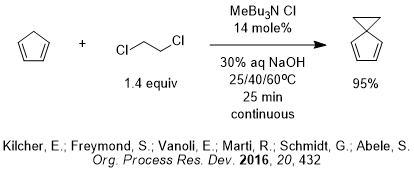 In this case, the right type of flow was achieved by using self-made Raschig rings from 1 mm diameter Teflon tube. When using two strategically placed static mixers with these Raschig rings in a three reactor system (each at different temperatures) a yield of 95% was achieved with a residence time of 25 min.
One of the challenges was to avoid solids that hinder the operation of small diameter flow reactors. The use of 30% NaOH instead of 50% NaOH while working at an optimized phase-transfer catalyst level prevented solid build up.
This system is impressive because after optimization, the yield was 95% which is much better than the 75% yield achieved in a batch reactor, the type of reactor that most of us process chemists use in our comfort zone.
We recommend reading this article that was well written with well-designed experiments.
The patent cited in the diagram uses tetrabutylammonium iodide in several examples for etherification using either DMF or NMP as the solvent. One may speculate that polar solvents were used due to the high polarity of the amino isooxazole products after hydrolysis.
The use of tetrabutylammonium iodide suggests that the etherification is catalyzed by rapid in-situ formation of the more reactive alkyl iodide, though most of the PTC etherifications reported in this patent were performed at room temperature, so iodide co-catalysis may not have been required. If this reaction were to be optimized for scale up, one would use tetrabutylammonium bromide and KI, both at levels much lower than 10mole% which would save on the cost of the catalyst.
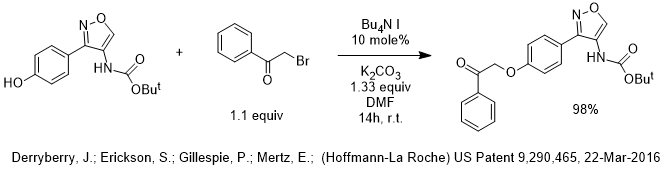
The price of iodine and iodine derivatives fluctuate significantly over time. The price of tetrabutylammonium iodide is usually set at the highest historical cost of iodide. Moreover, quats like tetrabutylammonium have a much higher affinity for iodide than for bromide, typically 100 times more or higher. For these reasons, we usually use tetrabutylammonium bromide in combination with KI since KI is rarely at the historical high of iodine price and TBAI is formed from TBAB and KI in-situ to an overwhelming extent.
It is not known if the inventors screened less polar solvents that would form two phases with water and make workup a bit easier, if scaled up. The reaction was reported on a small scale (~2 mL) and more than 90% of the reaction mass was DMF. Even though the isooxazole reactant is quite polar, the ion pair with the quat as the phenoxide may be amenable to PTC in a less polar solvent. This is important because the final isolation of the intermediate was by chromatography which should usually be avoided. PTC in toluene may facilitate this possibility.
Additional similar TBAI-catalyzed reactions were reported by the same group in US Patent 9,296,711 on March 29, 2016.
If your company seeks to develop low-cost high-performance green chemistry for etherifications, now contact Marc Halpern of PTC Organics to integrate highly specialized expertise in industrial phase-transfer catalysis with your commercial process development, process improvement or process retrofit programs to increase profit and process R&D efficiency.
A patent issued this month that describes a solution to an occasional challenge encountered in PTC reactions which is when a PTC reaction slows down or stalls more than expected based on simple kinetics or for other reasons.
When PTC reactions actually stall, it is often due to decomposition of the phase-transfer catalyst. This can be diagnosed by simply adding more phase-transfer catalyst which jump starts the reaction and drives it to completion.
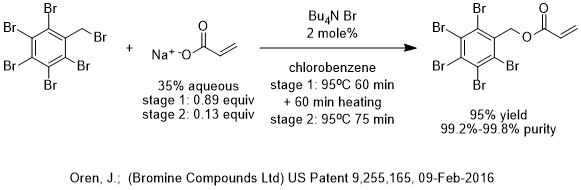
In the case of US Patent 9,255,165, the reaction is conclusively shown (using comparative examples and control experiments) to be slowed down by the accumulation of bromide leaving group that competes with the acrylate anion that is the nucleophilic reactant.
As we teach in our 2-day PTC course, quaternary ammonium phase-transfer catalysts have different affinities toward different anions. For example quats preferably associate about 10 times more with bromide than with chloride and about 1,000 times more than with fluoride. A lower alkyl carboxylate anion such as acetate has an affinity toward quats that is about 10 times less than chloride or 100 times less than bromide.
As a result, as a PTC reaction progresses that has a bromide leaving group and a carboxylate anion with low number of carbons, the accumulating bromide provides more and more competition for association with the quat and slows down the reaction for thermodynamic association/extraction reasons that go beyond the normal kinetic reasons of diminishing concentration of the reacting anion.
In this case, the bromide does not act as a true catalyst poison that would totally shut down the reaction, but it slows down the transfer of acrylate so much that it is worthwhile to physically remove the bromide from the system and replace it with fresh acrylate.
The invention disclosed by the inventor is to carry out the PTC nucleophilic esterification reaction between sodium acrylate and pentabromobenzyl bromide in chlorobenzene and TBAB as the phase-transfer catalyst, in batch mode, to rather high conversion of 75% to 95% within an hour, separate the aqueous phase and replace it with fresh aqueous sodium acrylate. The second stage reaction proceeds to completion in another 60-75 minutes.
The process is also described in continuous mode.
Such a solution to this problem is obvious to a PTC expert who is well aware of the relative affinities of various anions to various quaternary ammonium cations. Now contact Marc Halpern of PTC Organics if you want to benefit from the most highly specialized expertise in phase-transfer catalysis to achieve your process development goals in the shortest development time.