In phase-transfer catalysis, it is rare to actually use quaternary ammonium (quat) hydroxides as phase-transfer catalysts since you can very often use an inexpensive combination of NaOH and a standard quat bromide or chloride. However sometimes, you can use a quat hydroxide in stoichiometric quantities in a diagnostic experiment to determine whether a PTC-OH reaction will work at all before attempting to optimize a PTC application using NaOH with catalytic quantities of QBr or QCl.
Sometimes, the quat hydroxide you need is not commercially available. If that is the case, you may need to make the QOH yourself. Since hydroxide is a hydrophilic “hard anion”, it has a lower affinity for organic quaternary ammonium cations than larger softer anions like chloride and especially bromide. This causes quat hydroxides to be expensive and hard to make. Therefore, when you try to exchange the ion in QX to make QOH by contact with NaOH, you need to choose X such that it is more hydrophilic than hydroxide.
One way of doing this is to choose X that is a dianion such as sulfate or even a trianion such as phosphate. Quat sulfates are often made by making quat hydrogen sulfates which become quat sulfates in-situ upon the addition of some base. Quat phosphates are hard to find.
US Patent 8,163,951 describes the formation of tetramethyl ammonium sulfate and even tetramethyl ammonium phosphate followed by ion exchange to tetramethyl ammonium hydroxide in high purity. The formation of tetramethyl ammonium phosphate is of particular interest to us since we have not seen this before.
We speculate that specialty methyl trialkyl hydroxides may be able to be made by the reaction of higher trialkylamines with trimethyl phosphate followed by hydrolysis and ion exchange with NaOH or using basic ion exchange resins.
If your company can benefit from achieving higher process performance in a shorter development time by having access to the best PTC expertise available, now contact Marc Halpern by E-mail or by phone at + 1 856-222-1146 to inquire about using phase-transfer catalysis to achieve low-cost high-performance green chemistry.
If you’re not sure if PTC can help your reaction, now fill out the form shown at http://phasetransfer.com/projectform.pdf and send it to Marc Halpern by fax at +1 856-222-1124 or by E-mail of a scanned copy. If we do not have a secrecy agreement already in place, please use “R-groups” instead of the exact chemical structures.
PTC excels in performing reactions with water sensitive compounds such as chloroformates that are often used as protecting groups (e.g., benzyl chloroformate for the CBz group). PTC also excels in performing reactions involving anions, including nucleophilic substitutions using inorganic nucleophiles or base-induced alkylations.
When performing consecutive reactions for protection and a subsequent nucleophilic reaction (including base-initiated alkylation), you should consider PTC for streamlining the process by catalyzing both reactions using a single solvent, a single phase-transfer catalyst and achieving high atomic efficiency across both steps.
For example, the May 2013 PTC Reaction of the Month describes the nucleophilic substitution of a CBz protected serine methyl ester. The precursor protection reaction was not described in the patent, but since they were performing the subsequent thiophenoxide reaction with PTC (TBAB, TBPB or Aliquat 336), they could have easily performed the protection with benzyl chloroformate with the phase-transfer catalyst already present and likely be able to use the same solvent as the substitution reaction. This may have enabled avoiding isolation of the intermediate which would reduce cycle time and handling losses.
Commercial quantities of benzyl chloroformate can be obtained from VanDeMark Chemicals that also happens to be the commercial supplier of HEG Cl phase-transfer catalyst for high temperature reactions.
If your company can benefit from achieving higher process performance in a shorter development time by having access to the best PTC expertise available, now contact Marc Halpern by E-mail to inquire about using phase-transfer catalysis to achieve low-cost high-performance green chemistry.
If you’re not sure if PTC can help your reaction, now fill out the form shown at http://phasetransfer.com/projectform.pdf and send it to Marc Halpern by fax at +1 856-222-1124 or by E-mail of a scanned copy. If we do not have a secrecy agreement already in place, please use “R-groups” instead of the exact chemical structures.
Last month we explained why tetrabutyl ammonium chloride, TBAC, is more expensive than tetrabutyl ammonium bromide, TBAB. This month we will explain a more important reason why the use of TBAC usually means (though not always) that the PTC process using it is not optimal.
About 80-90% of PTC reactions liberate a leaving group, including C-/N-/O-/S-alkylations and substitutions using inorganic nucleophiles. As the reaction proceeds, more and more leaving group is liberated. That means that any intended effect for the chloride is likely to get swamped out by the ever increasing leaving group anion. This is especially true since most quats usually prefer to pair with most other leaving group anions compared to chloride.
Let’s assume for a moment that the leaving group is bromide. At 50% conversion of the desired reaction, there is obviously 50 mole% bromide in the system. If you are using 5 mole% TBAC as the phase-transfer catalyst, then at 50% conversion, there is 10 times more bromide present than chloride. An example of this is an otherwise excellent patented procedure shown at http://phasetransfer.com/C-alkfluorene.gif.
One reason to choose chloride as the counterion for tetrabutyl ammonium would be to attempt to enhance the extraction of the desired reacting anion due to the relative affinities of quats for chloride versus many useful anions. This is often why PTC chemists often choose hydrogen sulfate. While that may make a difference during the first few percent conversion or in cases in which there is no leaving group (e.g., oxidations with peroxide), the chloride simply gets overwhelmed by the leaving groups at higher conversion.
As a result, the added cost of TBAC vs TBAB is usually not justified when there is a leaving group. TBAC can potentially be optimal in certain cases in which there is no leaving group, but very rarely when there is a leaving group. The use of chloride with tetrabutyl ammonium requires some compelling reason to overcome the cost barrier.
If your company can benefit from achieving higher process performance in a shorter development time by having access to the best PTC expertise available, now contact Marc Halpern by E-mail to inquire about using phase-transfer catalysis to achieve low-cost high-performance green chemistry.
If you’re not sure if PTC can help your reaction, now fill out the form shown at http://phasetransfer.com/projectform.pdf and send it to Marc Halpern by fax at +1 856-222-1124 or by E-mail of a scanned copy. If we do not have a secrecy agreement already in place, please use “R-groups” instead of the exact chemical structures.
Last week, someone asked about tetrabutyl ammonium chloride (“TBAC”) on a process chemistry group on LinkedIn. In our experience, if someone is using TBAC, there is at least a 90% probability that there is an opportunity to improve the process. There are several reasons for this.
First, we should point out that TBAC is more expensive than TBAB (tetrabutyl ammonium bromide). Why? When you try to react tributylamine with butyl chloride directly, you get nearly exclusively dehydrohalogenation and irreversibly create butene, so you do not make TBAC. In contrast, if you react tributylamine with butyl bromide in one of a few selected solvents under the right conditions, you can make TBAB in very high yield with very little loss to dehydrohalogenation.
If you want to convert TBAB into TBAC, you must climb a thermodynamic hill since the tetrabutyl ammonium cation prefers to pair with bromide about 10 times more than with chloride. So, you would need to do multiple expensive ion exchange extractions or use a countercurrent extraction. In any case, it is expensive.
On top of that, TBAC is hygroscopic and hard to keep dry or in its low hydrated form.
As a result, TBAC is often made from TBA hydrogen sulfate, since it is easier to exchange hydrogen sulfate for chloride. But that is expensive too.
Those are just reasons for why TBAC is expensive. But there are usually more compelling reasons for using other phase-transfer catalysts other than TBAC. They have to do with the nature of PTC applications, especially nucleophilic substitutions and most PTC strong base reactions that generate a leaving group.
Those reasons will be described in next month’s PTC Tip of the Month. Feel free to send an E-mail directly to Marc Halpern if you think you know why it is almost never optimal to use expensive TBAC as a phase-transfer catalyst for most PTC nucleophilic substitution applications. If you provide a “right answer”, let us know if we can publish your name as having given a right answer.
If you’re not sure if PTC can help your reaction, now fill out the form shown at http://phasetransfer.com/projectform.pdf and send it to Marc Halpern by fax at +1 856-222-1124 or by E-mail of a scanned copy. If we do not have a secrecy agreement already in place, please use “R-groups” instead of the exact chemical structures.
One of the earliest PTC publications was called “Purple Benzene”. A crown ether was used to dissolve potassium permanganate in benzene. There are other publications that describe the use of the more affordable quats with permanganate to perform a variety of selective oxidations. This PTC Tip of the Month will discuss how we may be able to commercialize PTC-permanganate oxidations.
There are two reasons that permanganate is not used commercially as much as it should and these problems can be solved.
The two reasons are cost and environmental.
The byproduct of permanganate oxidation is manganese dioxide, a solid that cannot be thrown away easily. It usually must be landfilled or recycled.
In a meeting at Informex last week, I learned that Carus Chemical in Illinois will take back the manganese dioxide and convert it back to potassium permanganate if minimum quantities are met. This obviously affects the net cost of the permanganate and it also solves the problem of what to do with the large amount of the brown solid MnO2 that is generated. The alternative is disposal in a landfill, an obvious showstopping disadvantage.
If your company needs to perform a commercial scale oxidation for which selectivity can only be achieved using permanganate, you should consider outsourcing the oxidation to an organic chemical manufacturer that has relatively easy access to the Carus plant. Carus will perform the conversion of MnO2 back to KMnO4 if the quantity is at least 2 truckloads per year.
PTC Organics works with a strategic alliance partner in Indiana about 2 hours from the Carus plant.
Since the combination of [1] phase-transfer catalysis and permanganate provides unique selectivity performance for certain oxidations and [2] PTC Organics can develop and commercialize such oxidations in a manufacturing facility close enough to the Carus plant to enable perpetual recycle of the manganese, you should contact us to explore viable oxidations with permanganate.
This combination of PTC, permanganate and manganese recycle should help you expand the scope of commercial organic transformations that your company can now feasibly perform.
If you’re not sure if PTC can help your reaction, now fill out the form shown at http://phasetransfer.com/projectform.pdf and send it to Marc Halpern by fax at +1 856-222-1124 or by E-mail of a scanned copy. If we do not have a secrecy agreement already in place, please use “R-groups” instead of the exact chemical structures.
If you are performing a PTC reaction that involves a benzyl halide or allyl halide, you may be able to either form your PTC quat in-situ or you can prepare it ahead of time and charge it to the reactor.
In the PTC Reaction of the Month shown below, the inventors used several benzyl bromide derivatives in a previous step and then quaternized these compounds with trimethylamine to form the phase-transfer catalyst that they used in subsequent C-alkylations.
In this case, since they were producing the benzyl bromides by bromomethylation of commodity aromatics, their economics may have been more favorable to make their own quats instead of buying them.
When you use benzyl halides or allyl halides, you may want to explore the economics of making your own quats.
If your company can benefit from achieving higher process performance in a shorter development time by having access to the best PTC expertise available, now contact Marc Halpern by E-mail or by phone at + 1 856-222-1146 to inquire about using phase-transfer catalysis to achieve low-cost high-performance green chemistry.
If you’re not sure if PTC can help your reaction, now fill out the form shown at http://phasetransfer.com/projectform.pdf and send it to Marc Halpern by fax at +1 856-222-1124 or by E-mail of a scanned copy. If we do not have a secrecy agreement already in place, please use “R-groups” instead of the exact chemical structures.
Whether you are doing process research, process development, lab synthesis or plant support, you are always trying to achieve the highest yield, best selectivity, lowest excess reactants, etc. in the least time.
Phase-transfer catalysis delivers high performance with low cost for many of the routine reactions you perform each year. Let’s face it, many of the reactions you perform are straightforward etherifications, alkylations, esterifications, oxidations and the like. These are the reactions in which PTC excels.
So, did you run a PTC reaction last year? If you did, why did you choose PTC? If you didn’t, why didn’t you?
Please share good reasons for using or not using PTC in 2012 and please let us know if it’s OK to share your experiences with the PTC community receiving the PTC Tip of the Month. Do not disclose proprietary information but please articulate your driving forces for using PTC last year or maybe you had a really good excuse/reason for not doing so.
If your company can benefit from achieving higher process performance in a shorter development time by having access to the best PTC expertise available, now contact Marc Halpern by E-mail to inquire about using phase-transfer catalysis to achieve low-cost high-performance green chemistry.
If you’re not sure if PTC can help your reaction, now fill out the form shown at http://phasetransfer.com/projectform.pdf and send it to Marc Halpern by fax at +1 856-222-1124 or by E-mail of a scanned copy. If we do not have a secrecy agreement already in place, please use “R-groups” instead of the exact chemical structures.
If you think you know what you put into your reactor when you used Aliquat 336 (trademark of BASF) or Adogen 464 (trademark of Evonik), you were more likely than not, WRONG. The confusion in the literature is horrendous and is perpetuated by the incorrect MSDS’s that are ubiquitous on the internet, including those from the most well-known and trusted distributors.
The ONLY MSDS’s that are correct are those from the manufacturers BASF (August 2011 version) and Evonik (June 2010 version). Neither provides a molecular weight, but at PTC Organics, we use a value of 432 g/mole.
If you are relying on older MSDS’s or MSDS’s from Aldrich to determine the structure of the quat salt or its molecular weight or its correct CAS Registry Number, you might be making mistaken assumptions.
These pieces of information may be very important to you if you are attempting to be compliant with regulations, responsible for the fate of the substance, calculating the desired phase-transfer catalyst loading for a PTC application, trying to understand the peaks in a chromatogram, etc.
We recently studied and wrote a summary about the historical MSDS’s for Aliquat 336, Adogen 464, methyl tricaprylyl ammonium chloride, methyl tricapryl ammonium chloride (this is NOT a typo), methyl trioctyl ammonium chloride and similar compounds.
This in-depth 7-page article clarifies the confusion and resolves the issue of the structure of the quat salt and its molecular weight.
Since the article is rather involved, we will share here a few selected pieces of information that we were able to clarify as correct that helps define the substance. The current CAS # for methyl tricaprylyl ammonium chloride is 63393-96-4. If you are using any other CAS #, you need to read this article. If you are using Aliquat 336 or Adogen 464 and compliance is important to you, you need to read this article.
One more potentially huge point, would you be surprised to learn that the quat chloride content of Aliquat 336 and Adogen 464 is only about 90%? Most of you are probably not using that piece of information when determining catalyst loading. I was not aware of this for years. This 10% or so correction means that a lot of academic literature and patent literature has incorrect mole ratios, which also impacts structure-activity relationship conclusions.
You need to read this article, even if you think you’re sure you know what is in a bottle, pail, drum or tank car of Aliquat 336 and Adogen 464.
If your company can benefit from achieving higher process performance in a shorter development time by having access to the best PTC expertise available, now contact Marc Halpern by E-mail to inquire about using phase-transfer catalysis to achieve low-cost high-performance green chemistry.
If you’re not sure if PTC can help your reaction, now fill out the form shown at http://phasetransfer.com/projectform.pdf and send it to Marc Halpern by fax at +1 856-222-1124 or by E-mail of a scanned copy. If we do not have a secrecy agreement already in place, please use “R-groups” instead of the exact chemical structures.
Outstanding mechanistic work was done by phase-transfer catalysis pioneers in the 1970’s and some of this early work has great value that is directly applicable to developing commercial PTC processes today. One such surprising and fascinating behavior that LOOKS LIKE IT’S AUTO-CATALYTIC was reported in Starks’ classic landmark paper: Starks, C.; Owens, R.; J. Amer. Chem. Soc., 1973, 95, 3613.
The reaction studied was the simple nucleophilic substitution between sodium cyanide and 1-bromooctane to form 1-cyanooctane. When using tetrabutyl phosphonium bromide (TBP Br) as the catalyst, the reaction starts very slowly and speeds up as conversion increases, just like an autocatalytic reaction. Conversions were 10% at 1 hour, 20% at 2 hours, 67% at 3 hours and 97% at 3.5 hours. That is a remarkable increase in reaction rate and is opposite to normal reactions that slow down as conversion increases.
Even though this looks like autocatalytic behavior, there is a simple explanation that is worthwhile to know since it applies to many solvent-free PTC reactions. Following is the valuable lesson that is applicable to solvent-free PTC reactions. In fact, some of you may have encountered this behavior in the lab, pilot plant or plant and maybe wondered why and how to design the reactor.
TBP Br is “relatively insoluble in 1-bromooctane but highly soluble in 1-cyanooctane.” In a true PTC system, the reaction takes place in the organic phase and the role of the phase-transfer catalyst is to transfer the reacting anion into the bulk organic phase. If the TBP cation is not in the organic phase, it can’t catalyze the reaction very well except at the interface. As the reaction proceeds, the organic phase contains more and more cyanooctane and the TBP cation becomes more and more soluble in the organic phase (= reaction phase), carrying with it the cyanide raectant. Hence, the reaction gets faster and faster at higher conversions DUE TO INCREASING SOLUBILITY IN THE ORGANIC REACTION PHASE AS THE SOLVENT CHANGES IN THE SOLVENT-FREE PTC SYSTEM. This behavior was confirmed using C-14 labeled TBP Br.
To make this more interesting, when Starks used tributyl hexadecyl phosphonium bromide (TBHDP Br), typical perfect pseudo-1st order kinetics were observed throughout the reaction including nearly 80% conversion at 1 hour (> 50% conversion at 20 min). This is totally consistent with the extraction mechanism and in fact, Starks proved the extraction mechanism (as much as a mechanism can be proved) in this publication with in-depth kinetic studies examining multiple aspects of the reaction. Starks coined the term “phase-transfer catalysis” and proposed the extraction mechanism.
Clearly, this paper and Starks’ earlier paper from 1971 are the most important foundation publications in the history of phase-transfer catalysis. If you haven’t read this publication lately, get a copy and read it. It’s an extremely compelling “scientific work of art.”
If your company can benefit from achieving higher process performance in a shorter development time by having access to the best PTC expertise available, now contact Marc Halpern by E-mail to inquire about using phase-transfer catalysis to achieve low-cost high-performance green chemistry.
If you’re not sure if PTC can help your reaction, now fill out the form shown at http://phasetransfer.com/projectform.pdf and send it to Marc Halpern by fax at +1 856-222-1124 or by E-mail of a scanned copy. If we do not have a secrecy agreement already in place, please use “R-groups” instead of the exact chemical structures.
The role of the phase-transfer catalyst is to bring reactants together into the same phase that are initially in different phases with the purpose of achieving much more rapid reaction. As a result, many PTC systems require relatively little agitation beyond a certain minimum that promotes disturbing the interface enough to allow the phase-transfer catalyst to do the heavy lifting of one of the reactants across the phase boundary.
However, some PTC systems are “transfer rate limited” (“T-Reactions”) and continue to be sensitive to agitation efficiency, even when mixing is excellent. In those cases, the combination of phase-transfer catalysis with supercharged agitation provides the highest reactivity. In fact, if one can optimize the combination of PTC and agitation to achieve VERY fast reactions, one can achieve very high throughput continuous processes.
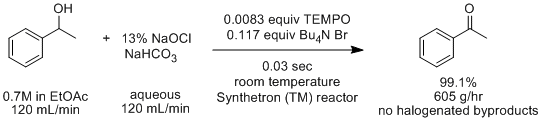
At the ACS Meeting in Philadelphia last month, a poster was presented by a collaboration between KinetiChem Inc., ProTeaf Technologies and Western Kentucky University that described a high throughput process for a PTC oxidation that appears to have a contact time of “0.03 seconds in the reaction zone.”
The reactor was KinetiChem’s Synthetron (TM) film-shear reactor. The catalyst was a mixture of tetrabutylammonium bromide and TEMPO. The oxidizing agent was pH-adjusted bleach. Conversion of 99.1% was achieved with an extremely short residence time.
If your company can benefit from achieving higher process performance in a shorter development time by having access to the best PTC expertise available, now contact Marc Halpern by E-mail to inquire about using phase-transfer catalysis to achieve low-cost high-performance green chemistry.
If you’re not sure if PTC can help your reaction, now fill out the form shown at http://phasetransfer.com/projectform.pdf and send it to Marc Halpern by fax at +1 856-222-1124 or by E-mail of a scanned copy. If we do not have a secrecy agreement already in place, please use “R-groups” instead of the exact chemical structures.