This month’s PTC Catalyst of the Month is not a phase-transfer catalyst but it looks like it could be an amazing chiral phase-transfer catalyst. This compound looks half like a crown ether and half like a Maruoka-type chiral framework. In other words, it looks like a molecule designed by someone who understands that organized binding is where the real power is. When I saw this crown-Maruoka hybrid, it reminded me of the powerful Greek mythology centaur.
The patent, Shibata, T.; Shinkura, S.; Kawahara, N.; Fujioka, Y.; Terada, M. (Daicel Corporation) US 2026/0062375, 05-Mar-2026, is a chromatography patent. It is directed to amine separation, and the examples around this compound describe chiral separation of dl-1-phenylethylamine and related systems.
The crown-ether-like portion of the molecule suggests selective complexation. The rigid chiral aromatic scaffold suggests organized asymmetry. Put those together and you get a recognition element that can discriminate among guests in a highly structured way.
In PTC, we use that kind of thinking all the time, even if we do not always say it explicitly. We think about cavity fit, ion pairing, hydration, steric accessibility, rigidity, and multi-point interaction. We think about how a molecular architecture changes where an ion wants to be, how tightly it is bound, and how selectively it behaves. Crown ethers, PEGs, cryptands, phase-bound systems, and chiral PTC create a microenvironment that controls binding and therefore controls outcome.
This patent is a nice reminder that the same thought process extends beyond PTC.
In the disclosed process, the key difluoromethylation step proceeds via an isolated tetrabutylammonium (TBA) phenolate salt rather than an in situ generated sodium or potassium phenoxide. In the first step, the phenol intermediate is treated with approximately 1.1 equivalents of aqueous tetrabutylammonium hydroxide to form the isolated TBA phenolate which is obtained in 87% yield. This salt is then charged into DMF and reacted with chlorodifluoromethane at 50–55 °C. Under these homogeneous conditions, the desired difluoromethyl ether is formed in 94% isolated yield.
The obvious question is why did the inventors choose to use stoichiometric tetrabutylammonium salt of the phenolate instead of catalytic quat salt, especially since the reaction was performed on a 33 kg scale.
The inventors didn’t address this question directly, but they did report that when difluoromethylation is performed using sodium chlorodifluoroacetate and potassium carbonate in DMF/water, the reported yield drops to 76%. That alternative pathway proceeds via in situ difluorocarbene generation under basic conditions and involves gas evolution and competing side reactions. The 94% yield achieved with the preformed TBA phenolate demonstrates that counterion control and homogeneous reaction conditions significantly enhance efficiency and suppress byproduct formation.
Although not reported, one can envision unit operations for recovering the tetrabutylammonium chloride byproduct from the aqueous phase since the product is isolated by filtration. However, converting the tetrabutylammonium chloride to tetrabutylammonium hydroxide is not a trivial or inexpensive process. It might be possible to form the TBA-phenolate salt from recovered TBA Cl, NaOH and phenol, but this is speculation.
KryptofixTM 2.2.2 been recognized for decades in the PTC community for its exceptional ability to complex potassium ions even more than crown ethers, but its high cost has historically limited its use to only the most demanding applications to produce very expensive products.
A patent application published this month highlights a compelling case where the performance of KryptofixTM 2.2.2 is justified. In the radiolabeling of a PET imaging agent with fluorine-18, a costly and short-lived isotope, KryptofixTM 2.2.2 plays a critical role in forming a reactive [K⁺·F⁻·cryptand] complex. This is achieved by eluting the F-18 isotope with potassium carbonate and KryptofixTM 2.2.2 in acetonitrile/water, followed by drying at 110 deg C for 10 minutes. The substrate is then introduced, and the nucleophilic fluorination proceeds using stoichiometric [K⁺·F⁻·cryptand] complex at 100 deg C for 10-15 minutes.
This application stands out because the synthetic route avoids the formation of hazardous nitrosamines, which is a major consideration in pharmaceutical synthesis.
The resulting F-18 labeled product exhibited a radiochemical purity of 99% even after 10 hours. This reflects both the chemical stability of the labeled product and the appropriateness of KryptofixTM 2.2.2 as the phase transfer agent (not a catalyst) in this sensitive medical application.
While the patent application did not quantify residual moisture after drying, for example via Karl Fischer titration, such data would be helpful in correlating drying efficiency with labeling yield.
This example reinforces the value of KryptofixTM 2.2.2 in specialized, high-value phase-transfer chemistry where its unique capabilities are crucial.
Lin, C.; Chung, T.; Huang, S. (National Cheng Kung University) U.S. Patent Application 2025/0382711, 18-Dec-2025
Even though tetrabutylammonium phosphate is not being used as a phase transfer catalyst in this patent application, we find the following aspects of its use to be interesting. The chemistry involves the electrochemical reduction of 2,5-furandicarboxylic acid at a bismuth or lead cathode in acidic aqueous media, resulting primarily in 2-hydroxyadipic acid, with adipic acid formed under more strongly reducing conditions. This overall reaction is a furan ring opening with hydrogenation in a single electrochemical step, using water as the hydrogen source and avoids molecular hydrogen, high temperature, or precious-metal catalysts, under mild conditions.
Tetrabutylammonium phosphate plays a critical role in this system and appears to suggest some structure–activity relationships. It is speculated that the symmetric tetrabutylammonium cation, with four equivalent C4 alkyl groups, is particularly effective at organizing the electrochemical double layer at the cathode surface. Compared with non-symmetric quaternary ammonium ions such as tributylmethylammonium, the fully symmetric cation packs more uniformly and reproducibly at the metal–electrolyte interface. This improved interfacial ordering appears to promote productive adsorption and activation of 2,5-furandicarboxylic acid while suppressing competing pathways such as unselective hydrogen evolution.
The choice of phosphate as the counterion also appears to be an important choice. Halide-containing quaternary ammonium salts, especially bromides and chlorides, are known in electrochemistry to engage in specific anion adsorption, perturb surface electronic structure, and in some cases accelerate corrosion or surface reconstruction of metal electrodes. In contrast, phosphate and dihydrogen phosphate are comparatively non-aggressive anions under acidic cathodic conditions. Their use minimizes halide-induced surface poisoning and may contribute to improved electrode stability, particularly for bismuth and lead surfaces that are sensitive to halogen chemistry.
The other quat salts shown in the graph are tetrapentylammonium bromide and tetraethylammonium perchlorate. It is not clear why these quat salts were chosen. Tetrapentylammonium bromide appears to give similar results to tetrabutylammonium phosphate (see graph), but we might be concerned about electrode corrosion.
While I have been focusing on structure-activity relationships for quat salts in PTC systems for 49 years, I am always curious to see structure-activity relationships for quat salts in non-PTC systems. When the use of several quat salts in electrochemical systems gives different results for different quat salts, I like to understand if there is any learning value or insight that might affect the way I choose quat salts for synthetic applications.
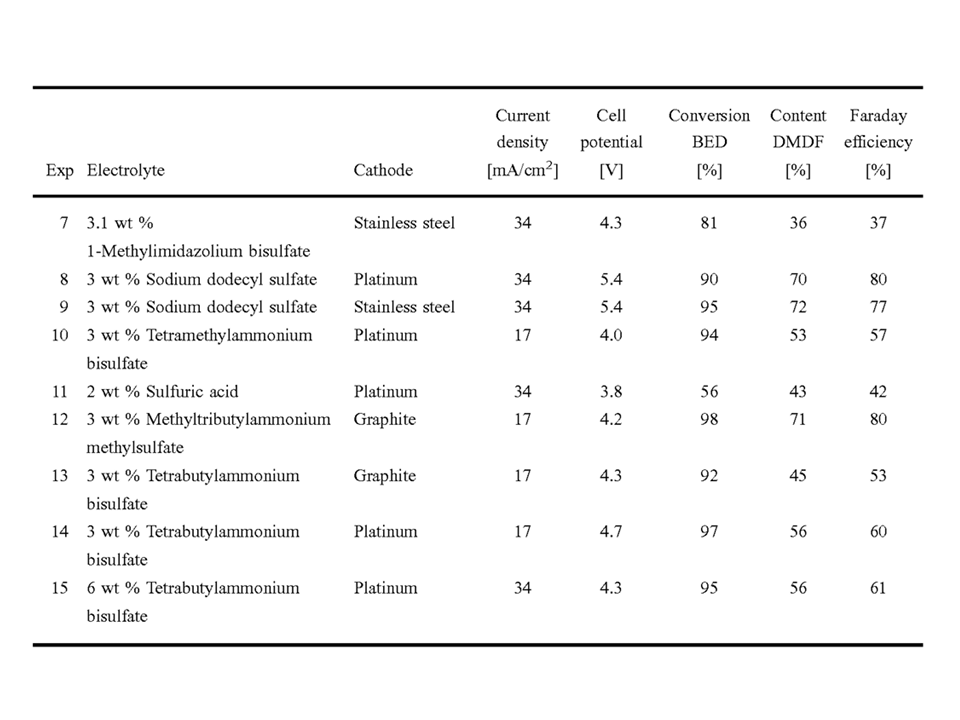 When quat salts appear in the patent literature, they are mostly as phase-transfer catalysts. There are other applications, such as in toners, as electrolytes in specialty batteries with organic solvents and in a variety of other applications. One of the rarer applications of quat salts is as an electrolyte for electrochemical oxidations for organic synthesis.
The diagram shows a useful electrochemical oxidation. The substrate is butene-1,4-diol, and the product is 2,5-dimethoxy-2,5-dihydrofuran (DMDF). The oxidation is performed under mild conditions and uses methanol as solvent (and reactant), graphite anode, a flow-through electrochemical cell that feeds the substrate vertically from the bottom flowing to the top at a rate of 50 mL/min and is performed at room temperature for 90 minutes.
Several quaternary ammonium salts were used as electrolytes and what caught my eye was the fact that the performance of the various quat salts were different, even though other factors were also being changed, so it wouldn’t be fair to try to derive firm conclusions for structure-activity relationships. Structure-activity performance of quats has always been my focus since the late 1970’s.
What I can’t explain (and would like to request your input) is why some of these quats work so well, while others, not so much.
When methyl tributyl ammonium outperforms tetrabutylammonium in classical PTC applications, that usually indicates a “T-reaction.” However, this application is not PTC, it’s an electrochemical oxidation.
Using the same cathode and the same current density, methyltributyl ammonium delivers higher selectivity and higher Faraday efficiency than tetrabutylammonium. While there is a difference in the quat cation, I do not pretend to understand the difference in performance.
Maybe one of our readers has expertise in electrochemistry and can provide some insight about why we see these differences in activity. Is it ion-pairing, local viscosity effects, specific adsorption at the electrode? I have no clue.
I also can’t say that I understand the actual organic reaction, in particular, where does the methoxy group come from in DMDF? Is it possible that under anodic conditions, methanol can form methoxy radicals (·OCH₃) or methoxide ions, which then attack oxidized forms of the diol?
It will be fun to see what our audience comes up with to explain these results.
Many thanks to Dr. Peter G. M. Wuts, the world-renowned author and expert in organic synthesis (click here for Wuts Chemical Consulting) for suggesting that we share with the PTC community the excellent review article “Advances in Combined Asymmetric Catalysis of Transition Metal/Phase-Transfer Catalysts” by Yi-Fan Dong, Si-Ru Wang, Zhi-Yong Han, Xiang Wu, Eur. J. Org. Chem. 2025, 28, e202401088.
This review highlights recent advances in the cooperative use of chiral phase-transfer catalysts (PTCs) with transition metal catalysis, an area that has matured significantly over the past two decades. The authors outline how this dual catalytic strategy enables reactivity and stereoselectivity that are often unachievable with either catalyst class alone. Central to this approach is the ability of chiral PTCs, particularly quaternary ammonium and phosphonium salts, to control ion-pairing environments and mediate phase transfer, while transition metals catalyze bond-forming steps. This synergy has proven particularly effective in asymmetric allylic alkylations and related transformations.
The article organizes its discussion around catalyst pairings, with detailed examples involving Pd, Ir, and Ag complexes combined with both cationic and anionic PTCs. Early breakthroughs using cinchona-derived ammonium salts with Pd catalysis established a precedent for enantioselective ion-pair-driven allylations. Further innovations included chiral phosphate-based anionic PTC’s that enabled stereocontrolled arylations and Heck-type reactions, as well as hybrid systems where ion-pairing is integrated directly into ligand design. These diverse systems demonstrate the growing sophistication and versatility of metal/PTC catalysis in complex asymmetric synthesis.
While the majority of current systems rely on precious metals, the authors note the potential for future development using more earth-abundant metals such as nickel and cobalt. Overall, this review serves as a comprehensive resource for understanding the mechanistic logic, structural design, and synthetic potential of combined PTC/transition metal catalysis and underscores the broad utility of this approach in pushing the boundaries of asymmetric methodology.
We highly recommend reading this excellent review article!
The use of triethyl benzyl ammonium (TEBA) chloride was reported for the reaction shown in the diagram.
The reaction was between methacrylic acid and glycidyl methacrylate that ring-opened the epoxide followed by esterification to produce glycerol dimethacrylate that contains very low levels of residual glycidyl methacrylate that is toxic.
Historically, it is known that the halide of a quat halide can initiate the ring opening of an epoxide to form a halohydrin intermediate, then the halide can serve as a leaving group when a nucleophile is present. The use of quat chloride to ring-open an epoxide is known for etherification with alcohols.
In the reaction between methacrylic acid and glycidyl methacrylate (GMA), the methacrylic acid is a very weak nucleophile unless a base is present to neutralize the carboxylic acid. In this case, it is desired to avoid the presence of base due to a variety of potential side reactions.
Accordingly, one may speculate that the quat chloride reacts with GMA forms the chlorohydrin and then the hydroxyl of the neutral carboxylic acid attacks the chlorohydrin to perform the esterification to produce glycerol dimethacrylate. Perhaps the weak nucleophilicity of the neutral methacrylic acid is strong enough to perform this attack at the elevated temperature of 97-100 deg C for 10 hours.
The choice of TEBA as the quat is questionable since this quat is not very stable at 100 deg C for many hours in the presence of nucleophiles. The same temperature that is apparently required to activate the nucleophilicity of the neutral carboxylic acid, may undesirably cause the attack of the methacrylic acid on the benzyl group of benzyl triethylammonium chloride that would produce benzyl methacrylate and triethyl amine as the leaving group.
This is one reason that at PTC Organics we avoid the use of benzylated quats in industrial commercial PTC applications, especially TEBA since benzylation of the nucleophile is often observed and constitutes an undesired impurity. We would choose more stable quat chloride that do not contain a benzyl group (or an allyl group) since they are labile, especially at higher temperatures such as 100 deg C over many hours.
In my early days using PTC in the 1970’s, I learned the hard way that TEBA chloride causes benzylated impurities even though this phase-transfer catalyst with a q-value of about 1.6 is excellent to promote the reactivity of PTC T-Reactions.
If your company is using benzylated quats, especially TEBA, in commercial processes, you should actively look for benzylated byproducts. If you find them, now contact Marc Halpern of PTC Organics for consulting on the best alternatives for TEBA for your specific application.
Quat phosphotungstates and oxophosphotungstates are useful in many PTC oxidations and PTC epoxidations. They are often formed by mixing sodium tungstate, quat salt and phosphoric acid simultaneously. Sometimes the three components are added stepwise. When the phosphoric acid is added last, quat tungstates are formed as intermediates.
A procedure was published this month in Wang, D.; Yuan, Y.; Zhang, Y. (The Trustees of Boston College), US Patent Application Publication 2025/0223244, 10-Jul-2025, that provided insight into quat tungstates that are formed when mixing a quat salt with sodium tungstate.
When sodium tungstate was mixed with tetrabutylammonium bromide in water in a molar ratio of 2.0:1.0, then acidified to pH 2 with concentrated HCl, the inventors reported that tetrabutylammonium decatungstate was formed. The quat-tungstate was characterized by UV to identify the decatungstate anion. The stoichiometry of the quat to tungsten ratio was not discussed.
The same procedure was performed using tetraphenyl phosphonium bromide except they used 2.78 moles tungstate per mole of phosphonium salt.
I have looked at a lot of literature that describes the stoichiometry between quat, tungsten, oxygen in polyoxometallates, with and without phosphorus. The motivation has always been to attempt to help understand certain aspects of PTC oxidations and epoxidations using quat-based polyoxometallates. Other than cases in which x-ray crystallography can be used to characterize the structures of these polyoxometallates, it is my impression that the structures and even atom ratios are conjecture. I am not an inorganic chemist so maybe my understanding of known information is incorrect. This report of the synthesis of quat decatungstate adds just a bit to my understanding of these systems.
The ionic liquids, tetraethylammonium imidazolate, tetrabutylammonium imidazolate and decyl trimethyl ammonium imidazolate were prepared in high yield by a simple procedure that mixed the quat chloride with 1.0 equivalent of sodium imidazolate in water, stirred at r.t. for 2 hours, dried and treated with ethanol.
Following is the procedure described in Jung; I., Pyun; L., Min; B., Lee; J., Jeong; J. (SK Innovation Co.) US Patent Application Publication 2025/0153143, 15-May-2025
4.60 g (27.8 mmol) of tetraethylammonium chloride, 2.50 g (27.8 mmol) of sodium imidazolate, and 10 mL of distilled water were added to 100 mL of RBF, and the solution was stirred at room temperature for 2 hours and dried under vacuum at 50° C. for 5 hours. Next, 20 mL of ethanol was added thereto, the solution was stirred at room temperature for 2 hours to produce a white solid, which was then removed, and the filtrate was dried under vacuum at 50° C. for 15 hours to obtain 5.1 g (93%) of a highly viscous yellow liquid.
Another reminder was reported this month that described how easy it is to form quat salts with organic anions.
In this case, an organic N-sulfate salt dissolved in water was first produced by reacting the hydroxyl amine shown in the diagram with a pyridine-sulfur trioxide complex in methylene chloride, then was treated with aqueous sodium bicarbonate.
The aqueous solution of the salt was contacted with an organic solution of tetrabutylammonium hydrogen sulfate in chloroform (not our first choice for an industrial process) and was stirred for 10 minutes. Finally, “the resulting organic layer was dried over anhydrous sodium sulfate, filtered, and then concentrated under reduced pressure to afford the product (yield 91%).”
As we teach in the 2-day course “Industrial Phase-Transfer Catalysis,” tetrabutylammonium hydrogen sulfate is often used to exchange anions since sulfate, formed from the hydrogen sulfate under basic conditions, is a dianion that is disfavored for pairing with the tetrabutylammonium cation. In this case, the anion to be paired with the quat, has 13 carbon atoms and therefore has a much higher affinity to the quat than the inorganic sulfate dianion.
In any case, liquid-liquid ion exchange of the anion paired with the quat cation is very often a simple procedure to execute and yield are high…when the anion desired to be paired with the quat at the end is more organophilic than the anion that is being replaced.