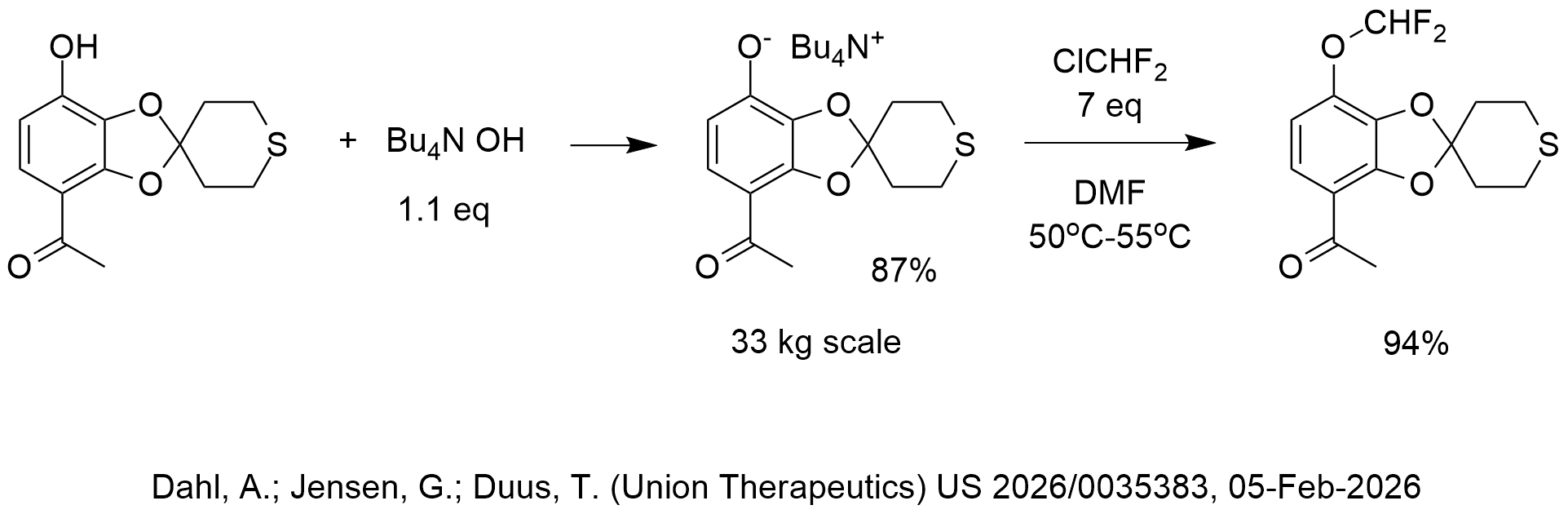
In the disclosed process, the key difluoromethylation step proceeds via an isolated tetrabutylammonium (TBA) phenolate salt rather than an in situ generated sodium or potassium phenoxide. In the first step, the phenol intermediate is treated with approximately 1.1 equivalents of aqueous tetrabutylammonium hydroxide to form the isolated TBA phenolate which is obtained in 87% yield. This salt is then charged into DMF and reacted with chlorodifluoromethane at 50–55 °C. Under these homogeneous conditions, the desired difluoromethyl ether is formed in 94% isolated yield.
The obvious question is why did the inventors choose to use stoichiometric tetrabutylammonium salt of the phenolate instead of catalytic quat salt, especially since the reaction was performed on a 33 kg scale.
The inventors didn’t address this question directly, but they did report that when difluoromethylation is performed using sodium chlorodifluoroacetate and potassium carbonate in DMF/water, the reported yield drops to 76%. That alternative pathway proceeds via in situ difluorocarbene generation under basic conditions and involves gas evolution and competing side reactions. The 94% yield achieved with the preformed TBA phenolate demonstrates that counterion control and homogeneous reaction conditions significantly enhance efficiency and suppress byproduct formation.
Although not reported, one can envision unit operations for recovering the tetrabutylammonium chloride byproduct from the aqueous phase since the product is isolated by filtration. However, converting the tetrabutylammonium chloride to tetrabutylammonium hydroxide is not a trivial or inexpensive process. It might be possible to form the TBA-phenolate salt from recovered TBA Cl, NaOH and phenol, but this is speculation.
About Marc Halpern

Dr. Halpern is founder and president of PTC Organics, Inc., the only company dedicated exclusively to developing low-cost high-performance green chemistry processes for the manufacture of organic chemicals using Phase Transfer Catalysis. Dr. Halpern has innovated PTC breakthroughs for pharmaceuticals, agrochemicals, petrochemicals, monomers, polymers, flavors & fragrances, dyes & pigments and solvents. Dr. Halpern has provided PTC services on-site at more than 260 industrial process R&D departments in 37 countries and has helped chemical companies save > $200 million. Dr. Halpern co-authored five books including the best-selling “Phase-Transfer Catalysis: Fundamentals, Applications and Industrial Perspectives” and has presented the 2-day course “Practical Phase-Transfer Catalysis” at 50 locations in the US, Europe and Asia.
Dr. Halpern founded the journal “Industrial Phase-Transfer Catalysis” and “The PTC Tip of the Month” enjoyed by 2,100 qualified subscribers, now beyond 130 issues. In 2014, Dr. Halpern is celebrating his 30th year in the chemical industry, including serving as a process chemist at Dow Chemical, a supervisor of process chemistry at ICI, Director of R&D at Sybron Chemicals and founder and president of PTC Organics Inc. (15 years) and PTC Communications Inc. (20 years). Dr. Halpern also co-founded PTC Interface Inc. in 1989 and PTC Value Recovery Inc. in 1999. His academic breakthroughs include the PTC pKa Guidelines, the q-value for quat accessibility and he has achieved industrial PTC breakthroughs for a dozen strong base reactions as well as esterifications, transesterifications, epoxidations and chloromethylations plus contributed to more than 100 other industrial PTC process development projects.
Dr. Halpern has dedicated his adult life to his family and to phase-transfer catalysis (in that order!).