

The 60-Second PTC Test for Low-Cost, High-Performance Green Chemistry
Summary
How can you quickly determine whether an existing process, or a process under development, could benefit from phase-transfer catalysis and potentially deliver 10 to 30% cost reduction?
The first screen is surprisingly simple. A process should be considered a candidate for phase-transfer catalysis if it meets two criteria. First, the process requires one or more performance improvements that phase-transfer catalysis is capable of providing. Second, the chemistry falls within the scope of reaction categories that are commonly amenable to phase-transfer catalysis.
If a process meets both criteria, it deserves serious consideration as a PTC candidate.
This does not mean that PTC will definitely work. It means that the opportunity is strong enough to justify a more detailed technical evaluation and, in many cases, investment of R&D resources that may provide a substantial return through lower cost of manufacture, higher productivity, improved selectivity, reduced waste, safer operation, or simplified workup.
Chemical manufacturers are under continuous pressure to reduce cost of manufacture, improve productivity, reduce waste, simplify operations, and get more value from both R&D and plant assets. A process improvement does not have to be exotic to be valuable. A modest improvement in yield, cycle time, reagent charge, solvent handling, reaction selectivity, or workup can have a significant economic impact when applied to a commercial or late-stage development process.
The purpose of the 60-Second PTC Test is to help process chemists, plant support chemists, process engineers, and technical managers quickly identify reactions where phase-transfer catalysis may provide meaningful cost reduction and process performance improvement.
Why This Test Is Needed
Many companies do not miss PTC opportunities because PTC was evaluated and rejected. They miss PTC opportunities because PTC was never seriously considered.
This happens frequently when a process is already “acceptable.” The reaction works. The product can be made. The plant can run. The development group has moved on. However, acceptable is not the same as optimized. At commercial scale, the difference between an acceptable process and a more highly optimized process can be economically significant, sometimes representing hundreds of thousands or even millions of dollars in annual value.
Many existing and developing processes still operate with lower yield than desired, excessive reaction time, excess reactants, expensive or hazardous strong bases, difficult solvent systems, avoidable waste streams, reaction selectivity limitations, difficult workups, or limited reactor productivity. In many cases, these limitations are not fundamental. They may simply reflect the fact that the reaction was never properly evaluated under PTC conditions.
The 60-Second PTC Test provides a fast way to identify those opportunities.
The 60-Second Phase-Transfer Catalysis Test
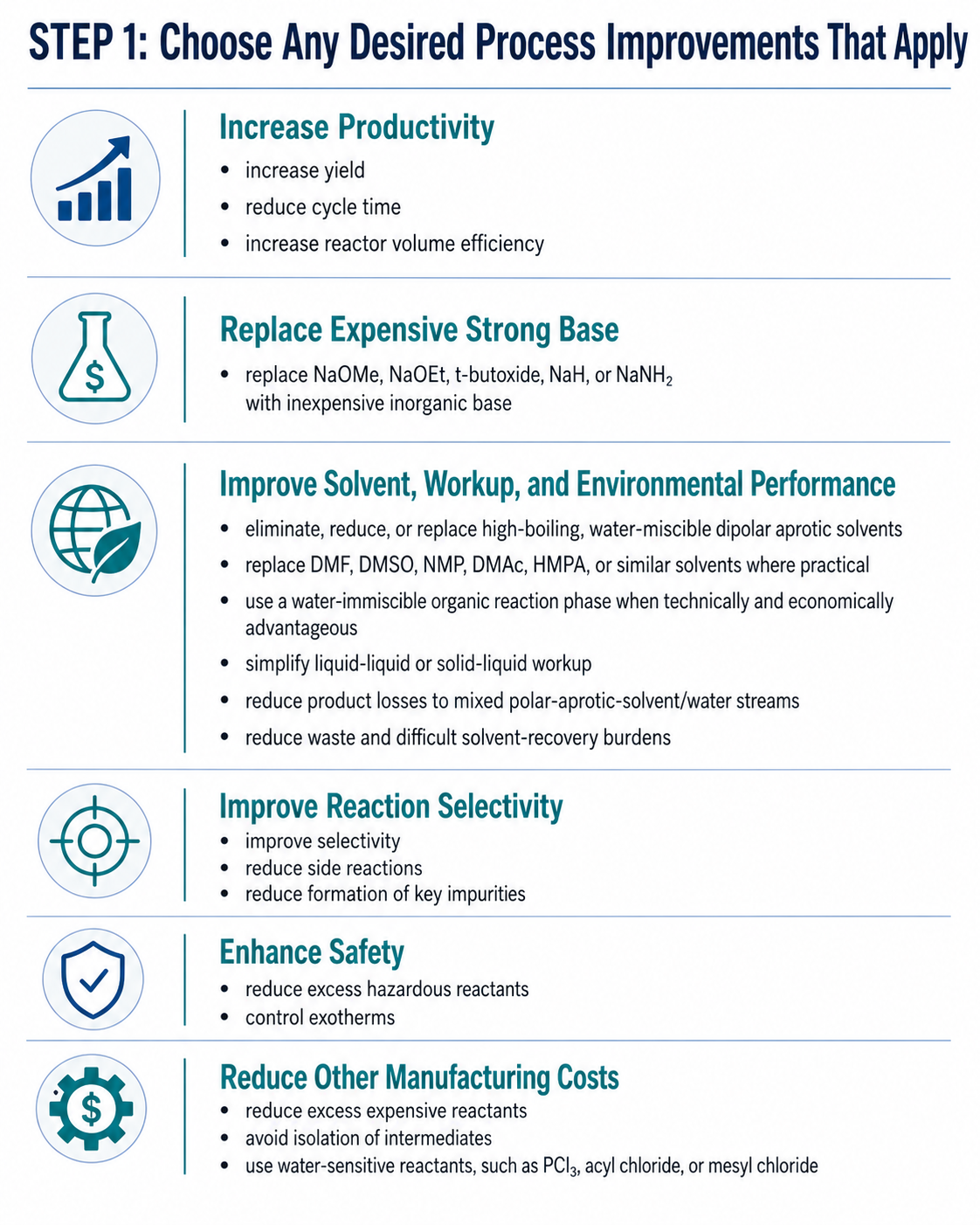
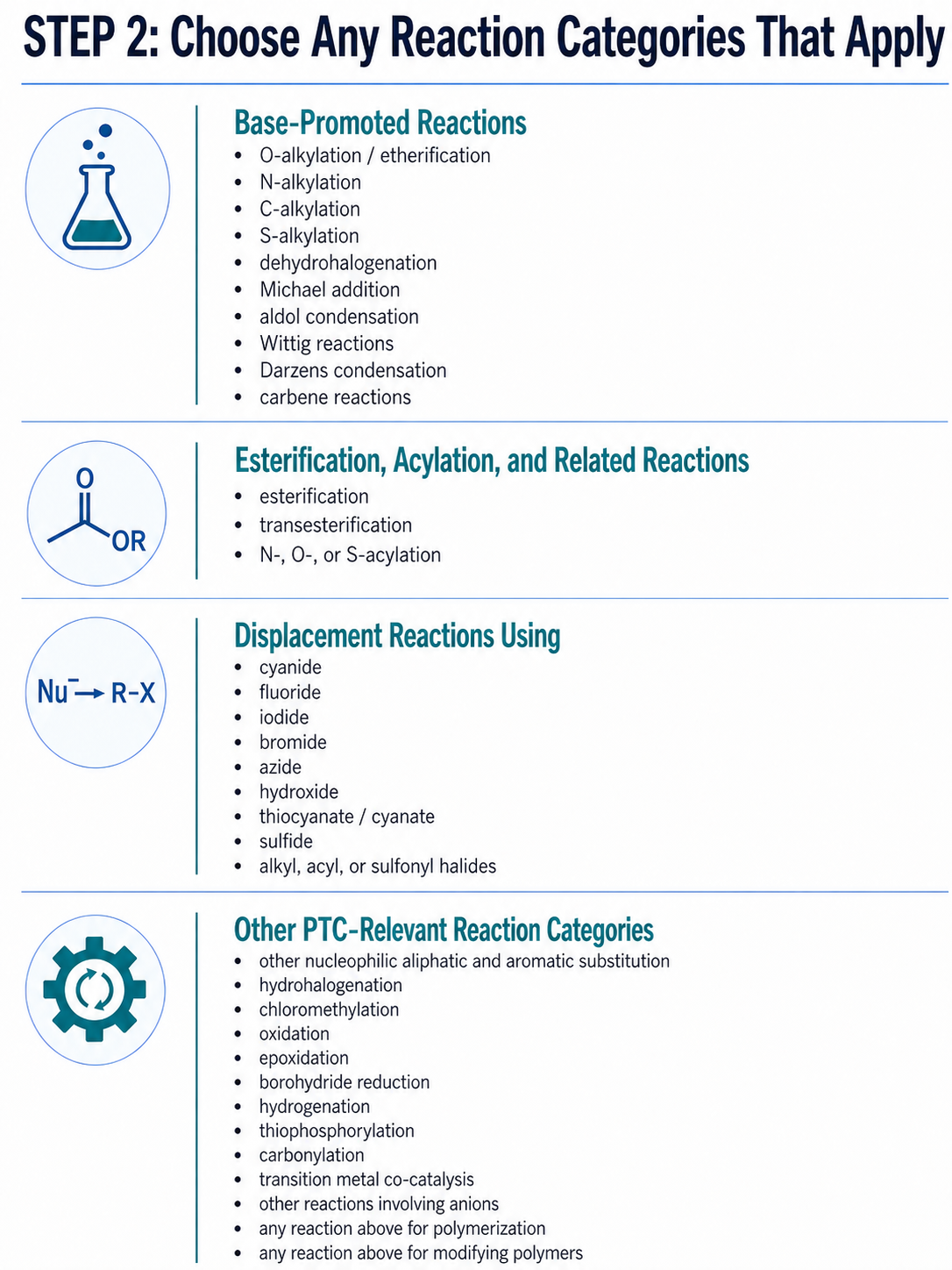
Here is the very simple test! Does your existing plant process, or process in development, meet one or more of the criteria in Step 1? If so, does your existing plant process, or process in development, meet one or more of the criteria in Step 2?
What should you do right now in the next 60 seconds?
Think of the process that you are developing right now or are supporting in production right now. Then read the list of benefits in Step 1 and the list of reactions in Step 2. That should take you 60 seconds or less. Very simply put, if your process would benefit from any of the performance improvements in Step 1 and involves a reaction listed in Step 2, then phase-transfer catalysis should be considered as a process improvement option.
Then go to Step 3 to interpret the result.
STEP 3: Interpret the Result
If your new or existing process could benefit from at least one desired process improvement listed in Step 1, and includes at least one reaction listed in Step 2, then the process should be treated as a serious candidate for phase-transfer catalysis evaluation.
This does not mean that PTC will definitely work. It means that the reaction has the right combination of process need, reaction type, and potential economic value to justify further technical evaluation.
The practical question is not whether PTC can improve every reaction. It cannot. The practical question is whether this specific reaction has a high, medium, or low probability of achieving specific process targets using PTC.
That is the question to be answered next.
The 60-Second PTC Test is a screening tool. It provides a practical way to identify reactions where PTC evaluation is technically justified. That is valuable because many companies never reach that point. They do not reject PTC after proper evaluation. They miss the opportunity because PTC is never seriously considered.
Why Step 1 Is Not a Gimmick
Some chemists may look at Step 1 and say, “Of course we want increased yield, reduced cycle time, better selectivity, lower solvent use, safer conditions, and lower manufacturing cost. Everyone wants those things.”
That is exactly the point.
Step 1 is not a gimmick. It identifies the process performance improvements that often create the economic justification for evaluating PTC. The relevant question is not whether these improvements are desirable. They obviously are. The relevant question is whether phase-transfer catalysis is a practical way to achieve one or more of these improvements in a specific reaction.
In many cases, PTC can provide process benefits by changing the reaction environment rather than merely adjusting temperature, concentration, solvent, or reaction time within the same conventional process framework. For example, PTC may enable the use of inexpensive inorganic bases such as NaOH or K₂CO₃ instead of more expensive or hazardous strong bases. It may reduce reagent excess, improve reaction selectivity, suppress side reactions, shorten cycle time, or reduce waste.
PTC can also improve the practical process aspects surrounding the reaction. When the product remains in a water-immiscible organic phase and inorganic salts remain in an aqueous phase or as separable solids, the workup can often be simplified. This can be especially valuable when PTC allows replacement of high-boiling, water-miscible polar aprotic solvents such as DMF, DMSO, NMP, DMAc, or HMPA with solvents that are less expensive, much easier to recover and often don’t need special processing such as drying. The opportunity is to avoid difficult polar-aprotic-solvent/water systems when a practical two-phase or multiphase PTC process can deliver better reaction and process performance.
Each of these improvements can be economically meaningful. Several of them occurring together can be decisive.
Why Step 2 Is Not a Gimmick
Step 2 is also not a gimmick. It is a practical list of reaction categories where PTC has repeatedly shown value in industrial organic chemistry and polymer chemistry.
Step 2 does not claim that all organic chemistry is suitable for PTC. Most organic reactions are not amenable to PTC improvement. But the list of reactions in Step 2 represents thousands of reactions that are commonly performed in many organic chemical industries including pharmaceuticals, agricultural chemicals, flavor & fragrances, monomers, polymers and a wide variety of commodity, specialty and fine organic chemicals.
PTC is most powerful when the reaction involves anions, nucleophiles, base-promoted transformations, ion pairs, reactions across phase boundaries, poorly soluble inorganic reagents, opportunities to replace strong base with inorganic base, or reaction systems where phase behavior can be used advantageously.
This is why Step 2 is so useful. It allows the process chemist to quickly recognize whether the current reaction belongs to a family of reactions where PTC should at least be considered.
From the 60-Second Test to a PTC Process Opportunity Screening
If a reaction passes the 60-Second PTC Test, the next step is to determine whether PTC has a high, medium, or low probability of achieving the specific process target. This is done by submitting your opportunity to Marc Halpern of PTC Organics Inc. who has five decades of experience in PTC, of which more than four decades are in industrial PTC.
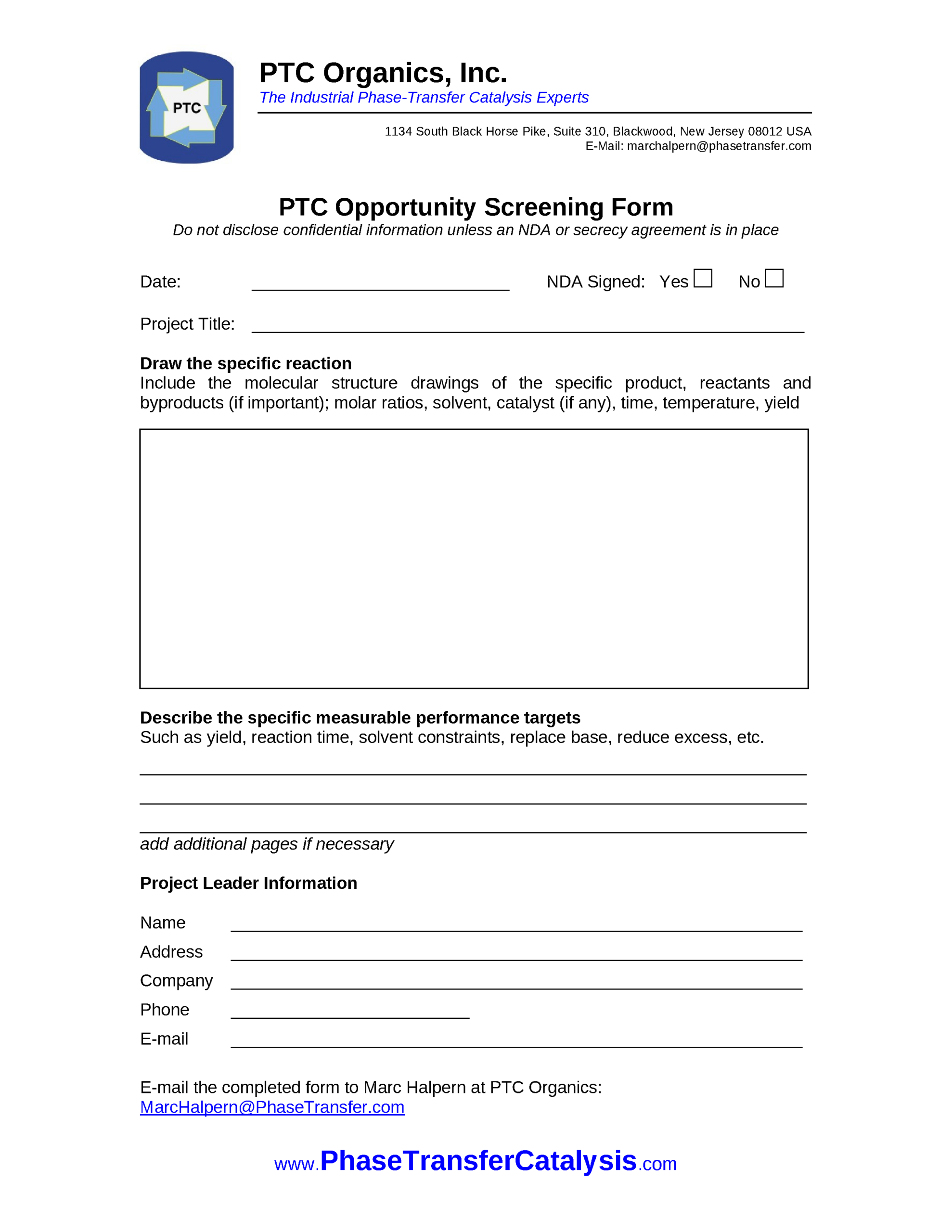
The estimate of probability-of-success for an opportunity requires more than a generic reaction category. For a meaningful estimate, PTC Organics usually needs to review the actual substrate structure, actual product structure, current reagents and molar ratios, solvent, base, catalyst if any, reaction time, temperature, yield, key impurities or side reactions, workup or isolation issues, current process limitations, and specific measurable performance targets.
In most cases, the identities of the actual molecules are crucial and “R-groups” are not specific enough to estimate a probability of success. Generic functional group descriptions may be useful for very preliminary discussion, but they are usually not sufficient for a reasonable probability-of-success estimate.
For that reason, if the reaction is confidential, the appropriate first step is to request an NDA.
Do not submit proprietary information unless an NDA is already in place.
Free Initial PTC Probability-of-Success Screen
How the Screen Improves Process R&D Efficiency
For process R&D managers, the value of the PTC Process Opportunity Screening Form is not limited to identifying good PTC candidates. It can also improve R&D efficiency by helping teams decide which opportunities deserve laboratory resources and which do not.
A process R&D group may have many possible reactions that could theoretically be evaluated using PTC. However, not every opportunity deserves the same level of effort. Some reactions may have a high probability of achieving a valuable performance target. Others may have only a low probability of success, or the possible economic benefit may not justify the required development work.
A PTC probability-of-success screen can help a technical team prioritize projects before investing weeks or months of laboratory effort. In some cases, one day of expert review can help a company sort through many possible PTC opportunities and decide which projects deserve immediate attention, which should be deferred, and which should not be pursued.
That is one of the practical benefits of the 60-Second PTC Test and the PTC Process Opportunity Screening Form. They help convert a long list of possible process improvement ideas into a more focused set of PTC candidates for internal technical and economic review.
PTC Organics offers one free initial PTC probability-of-success screen per company for qualified submissions.
The most useful submissions define the desired improvement numerically, such as:
- increasing yield from 85% to at least 92%
- reducing reaction time from 48 hours to 24 hours
- reducing reaction time from 48 hours to less than one 8-hour shift
- replacing NaH with NaOH or K₂CO₃
- reducing excess alkylating agent from 2.0 equivalents to 1.2 equivalents
- replacing DMF, DMSO, NMP, DMAc, or HMPA with a more practical solvent where technically feasible
- reducing a specific impurity from 4% to below 1%
- improving selectivity from 85:15 to at least 95:5
- avoiding isolation of an intermediate
Vague targets such as “increase yield,” “reduce cycle time,” “reduce cost,” “make the process greener,” or “as much as possible” are not sufficient for a meaningful probability-of-success estimate, because different targets can have very different probabilities of success.
The purpose of the initial screen is to answer one practical question:
Does this reaction justify further PTC evaluation for the specific performance target provided?
The free initial screen does not include a full development plan, literature review, patent analysis, experimental program, process safety review, or guarantee of commercial success. Those items may be addressed in a paid consulting engagement if the opportunity warrants further work.
At the same time, the decision whether to pursue, defer, or reject any PTC opportunity remains entirely the responsibility of the company’s management. The free initial PTC probability-of-success screen is an aid to internal decision-making. It is not a recommendation to proceed, not a substitute for the company’s own technical, safety, regulatory, economic, intellectual property, and management review, and not a guarantee that any specific performance target will be achieved.
That said, the free initial screen can be valuable when deciding whether or not to invest constrained process R&D resources to evaluate the PTC process option. Think of the fully absorbed cost of one month of process R&D. Compared with that cost, the time required to complete a PTC Process Opportunity Screening Form is small. If a free initial probability-of-success screen helps you avoid a low-probability project or identify a high-probability PTC opportunity, it could be a costly mistake not to take advantage of it.
Why Specific Performance Targets Are Essential
The estimate of probability of success is not meaningful unless the target is specific.
For example, suppose a process currently gives an 85% yield. The question “Can PTC increase the yield?” is not specific enough. A more useful question is: “What is the probability that PTC can increase isolated yield from 85% to at least 92% while reducing formation of a key impurity?”
That is a real process target.
It is also very different from asking whether PTC can increase yield from 85% to 99%. The first target of 92% yield may have a high or medium probability of success. The second target of 99% may have a much lower probability of success for the same reaction.
The same logic applies to reaction time. If a reaction currently requires 48 hours, the statement “We want to reduce reaction time as much as possible” is not sufficient. More useful targets would be:
- reduce reaction time from 48 hours to 24 hours
- reduce reaction time from 48 hours to less than one 8-hour shift
- reduce reaction time from 48 hours to 48 minutes
These are completely different technical objectives. The probability of success may be high for the first, medium for the second, and low for the third.
The performance target must be defined before the probability of success can be estimated.
This discipline is important because companies do not need theoretical improvement. They need improvements that justify action. A yield increase from 85% to 92% may be economically compelling. A reaction time reduction from 48 hours to 24 hours may remove a plant bottleneck. Replacing NaH with NaOH or K₂CO₃ may reduce cost, simplify handling, and improve safety. Replacing DMF with a water-immiscible solvent may simplify workup and reduce solvent-recovery burden.
These are not vague goals. They are measurable process targets.
PTC Process Opportunity Screening Form
Guidelines for Specific Measurable Performance Targets
Following are guidelines to help you define each desired improvement numerically.
Do not write only “increase yield,” “reduce cycle time,” “reduce cost,” or “improve selectivity.” Define the target. As you define the specific performance targets, first determine the minimum improvement that would justify additional development or process change.
Examples of acceptable targets:
- increase yield from _______% to at least _______%
- reduce reaction time from _______ hours to _______ hours
- reduce excess reagent from _______ equivalents to _______ equivalents
- replace __________________ base with __________________
- replace __________________ solvent with __________________
- reduce impurity __________________ from _______% to below _______%
- improve selectivity from : to at least :
- eliminate isolation of intermediate __________________
- reduce the number of workup unit operations from _______ to _______
- increase reactor volume productivity from __________________ to __________________
Optional but useful questions to answer internally within your company:
- What is the expected future production volume?
- What is the current plant bottleneck?
- What is the estimated value of yield improvement?
- What is the estimated value of cycle-time reduction?
- What is the development timeline?
- What is the commercial launch timeline?
- Is this an existing plant process, late-stage development process, or early development route?
Call to Action: Submit a PTC Process Opportunity Screening Form
If your process meets both criteria in the 60-Second PTC Test, the next step is to request an NDA and submit a PTC Process Opportunity Screening Form.
The most useful submissions include actual structures, current process conditions, key limitations, and specific measurable performance targets.
PTC Organics will provide one free initial high / medium / low probability-of-success screen per company for qualified submissions. The purpose of this screen is to help determine whether your reaction deserves further PTC evaluation for the specific process target you define.
If the probability of success is high, and the economic impact is meaningful, then further PTC evaluation may be justified by your company. If the probability of success is low, then the screen may help avoid wasting R&D resources. If the probability of success is medium, then the decision may depend on the size of the potential economic benefit and the strategic importance of the process.
The purpose of this screen is to help determine whether your reaction deserves further PTC evaluation for the specific process target you define. For technical managers, it can also help prioritize constrained process R&D resources by identifying which opportunities have the best combination of probability of success and potential economic value. This form aids, but does not replace, the process R&D manager’s economic screening decision.
Conclusion
The 60-Second PTC Test is a simple tool, but it addresses a serious problem.
Many companies do not miss PTC opportunities because PTC was evaluated and rejected. They miss PTC opportunities because PTC was never properly considered.
If a process needs improved yield, shorter cycle time, lower reagent excess, replacement of strong base, improved selectivity, reduced side reactions, solvent replacement, waste reduction, simpler workup, avoidance of intermediate isolation, or higher productivity AND the reaction belongs to one of the reaction classes where PTC is commonly effective, then the process should be evaluated as a PTC candidate.
For cost-constrained chemical manufacturers, this is not merely an academic exercise.
A properly selected PTC opportunity can reduce cost, improve performance, simplify operations, and increase the value of existing chemical manufacturing assets.
The purpose of the 60-Second PTC Test is not to guarantee success.
The purpose is to identify reactions where the probability of success may be high enough to justify further evaluation.
That is often where major cost-reduction opportunities begin.
Did you already take the 60-Second PTC Test for your current process in development or in production?