Tetrabutylammonium nitrate-trifluoroacetic anhydride, TBAN-TFAA, is a known nitrating agent for addition of NO2 to double bonds (J. Org. Chem., 2013, 78, 8442) and aromatic rings (Fieser and Fieser Reagents for Organic Synthesis, 2006).
 A patent was issued last week (US Patent 10,028,962) that used TBAN-TFAA for the nitration 3-methylpyridine-2-carbonitrile that used 1.10 equiv TBAN and 1.12 equiv TFAA. This was a small scale reaction.
If this reaction would be considered for large scale, it may be worthwhile to consider using catalytic tetrabutylammonium salt (with a non-nucleophilic anion) and sodium nitrate in order to save the cost of the tetrabutylammonium salt. If any of you are aware if this has been tried and can disclose, please contact Marc Halpern of PTC Organics.
Tetrabutylammonium nitrate is made by ion exchange from an alkali nitrate with tetrabutylammonium chloride, bromide or hydrogen sulfate. Each of these quat salts has advantages and disadvantages from the standpoint of cost and thermodynamics, but the ion exchange unit operation costs money in all cases. A possible way to save money for a nitration using TBAN-TFAA would be to use a catalytic amount of tetrabutylammonium hydrogen sulfate and neutralize the proton with a non-aqueous base, then add stoichiometric sodium nitrate to the reaction (maybe potassium nitrate if the sodium salt doesn’t work due to lattice energy/structure).
As we teach in our 2-day course “Industrial Phase-Transfer Catalysis”, the affinity of a quaternary ammonium cation toward nitrate is about 1,000 times greater than for sulfate. That means that if we used, for example, 1 mole% tetrabutylammonium “sulfate” (neutralized hydrogen sulfate) and 1.1 equiv alkali metal nitrate, most of the tetrabutylammonium salt would be paired with nitrate and not with sulfate, even if the molar ratio of nitrate to sulfate were reversed at 1:100.
This is the basis for our speculation that the use of catalytic tetrabutylammonium hydrogen sulfate with just enough non-aqueous base to neutralize the proton (that will generate non-nucleophilic sulfate), plus the use of stoichiometric inorganic nitrate (with a cation that enables the nitrate anion to be physically available to the quat cation) has a good chance of forming tetrabutylammonium nitrate in situ under conditions that may not interfere with the trifluoroacetic anhydride.
If your company is continuously seeking ways to save money in commercial processes, now contact Marc Halpern of PTC Organics to explore opportunities to leverage highly specialized expertise in industrial phase-transfer catalysis with your internal company expertise to achieve low-cost high-performance green chemistry.
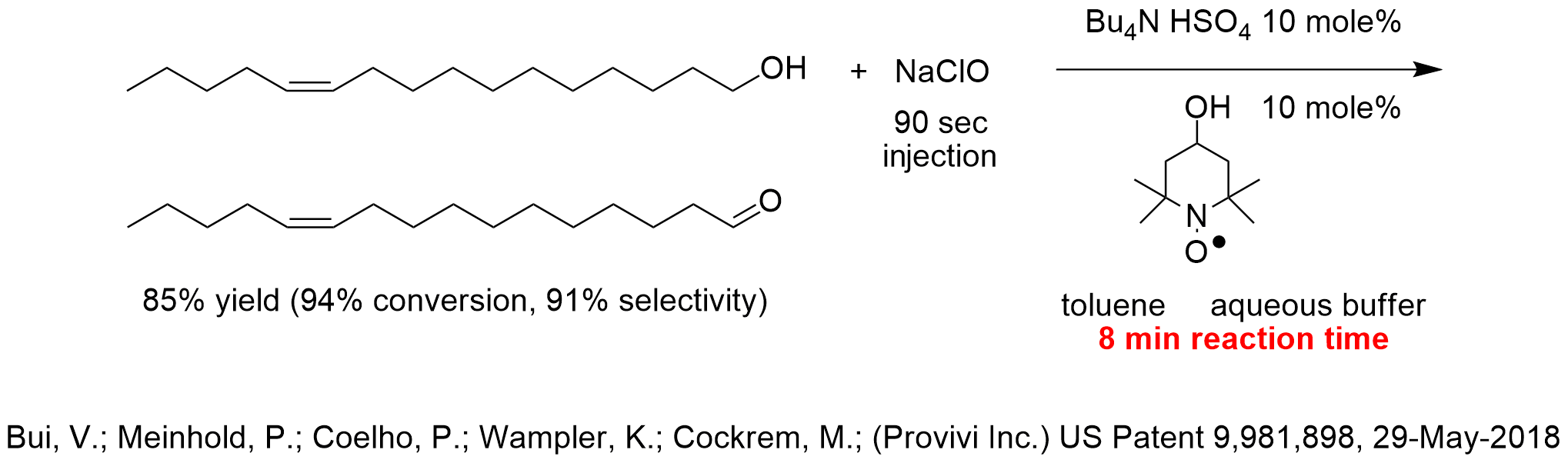
Phase-transfer catalysis excels in the selective mild oxidation of primary alcohols to aldehydes without overoxidation to the carboxylic acids as first reported by Lee and Freedman in the 1970’s as we teach in our 2-day course “Industrial Phase-Transfer Catalysis” (soon to be conducted in Philadelphia in October). TEMPO (2,2,6,6-tetramethylpiperidine 1-oxyl radical) is a well known catalyst for oxidant that is used in catalytic quantities, due to its high cost, in conjunction with other less expensive oxidizing agents. Hydroxy-TEMPO (HO-TEMPO) can be used in many cases in which TEMPO is used since it is readily made from less expensive starting materials.
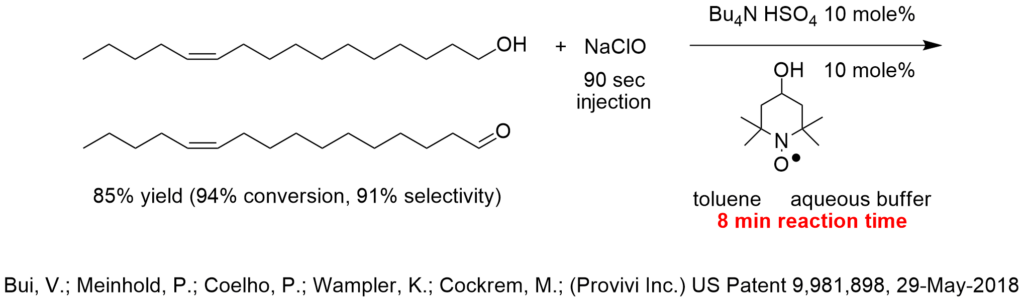
This patent shows that careful choice of PTC reaction conditions using hypochlorite and HO-TEMPO results in a very rapid and selective oxidation of alcohols to the aldehydes. Similar to the Lee and Freedman publication, the reaction must be stopped at the right time to minimize over-oxidation. In this case, the reaction time needs to be stopped at 8 minutes to achieve the highest amount of desired product.
Tetrabutylammonium hydrogen sulfate is usually used as the phase-transfer catalyst in PTC hypochlorite oxidations (quat hydrogen sulfates are also used for hydrogen peroxide oxidations). TBAB can make hypobromite in-situ and cause further complications.
A high shear Silverson mixer was used in this patent. PTC reactions that use sensitive reactants and products are sometimes better performed with lower agitation efficiency in order to minimize non-catalyzed interfacial side reactions. It is often better to let the phase-transfer catalyst control the contact between the reactants instead of the less controlled brute force of high shear agitation. It is not known if less agitation would be beneficial in this case but it is worthwhile to consider this concept in the future for compounds that are sensitive to water, oxidants, etc.
When you need to control selectivity to achieve the highest performance for your commercial process in development or in production, contact Marc Halpern of PTC Organics to integrate highly specialized expertise in industrial phase-transfer catalysis with your commercial needs.
Sometimes, we don’t choose a phase-transfer catalyst based on how much reactivity it will induce, but rather based on how efficiently we can recycle the catalyst and at minimal cost.
In a PTC dehydrofluorination patent that issued this month, Aliquat 336 was chosen to selectively produce 1-chloro-2,3,3-trifluoropropene from 3-chloro-1,1,2,2-tetrafluoropropane with only 5% byproducts. The base was aqueous KOH.

We speculate, but do not know, that the reason for choosing Aliquat 336 instead of TBAB for example, was that Aliquat 336 is so hydrophobic that it will not distribute significantly into the aqueous phase, even during workup which usually involves dilute aqueous solutions. TBAB distributes into dilute aqueous solution and would likely be lost to the aqueous waste stream during workup. The losses of Aliquat 336 into the aqueous waste stream in such systems are often negligible.
If you want to learn how to choose PTC conditions like an expert, including how to simultaneously optimize reactivity and catalyst separation from product, bring the course “Industrial Phase-Transfer Catalysis” to your department in-house or register for a public PTC course. The next public PTC course will be conducted in Philadelphia in October 2018.
We appreciate the input of expert process chemist, Peter Wuts, who pointed out that there is a better alternative explanation for the mode of action of the phase-transfer catalyst in the PTC-Suzuki reaction reported last month at http://phasetransfercatalysis.com/ptc_tip/ptc-suzuki-for-polymers/. Following is Dr. Wuts’ input.
“It is generally well accepted that boronates, in order to transfer to the Pd complex, require a nucleophile like water to add to the empty orbital on boron. It seems that these substrates are so “greasy” that the only way to accomplish this is with PTC and maybe the greasier and bigger catalyst is more effective. I don’t believe the quats have any influence on the palladium. The first thing that needs to happen in these reactions is the reduction of Pd(II) to LnPd(0). In this case it is probably the phosphine ligand (Ln) which is used in excess that reduces the Pd(II). Once this is accomplished, Pd(0) does oxidative addition with the bromide and then the Ar group from the boronate-nucleophile complex is transferred and then reductive elimination returns the Pd(0) which cannot react with a quat. The cycle starts over until all bromide is consumed. The [Q+ PdCl3-] complex is not relevant to the case at hand because we need to get into the Pd(0) manifold for the Suzuki to work.”
We would like to add that it may be possible that the role of the catalyst may be to deliver the required water to the reaction site by hydrogen bonding to the counteranion of the organophilic quat cation.
Peter Wuts of Wuts Chemistry Consulting (http://www.petergmwuts.com/) is one of the leading process chemists in the industry and is the author of the authoritative book “Protecting Groups: Effects on Chemical Reactivity.”
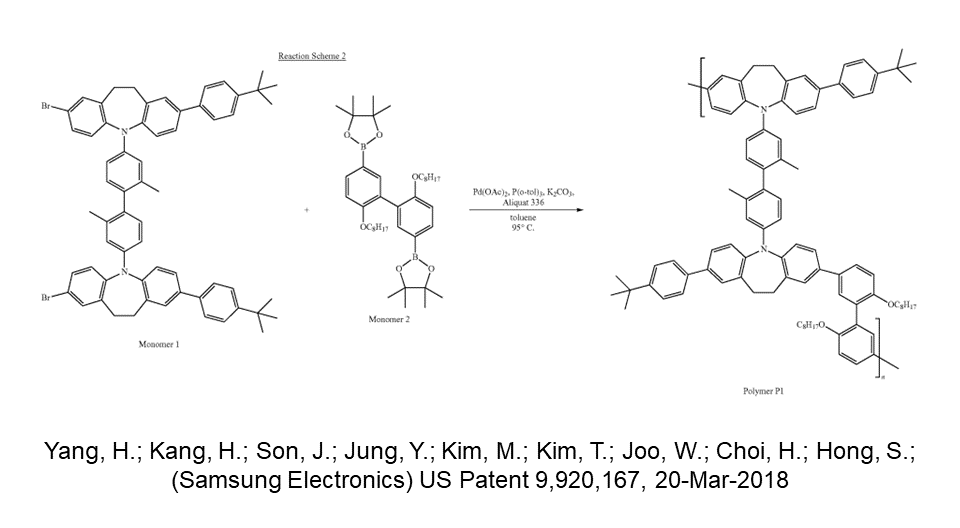
Higher molecular weight quats, such as Aliquat 336 seem to work better for Suzuki coupling reactions. This may be due to the ability of Aliquat 336 (and tetrahexylammonium) to prevent the precipitation of palladium (0) when using palladium (II) complexes.
In this Samsung Electronics patent, issued this month, several polymers were synthesized by Suzuki coupling using Aliquat 336 as the phase-transfer catalyst. An example is shown below.
Contact Marc Halpern of PTC Organics to develop low-cost high-performance green chemistry processes using phase-transfer catalysis.
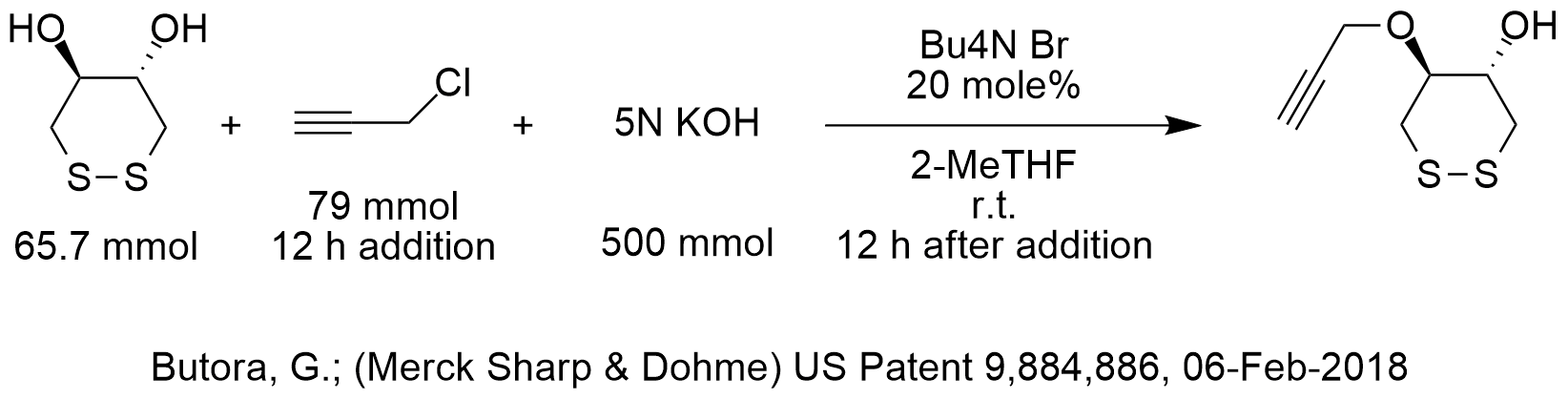
Usually in PTC etherification of diols, much more diether is formed than monoether, even when the amount of alkylating agent is limited to enough to alkylate just one hydroxyl. The reason is that the quaternary ammonium cation prefers to pair with more organophilic anions. Since the monoether is usually more organophilic than the starting diol, then the ion pair [Q+ R’ORO-] is preferred over [Q+ HORO-]. Since the quat delivers the alkoxide to the alkylating agent (propargyl chloride in this case) in the organic phase and the quat delivers more monoether anion than diol anion, we expect more diether. We teach this in our 2-day course “Industrial Phase-Transfer Catalysis.”
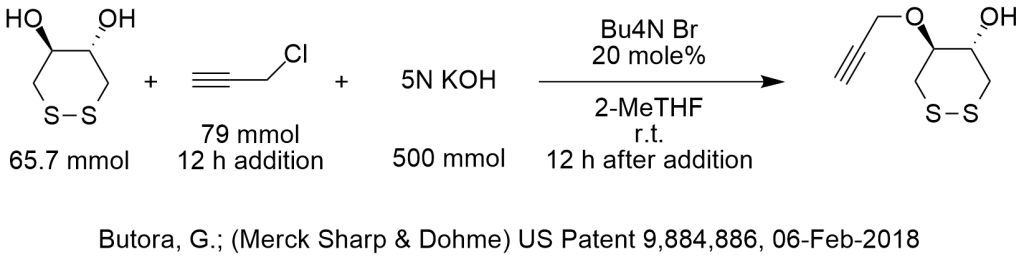
In the reaction shown, the inventor increased the probability of monoetherification by adding the alkylating agent slowly in a controlled manner that kept a high ratio of free diol to monoether in the early stages of the reaction. Performing the reaction at room temperature likely helped selectivity for controlled etherification (avoiding chaotic collisions that are not statistical). The reason that PTC was chosen for this reaction may have been to reduce the energy of activation enough to be able to perform the reaction at room temperature instead of at higher temperatures often used in etherifications of secondary alcohols.
However, it is possible that diether dominated in the reaction shown and that the inventor separated out and isolated the monoether formed in a lesser amount by chromatography. That would be consistent with what we usually observe in PTC etherification of diols, even when only 1 equiv of alkylating agent is used (1.2 equiv were used in this reaction). Since the amount of isolated product was not reported, we don’t know the actual selectivity of the etherification of this diol.
This monoetherification was performed with other reactants including a polyglycol.
The question mark in the title of this post is due to concern that the monooether may not be the dominant product but was successfully isolated for the synthetic purposes of the inventor. We think it is important to highlight the thought process that PTC etherification of diols favors diether formation over monoether formation, so when we see a PTC monoetherification of a diol, we should not conclude that PTC favors monoetherification.
Contact Marc Halpern of PTC Organics to achieve low-cost high-performance green processes for strong base reactions, usually using inexpensive inorganic bases and phase-transfer catalysis.
Improve Polymer Performance for Epoxy Resins
US Patent 9,868,751 shows that when using a variety of curing catalysts containing tetraphenyl phosphonium salts of anilide anions (salicylanilide derivative for example) for polymerizing epoxy resins with curing agents (phenolics such as novolacs) at 95 deg C, for encapsulating semiconductor devices, much better performance is obtained than when using non-phosphonium curing agents such as triphenyl phosphine.
The better performance includes higher flowability, higher stability, lower shrinkage and higher curing rates at lower temperatures, achieved in shorter curing times.
Although not addressed in the patent, the higher performance may be related to the combination of having an anionic curing agent paired with a thermally stable quaternary phosphonium cation.
Kim, M.; Kwon, K.; Lee, D.; Chung, J.; Cheon, J.; Choi, J.; (Samsung SDI CO., LTD.) US Patent 9,868,751, 16-Jan-2018
Improve Polymer Performance for Nitrile Rubber
US Patent 9,868,806 describes technology for producing nitrile rubber that is vulcanized without using sulfur. The rubber is a butadiene (58.5 parts)-acrylonitrile (35.5 parts) polymer containing glycidyl methacrylate (6 parts) for crosslinking. When using tetrabutylammonium bromide (4 parts), without the addition of heavy metal compounds, it is possible to achieve a high elongation at break and tensile strength.
Although not addressed in the patent, it is possible that the mechanism is ring opening of the epoxide by the bromide of TBAB followed by continued reaction of the resulting epoxide (addition reaction to an unsaturated bond).
Brandau, S.; Klimpel, M.; Magg, H.; Welle, A.; (Arlanxeo Deutschland GmbH) US Patent 9,868,806, 16-Jan-2018
Contact Marc Halpern of PTC Organics to integrate your expertise and commercial goals with PTC Organics’ highly specialized expertise in industrial phase-transfer catalysis to achieve higher process performance.
Pat O’Neill of Pfizer provided the following answer to last month’s challenge.
“I would say that this proceeds via acid catalysed hydrolysis of the enamine to the arylacetaldehyde, followed by alpha chlorination (very activated CH bonds). Finally, the alpha,alpha-dichloroarylacetaldehyde undergoes a facile hydrolysis (like a haloform reaction) to formic acid and the gem-dichloro compound. Alternatively, the dichloroarylacetaldehyde could undergo oxidation by HOCl to the arylacetic acid, which would decarboxylate readily to the same compound.”
This is the second challenge this year for which Pat O’Neill provided the first high quality answers. Thank you, Pat!
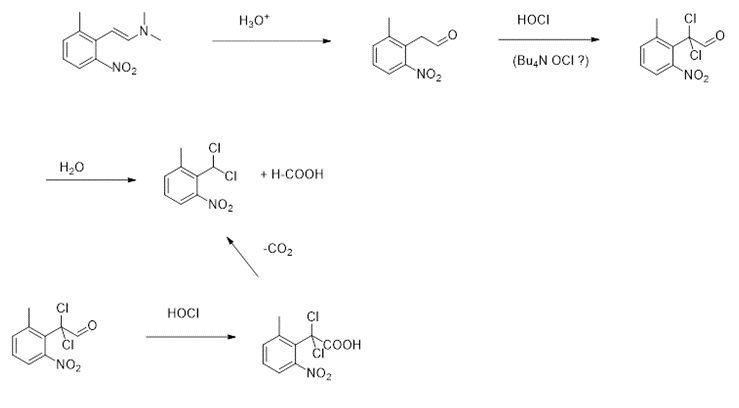
Phase-transfer catalysis is known to transfer and activate acids such as HCl, HBr, HI, HNO3 and others from the aqueous phase into the organic phase through hydrogen bonding of the acid proton to the halide of a quat salt such as TBAB. So, it is a pretty good idea to apply PTC conditions to transfer HClO into a nonpolar organic solvent and react it under mild conditions.
HClO is well known to add to alkenes to form chlorohydrins. I am not familiar with the reaction that would continue to convert the chlorohydrin or otherwise cleave the alkene then wind up with the benzal group (dichloromethyl).
Earlier this year, our audience helped us identify a reaction with which I was not familiar. Can you help me again this month? Please contact Marc Halpern at PTC Organics with your answer and specify if you authorize us to publish your name and company affiliation in next month’s PTC Tip of the Month.
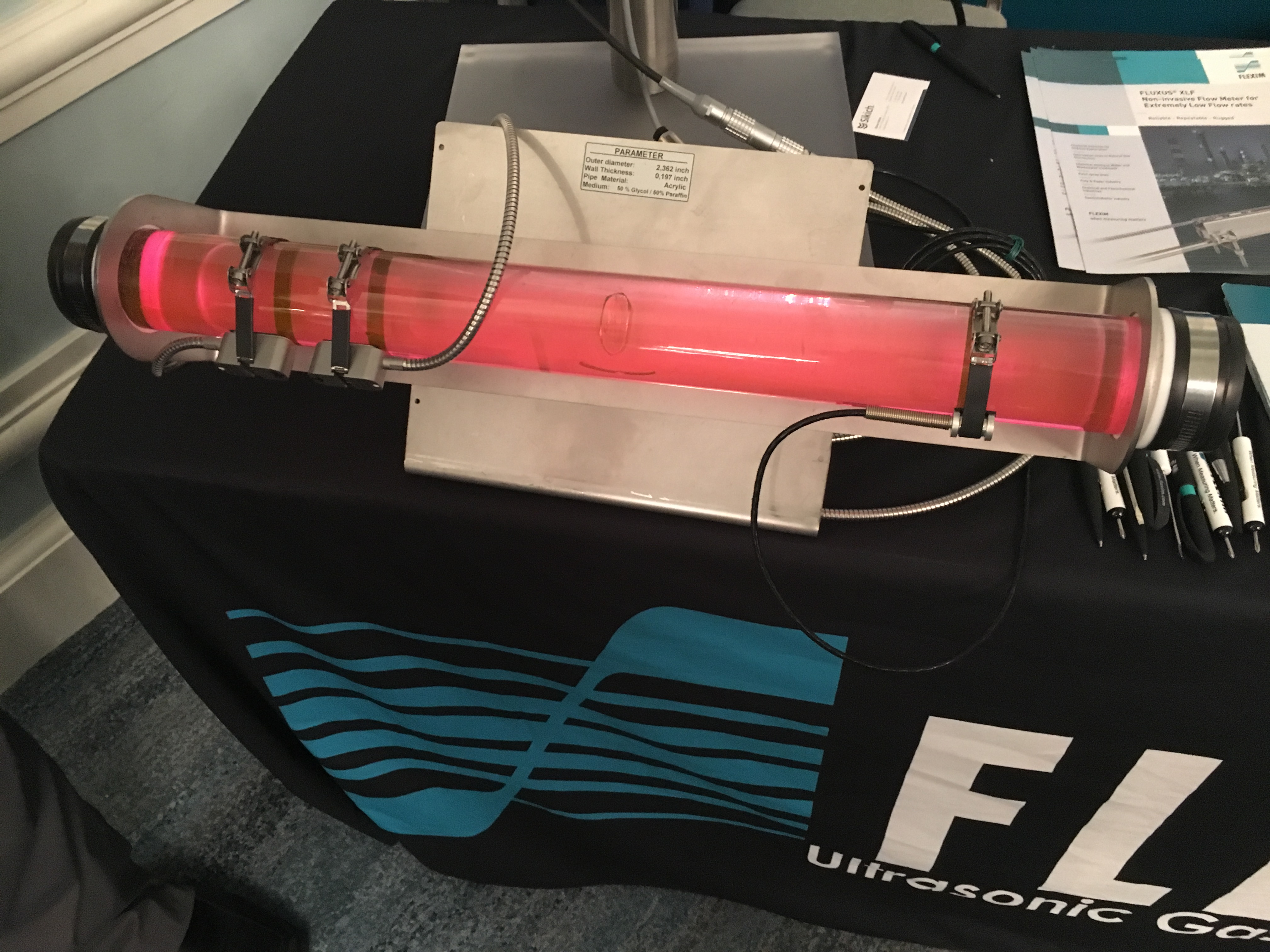
An exhibit at the 2017 Specialty & Agro Chemical trade show displayed a system by FLEXIM based on measuring changes in the speed of sound in a liquid that can be calibrated to determine conversion of chemical reaction that we think may be particularly useful for solvent-free phase-transfer catalysis reactions or in PTC systems that use solvent and are not overly dilute.
The advantage of the system is that no samples need to be taken and conversion can be monitored continuously after a calibration curve is established.
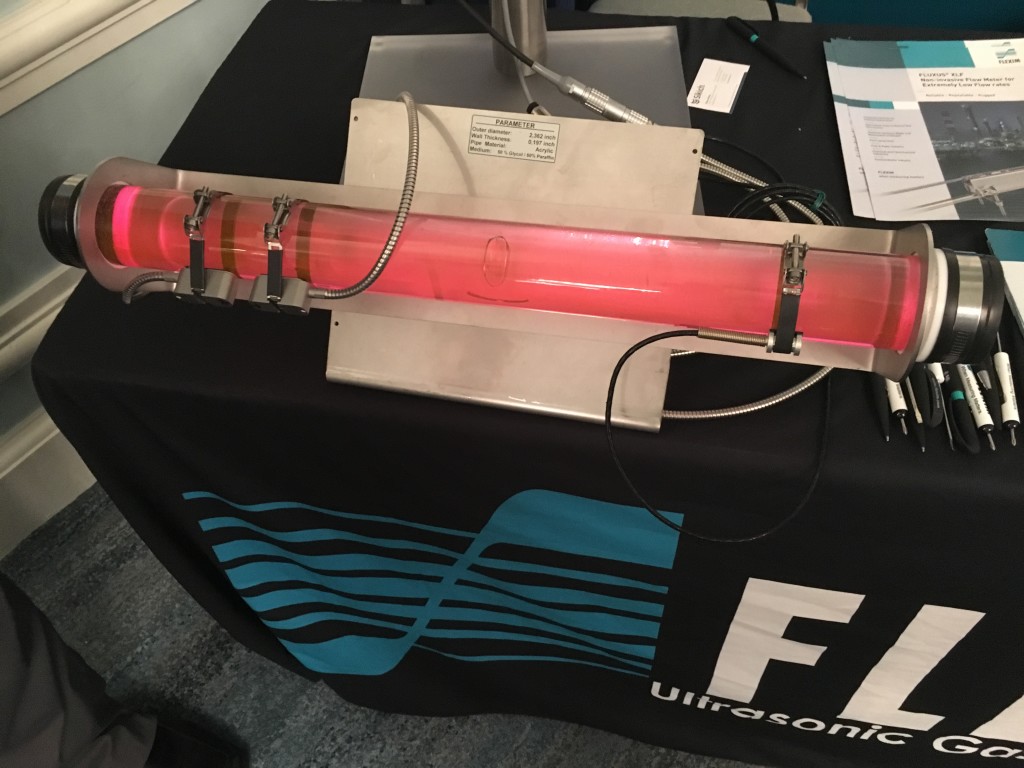
The principle is based on the fact that the speed of sound transmitted through a liquid is different as the density changes. The system uses a sound wave generator and a sound wave frequency detector, both attached externally to the outside walls of the reactor (shown on the left side in the picture). The reactor can be made of just about anything…glass, metal, plastic, etc. the system is quite sensitive and can discern between 10.0% aqueous NaCl and 10.1% aqueous NaCl, for example.
In Starks’ original solvent-free PTC reaction reported in 1971 in which octyl chloride was converted into octyl nitrile, the difference in densities between these two materials could be used to determine the relative compositions of the two materials, thereby determining conversion.
The main application of FLEXIM’s technology is non-invasive ultrasonic flow measurement.
PTC Organics would be happy to work with your company and the manufacturer of this system to evaluate the applicability of this system to continuously determining conversion of your PTC application without sampling, by integrating our highly specialized expertise in industrial phase-transfer catalysis with your company’s needs and the expertise of the manufacturer of the unit. Now contact Marc Halpern of PTC Organics to explore custom developing a solution for your solvent-free PTC application (or concentrated PTC system).


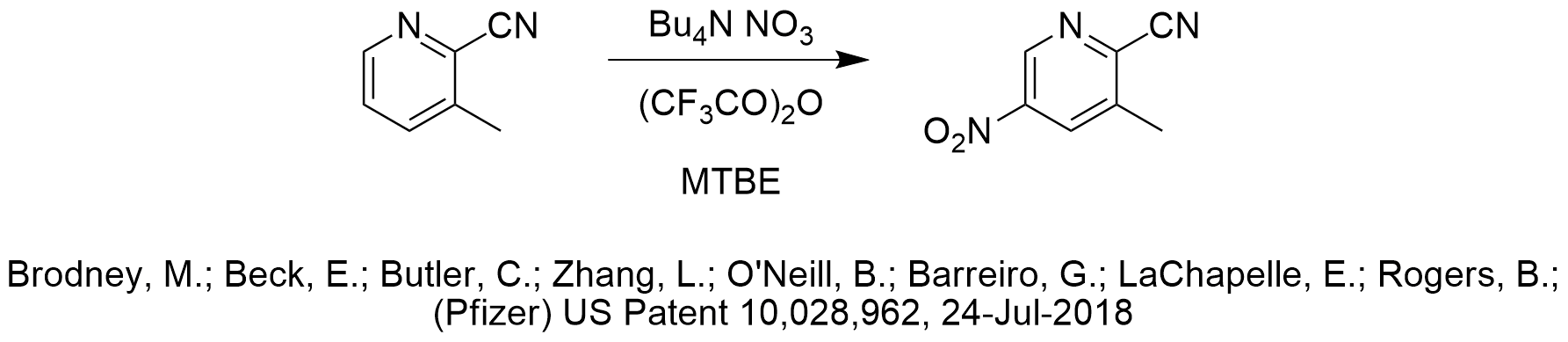 A patent was issued last week (US Patent 10,028,962) that used TBAN-TFAA for the nitration 3-methylpyridine-2-carbonitrile that used 1.10 equiv TBAN and 1.12 equiv TFAA. This was a small scale reaction.