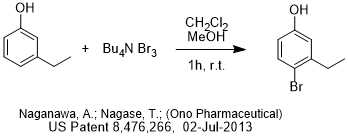
Tetrabutylammonium tribromide (TBATBr) is formed by the addition of bromine to tetrabutylammonium bromide in a solvent (preferbly a solvent from which the TBATBr can be precipitated).
TBATBr can be used for bromination as described in a patent issued earlier this month shown above or as a catalyst for esterification as will be described in next month’s PTC Tip of the Month.
Need to learn more about which phase-transfer catalyst to choose for a specific PTC application? Contact Marc Halpern of PTC Organics by E-mail.
Directory for suppliers of 80 PTC’s
HEG Cl is hexaethyl guanidinium chloride. This phase-transfer catalyst was made popular in the 1990’s when General Electric issued multiple patents for the use of HEG Cl for high-temperature PTC reactions, most notably nucleophilic aromatic substitutions.
GE documented comparative studies that showed that HEG Cl was more effective than even tetraphenyl phosphonium chloride, which has always been known to be a very effective phase-transfer catalyst for high-temperature reactions.
In fact, GE documented the use of HEG Cl for PTC applications at temperatures in the high 100’s and low 200’s (Celsius). GE and SABIC Innovative Plastics patented applications for the recovery of HEG Cl.
The point is that HEG Cl is known to be an excellent high-temperature phase-transfer catalyst. When we have high-temperature PTC applications to evaluate, we screen HEG Cl after assuring that the reaction is safe and implementing safe operating procedures and protective equipment.
HEG Cl is available from VanDMark Chemical Inc.
Need to learn more about which phase-transfer catalyst to choose for a specific PTC application? Contact Marc Halpern of PTC Organics by E-mail.
Tetrabutyl phosphonium bromide, TBPB, usually provides higher reactivity as a phase-transfer catalyst than TBAB, the corresponding ammonium salt, due to the looser ion pair with the reacting anion resulting from the larger more polarizable phosphorous. TBPB is also more thermally stable at higher temperatures than TBAB under most PTC conditions except in the presence of NaOH. TBPB is more expensive than TBAB and is usually used when TBAB doesn’t deliver adequate performance.
Tetrabutyl Phosphonium Bromide is available from Cytec
Need to learn more about which phase-transfer catalyst to choose for a specific PTC application? Contact Marc Halpern of PTC Organics by E-mail.
TBAC is an effective though expensive phase-transfer catalyst for both I-Reactions and T-Reactions but is rarely needed and should usually be replaced by either TBAB or TBA hydrogen sulfate depending on cost and the specifics of the chemical reaction being performed. It is often thought than TBAC may be less expensive than TBAB since butyl chloride is less expensive than butyl bromide, but as explained in the Tip of the Month above, butyl chloride cannot be used to be directly reacted with tributylamine to form TBAC.
Need to learn more about which phase-transfer catalyst to choose for a specific PTC application? Contact Marc Halpern of PTC Organics by E-mail.
At Informex last week, we met with Nagase, the company that is commercializing the use of the Maruoka catalysts to perform asymmetric PTC reactions.
The synthesis of one of Maruoka’s asymmetric phase-transfer catalysts was patented earlier this month.
Nagase is reporting that they perform commercial scale PTC alkylations using the Maruoka catalysts to synthesize alpha-monosubstituted and alpha, alpha-disubstituted amino acids. This is especially useful to produce unnatural amino acids.
Maruoka started to patent these chiral phase-transfer catalysts in the late 1990’s and published several landmark papers in the early 2000’s. He wrote a review for the special PTC feature issue of Organic Process Research & Development in 2008 pages 679-687 (Marc Halpern served as guest editor).
The commercialization of the use of Maruoka’s catalyst is described in Nagase’s August 2012 bulletin. We can refer you to Nagase’s representatives in the US with whom we have an ongoing relationship since they hosted PTC Organics’ lecture tour in Japan in 2003.
Need to learn more about which phase-transfer catalyst to choose for a specific PTC application? Contact Marc Halpern of PTC Organics by E-mail.
Trimethylamine can form in-situ phase-transfer catalysts by reacting with benzyl halides or allyl halides. It is probably not a good idea to try this with normal alkyl halides since the trimethylamine can act as a base and dehydrohalogenate the n-alkyl halide. Since benzyl groups and allyl groups don’t have beta protons, they cannot dehydrohalogenate.
In the PTC Reaction of the Month above, even if the benzyl trimethyl ammonium bromide quat would “decompose” by nucleophilic substitution, it would still form the desired product and liberate trimethyl amine that may requaternize and reform the phase-transfer catalyst in situ. So, when you are using benzyl halides or allyl halides as alkylating agents, you should really evaluate the feasibility of adding trimethyl amine to form the phase-transfer catalyst in-situ.
Please note that quats based on trimethyl amine cannot undergo Hofmann Elimination and will therefore be more stable than quats made from triethylamine.
Need to learn more about which phase-transfer catalyst to choose for a specific PTC application? Contact Marc Halpern of PTC Organics by E-mail.
Benzyl tributyl ammonium chloride is a phase-transfer catalyst that often behaves similar to tetrabutyl ammonium bromide from the standpoints of reactivity and catalyst separation. Benzyl groups exhibit structure-activity characteristics like butyl groups.
Benzyl tributyl ammonium chloride can be less expensive than TBAB since they are both made from tributylamine, but benzyl chloride is less expensive than butyl bromide. However, benzylated quats are less stable than quats with straight chain alkyl groups. For example, if you are performing a nucleophilic substitution, you must be cautious of the possibility of benzylating your nucleophile.
Overall, benzyl tributyl ammonium chloride could be considered as an alternative to TBAB if cost is an issue and benzylated impurities can be avoided or tolerated.
Benzyl Tributyl Ammonium Chloride is available from Dishman
Need to learn more about which phase-transfer catalyst to choose for a specific PTC application? Contact Marc Halpern of PTC Organics by E-mail.
Dimethyl Distearyl Ammonium Chloride is a quat salt with two long chains and two short chains that forms vesicles (not quite micelles, but not simple two phases either). Depending on the concentration, Dimethyl Distearyl Ammonium Chloride may form emulsions or may perform classical phase-transfer catalysis. This quat salt is also used in fabric softeners, cosmetics, and hair conditioners in which it is added primarily for its antistatic effects.
Dimethyl Distearyl Ammonium Chloride is available from Evonik
Need to learn more about which phase-transfer catalyst to choose for a specific PTC application? Contact Marc Halpern of PTC Organics by E-mail.
Tributyl Hexadecyl Phosphonium Bromide, TBHDP Br, is a highly organophilic phase-transfer catalyst with low accessibility of the positive charge on a polarizable phosphorous making ion pairs with this P-quat very loose and reactive. This makes this catalyst excellent for the reactivity of PTC I-Reactions. That is why TBHDP Br was the catalyst of choice in the classic papers in the 1970’s by Starks (described in the PTC Tip above) and Landini (another outstanding contributor to early understanding of PTC mechanism).
Tributyl Hexadecyl Phosphonium Bromide is available from Cytec and Biosolutions
Need to learn more about which phase-transfer catalyst to choose for a specific PTC application? Contact Marc Halpern of PTC Organics by E-mail.
The PTC Reaction of the Month shown above uses tetraoctyl ammonium salts. With a C# of 32 and a q-value of 0.5, TOAB is ideal for I-Reactions. However, the patent above describes the use of ultrasound which implies that mixing is important, though the patent didn’t describe a procedure without ultrasound.
Tetraoctyl ammonium bromide is indeed an excellent phase-transfer catalyst for many PTC reactions. Whether it is used in any given commercial PTC process will depend on economic feasibility which in turn will usually depend on the added incremental benefit provided by this highly organophilic phase-transfer catalyst versus the added cost for these extra carbons as well as the economics of recovery and recycle of this catalyst.
Tetraoctyl ammonium bromide is available from Dishman and Biosolutions
Need to learn more about which phase-transfer catalyst to choose for a specific PTC application? Contact Marc Halpern of PTC Organics by E-mail.