Butyl Triethyl Ammonium bromide is an interesting phase-transfer catalyst. It has a q-value of 1.75 which makes it excellent for T-Reactions, like methyl tributyl ammonium chloride that also has a q-value of 1.75. With a C# of only 10, it is more hydrophilic than methyl tributyl ammonium (C# = 13), so it is much easier to wash out into water which means less aqueous waste to achieve lower residual catalyst in the product.
One might be concerned that butyl triethyl ammonium chloride might not be organophilic enough to be an effective phase-transfer catalyst, but since most T-Reactions use concentrated NaOH, the salting out effect combined with the organophilic nature of the organic nucleophiles (carbanions, N-anions, enolates, etc.) renders the quat-anion pair organophilic enough to perform many PTC strong base reactions.
In addition, the bromide of butyl triethyl ammonium bromide can co-catalyze alkylations using alkyl chlorides to form the alkyl bromides in-situ that react faster than the alkyl chloride starting material.
On the negative side, the ethyl group is the most sensitive to Hofmann degradation in the presence of concentrated NaOH due to reduced steric hindrance around the terminal methyl groups and the fact that there are three beta protons to the nitrogen versus 2 beta hydrogens for other higher alkyl groups. Moreover, butyl triethyl ammonium has three ethyl groups (9 beta protons) which makes it very susceptible to Hofmann Elimination.
In the end, the only way to know if butyl triethyl ammonium bromide will outperform methyl tributyl ammonium chloride is to screen the two catalysts against each other.
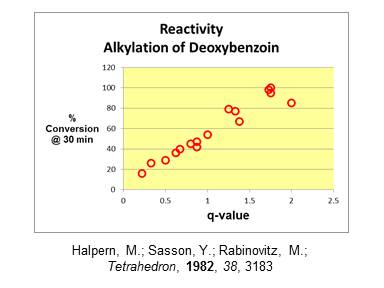
In Halpern’s early work using butyl triethyl ammonium bromide for the methylation of deoxybenzoin, it performed at the highest level together with methyl tributyl ammonium chloride (see graph).
If your company can benefit from unmatched highly specialized expertise in PTC strong base reactions to achieve low-cost high-performance green chemistry, now contact Marc Halpern of PTC Organics to explore a path forward to integrate that expertise with your process R&D program.
Maruoka patented a new class of spiro chiral phase-transfer catalysts. Previous Maruoka chiral PTC’s had substituted binaphthyl groups on both sides of the nitrogen or substituted biphenyl groups on both sides of the nitrogen. The current class of compounds claimed in this patent has a binaphthyl on one side of the nitrogen and a biphenyl on the other side.
Incorporating a mixed binaphthyl-biphenyl spiro ammonium salt achieves several advantages that include greater steric differentiation, greatly enhanced flexibility in the array of substituents one can envision to achieve stronger chiral recognition, lower cost synthetic route and more.
The patent describes the synthesis and characteristics of 17 mixed Maruoka catalysts with a variety of substituents of which methoxy and 3,4,5-trifluorophenyl are particularly notable.
This patent does not describe examples of the use of these chiral phase-transfer catalysts but one’s imagination can run wild with anticipation of the future impressive enantioselectivities.
If your company can benefit from expert choice of phase-transfer catalyst to achieve the highest performance in the shortest development time, you should consider bringing the in-house PTC course to your company or contact Dr. Marc Halpern of PTC Organics to inquire about PTC Process Consulting or PTC Process Contract Research.
Quats are very versatile and many different quat-anion pairs can be customized to meet specific needs for an application. In US Patent 7,578,971, PTC Organics helped its customer, Mercury Medical, develop a carbon dioxide detector (NOT carbon monoxide detector) used by emergency medical technicians to quickly determine in the field is a person is breathing. The quat salt customized for this purpose was methyltricaprylyl ammonium phenoxide.
The carbon dioxide detector is blue in air and turns yellow immediately when exposed to even small amounts of carbon dioxide from a person’s breath.
Ratner, J.; Green, D.; Crick, D.; Halpern, M.; (Mercury Enterprises) US Patent 7,578,971, 25-Aug-2009
If your company could benefit from a customized choice of a quat salt or other phase-transfer catalyst, contact Dr. Marc Halpern of PTC Organics to explore integrating the best available specialized expertise in industrial phase-transfer catalysis with your company’s process development needs to achieve the highest performance.
Cetyl pyridinium chloride, CPC, is a biocide used in mouthwash that is sometimes used as a phase-transfer catalyst. With a head-and-tail structure, CPC can serve as a surfactant, so care must be taken to avoid emulsions during workup after the reaction stage when using it as a phase-transfer catalyst. We prefer avoiding the use of CPC for PTC applications, but it does appear in the PTC literature.
A review of the properties and non-PTC applications of CPC was just published in the November 2014 issue of Speciality Chemicals Magazine (page 14).
If you need expert input for the choice of the best phase-transfer catalyst for a commercial PTC application, send an inquiry to Marc Halpern of PTC Organics.
Dodecyl trimethyl ammonium chloride is one of the quat salts that is primarily a surfactant but can sometimes work as a phase-transfer catalyst. If you decide to use this quat salt as a phase-transfer catalyst, be aware that even though it might work well for the chemical reaction that is usually performed in the presence of an aqueous phase with high ionic strength, you still might find that the workup will not be feasible when water washing the organic phase emulsifies as a result of crossing he critical micelle concentration threshold.
If your company can benefit from lower cost and higher performance by choosing the right phase-transfer catalyst for your application, now contact Marc Halpern to inquire about integrating the best PTC technology available provided by PTC Organics with your company’s technical and commercial goals.
Tetrapropylammonium perruthenate, Pr4N RuO4, is a mild oxidizing agent used to convert alcohols to aldehydes. Since it is expensive, it can be used in catalytic quantities in combination with a stoichiometric amount of N-methylmorpholine N-oxide.
If you need help choosing a phase-transfer catalyst for your application, contact Marc Halpern of PTC Organics.
Tetrakis(diethylamino)phosphonium bromide is a high temperature phase-transfer catalyst. It has been used in several hi-temp PTC halex reactions at 180 deg C for extended reaction times. We teach this in the 2-day course “Industrial Phase-Transfer Catalysis“.
Examples can be found in the following references:
Pasenok, S.; Appel, W.; Pfirmann; R.; Wessel, T.; Schach, T.; Schubert, H.; (Aventis), US Patent 6,103,659, 15-Aug-2000
Rack, M.; Smidt, S.; Budich, M.; Maywald, V.; Keil, M.; Wolf, B.; (BASF) US Patent 7,595,426, 29-Sep-2009
Two weeks ago, US Patent 8,802,811 was issued that uses a combination of tetrabutyl ammonium iodide with the ionic liquid 1-hexyl-3-methylimidazolium hexafluorophosphate to achieve 81% yield in a cyanation to form 3-hydroxyglutaronitrile. When using TBAI but no ionic liquid, the yield dropped to 50%. When using no PTC and no ionic liquid, the yield dropped to 35%. This is an interesting 8-page patent that might be good for lunch reading.
If you need help choosing a phase-transfer catalyst for your company’s process development program, contact Marc Halpern of PTC Organics.
US Patent 8,765,955 (July 2014) describes the use of several cinchona alkaloids. The specific cinchona alkaloid shown in the figure enabled the addition of nitromethane to a ketoester in 97% yield and 97% ee. The catalyst is recovered in greater than 95% yield by washing the silica gel column (used to isolate the product) with MeOH. The recovered catalyst was identical to that before the reaction by NMR analysis and can be reused without further treatment. This is impressive.
Ionic liquid onium salts are sometimes used as phase-transfer catalysts. Tributyloctylphosphonium trifluoromethanesulfonate was cited as such a catalyst in the June 2014 PTC Tip of the Month as a liquid at the wall temperature of the thin film distillation unit that facilitated its separation. Normally, this catalyst in the bromide form would be an effective phase-transfer catalyst for I-Reactions since it has 20 carbon atoms, a polarizable phosphorous at the core and a q-value of only 0.89.
If you need expertise about choosing the best phase-transfer catalyst for a PTC application and/or understanding the theory and practical impact of PTC I-Reactions and T-Reactions, attend the 2-day PTC course “Industrial Phase-Transfer Catalysis” or inquire about PTC Process Consulting.