
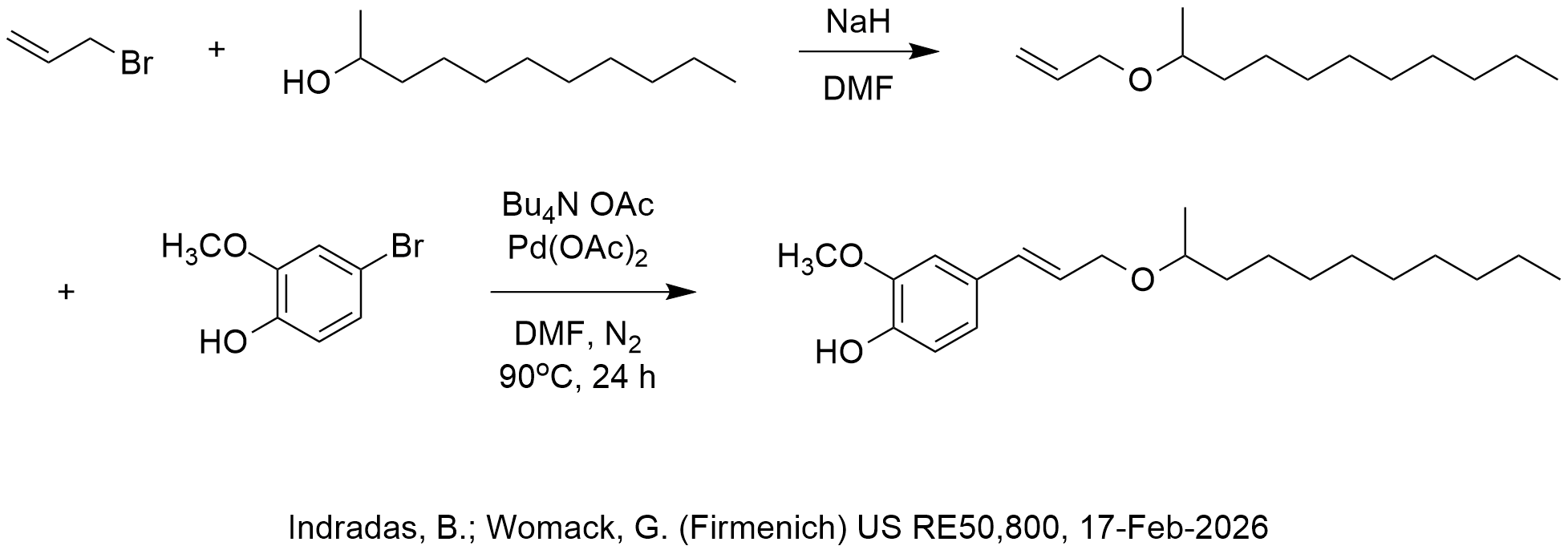
 This reissued patent discloses the preparation of cinnamyl ethers via a palladium-catalyzed Heck reaction between aryl halides and allyl ethers derived from perfumery alcohols. The allyl ethers are prepared in a conventional manner for the lab, using sodium hydride in DMF, controlled addition of allyl bromide, aqueous quench, extraction, purification. The resulting allyl ether is then combined with the aryl halide, tetrabutylammonium acetate, and Pd(OAc)₂ in DMF and heated at 90 °C under nitrogen.
The use of stoichiometric tetrabutylammonium acetate in DMF creates a homogeneous system, no inorganic solids, no alkali metal counterions, no heterogeneous buffering effects. From a mechanistic standpoint, acetate is not simply a proton scavenger in Heck chemistry. It serves as a ligand for the palladium and affects the ionic environment around the catalytic center. Replacing sodium or potassium acetate with a lipophilic quat salt removes alkali metal ion pairing from the system and ensures solubility. Whether this improves rate or selectivity is not demonstrated, but the choice of TBA OAc makes sense.
A surprising aspect of this reissued patent from an industrial perspective is the etherification step preceding the Heck reaction. The allyl ethers are prepared using sodium hydride in DMF, an approach that is standard for the lab but usually not optimal for process chemistry. Sodium hydride generates hydrogen, is expensive, requires pyrophoric handling, strictly anhydrous conditions, and solvent choices that are not always preferred in manufacturing environments. It works, it is reliable, it is academically comfortable, but it is not an optimal indusrial option.
Alkylation of alcohols with allyl bromide is one of the most classical of PTC reactions, employing aqueous sodium hydroxide and a quaternary ammonium catalyst that routinely delivers allyl ethers under mild conditions. Such systems eliminate hydride, eliminate hydrogen gas, reduce sensitivity to trace moisture, and simplify workup. The substrates shown in the patent include secondary and somewhat hindered alcohols, but nothing in the patent suggests they are incompatible with PTC-NaOH alkylation chemistry. The inventors do not explore the PTC alternative. They simply apply a homogeneous Williamson protocol.
If one is already comfortable employing tetrabutylammonium salts in the Heck step, it would be natural to at least consider whether a PTC could simplify the upstream etherification.