
The Industrial Phase-Transfer Catalysis Experts

PTC Tip of the Month E-Newsletter

PTC Tip of the Month - September 2025

Sometimes PTC Needs DMSO

By Marc Halpern, the leading expert in industrial phase-transfer catalysis.


When I formulated the “Halpern pKa Guidelines for the Evaluation and Optimization of New PTC Applications” in the early 1980’s, I used fluorene as the reference point for the upper limit for transition between T-Reaction and I-Reaction. The pKa of fluorene is 23 and is routinely deprotonated by hydroxide under PTC conditions followed by PTC activation of the fluorenyl carbanion as a nucleophile.

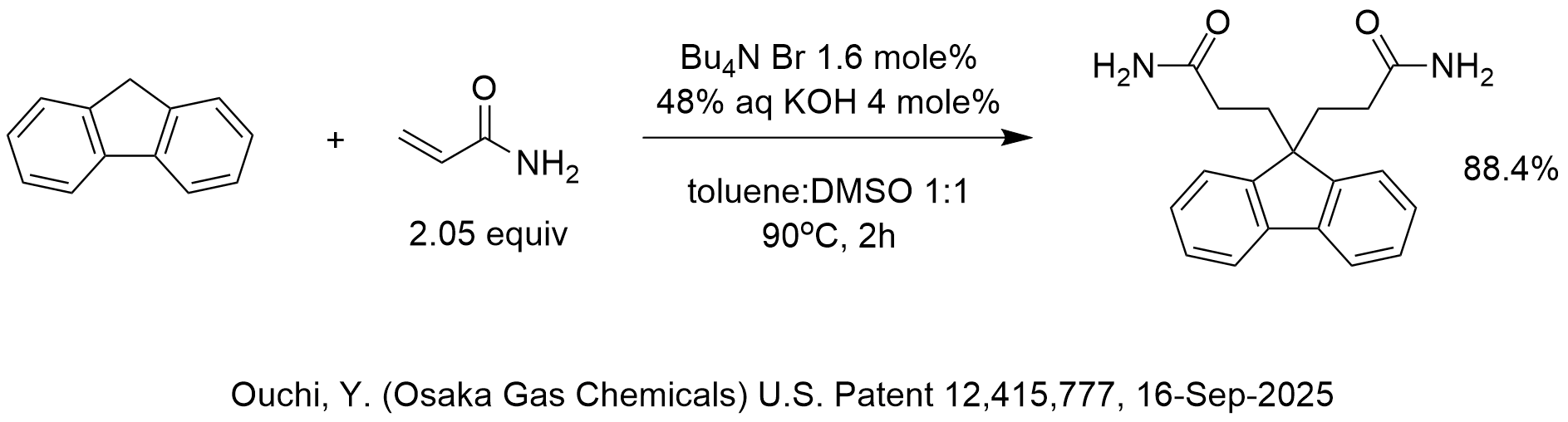
PTC is used in commercial C-alkylations of fluorene and the reaction discussed here is an effective PTC Michael Addition with the fluorenyl anion as the nucleophile.

The reaction shown in the diagram is a 1,4-conjugate addition of the fluorenyl anion to the α,β-unsaturated double bond of acrylamide, followed by protonation to yield a β-substituted amide.

We usually recommend performing PTC reactions in non-polar solvents such as toluene or somewhat polar solvents such as MIBK that are immiscible with water in order to facilitate workup. However, acrylamide is not soluble in toluene and apparently not even sufficiently soluble in MIBK. For this reason, the inventors probably had no choice but to use a mixed solvent 50/50 toluene/DMSO.

The reaction uses catalytic 48% KOH (4 mole%) since hydroxide is not consumed. The concentrated KOH promotes effective deprotonation.

Tetrabutylammonium is sufficiently stable under these conditions at 90 deg C for 2 hours to achieve complete conversion. The yield of 88.4% is after workup.

While this reaction may not be remarkable, it does remind us that PTC-hydroxide conditions are very effective for deprotonating organic substrates with acidic C-H groups that are many orders of magnitude less acidic than water (pKa 15.7), which is the conjugate acid of hydroxide and then activate the resulting carbanion to perform nucleophilic attack in high yield.

Marc Halpern has 49 years of practical experience in PTC-hydroxide reactions. If your company needs to achieve low-cost high-performance green chemistry reactions using strong base, now contact Marc Halpern of PTC Organics to determine if you can improve your R&D efficiency developing such processes.

About Marc Halpern

Marc Halpern

Dr. Halpern is founder and president of PTC Organics, Inc., the only company dedicated exclusively to developing low-cost high-performance green chemistry processes for the manufacture of organic chemicals using Phase Transfer Catalysis. Dr. Halpern has innovated PTC breakthroughs for pharmaceuticals, agrochemicals, petrochemicals, monomers, polymers, flavors & fragrances, dyes & pigments and solvents. Dr. Halpern has provided PTC services on-site at more than 260 industrial process R&D departments in 37 countries and has helped chemical companies save > $200 million. Dr. Halpern co-authored five books including the best-selling “Phase-Transfer Catalysis: Fundamentals, Applications and Industrial Perspectives” and has presented the 2-day course “Practical Phase-Transfer Catalysis” at 50 locations in the US, Europe and Asia.

Dr. Halpern founded the journal “Industrial Phase-Transfer Catalysis” and “The PTC Tip of the Month” enjoyed by 2,100 qualified subscribers, now beyond 130 issues. In 2014, Dr. Halpern is celebrating his 30th year in the chemical industry, including serving as a process chemist at Dow Chemical, a supervisor of process chemistry at ICI, Director of R&D at Sybron Chemicals and founder and president of PTC Organics Inc. (15 years) and PTC Communications Inc. (20 years). Dr. Halpern also co-founded PTC Interface Inc. in 1989 and PTC Value Recovery Inc. in 1999. His academic breakthroughs include the PTC pKa Guidelines, the q-value for quat accessibility and he has achieved industrial PTC breakthroughs for a dozen strong base reactions as well as esterifications, transesterifications, epoxidations and chloromethylations plus contributed to more than 100 other industrial PTC process development projects.

Dr. Halpern has dedicated his adult life to his family and to phase-transfer catalysis (in that order!).

Leave a Reply

Your email address will not be published. Required fields are marked *