

At first glance, tetrabutylammonium nitrate might look like a phase-transfer catalyst, but it isn’t. This is a homogeneous electrochemical oxidation of cyclooctane to cyclooctanone in acetonitrile with oxygen present, and the quaternary ammonium salt is functioning as a supporting electrolyte and nitrate-based mediator, not as a shuttle between phases.
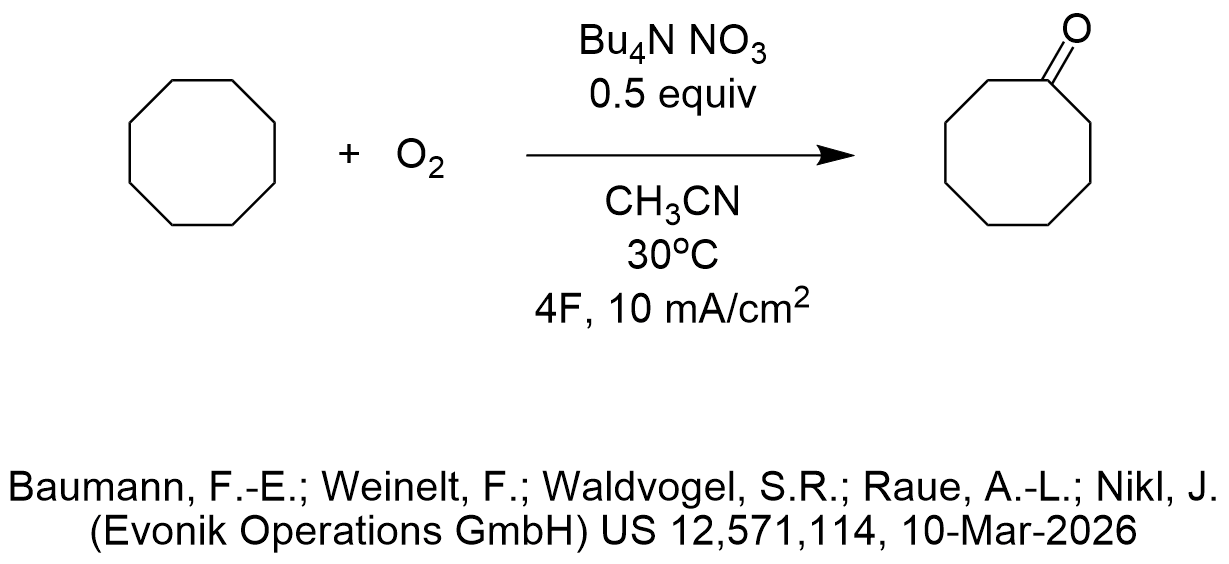
The identity of the anion is more important than the effect of quat structure. Holding the tetrabutylammonium cation constant and changing the anion from NO₃⁻ to BF₄⁻, PF₆⁻, or ClO₄⁻ collapses ketone formation from ~31% to ~3–4%. That is a decisive anion effect and this is not a spectator ion situation.
A PTC chemist will still recognize the logic. Ion identity, ion environment and local organization control the outcome. The difference is that the critical location is no longer a liquid–liquid interface as in classical PTC, but the anodic double layer.
The quat cation effect, while secondary, is still instructive. When nitrate is held constant, methyltrioctylammonium nitrate outperforms tetrabutylammonium nitrate (28% vs 16% under comparable non-optimal conditions). That is not phase transfer. It is microenvironment control at the electrode. A more lipophilic, longer-chain cation may improve substrate colocalization and organizes the interfacial region in a way that favors productive nitrate-mediated oxidation.
So the natural question is: if methyltrioctylammonium nitrate performs better, why did the inventors focus so heavily on tetrabutylammonium salts with different anions?
The most practical explanation is not mechanistic. It is logistical.
Tetrabutylammonium salts are widely available off the shelf in multiple anion forms, are consistent in purity and handling, are well-behaved in electrochemical systems and are easy to swap systematically for anion screening.
In contrast, methyltrioctylammonium salts are less commonly available across a full range of anions (other than chloride), are more hydrophobic and sometimes more variable in quality and are less convenient for a clean, controlled anion comparison study.
In other words, tetrabutylammonium provides a controlled platform for isolating the anion effect, which is clearly the dominant variable in this chemistry. Once that point is established, quat cation optimization becomes a secondary exercise.
There is also an industrial mindset behind this choice. Tetrabutylammonium nitrate is a reasonable baseline: soluble, accessible, and predictable. Even if it is not the absolute best performer, it is a practical benchmark. As process chemists, we start with the robust, commercially available standard, demonstrate the key mechanism and only then decide whether incremental gains from more specialized salts justify the added complexity.
One more point worth noting: the best conditions were not the most aggressive. The highest cyclooctanone yield was obtained at about 20% O₂ in N₂ rather than pure oxygen. That is a reminder that selectivity, control, and safety often align when the system is tuned properly.
In summary, the nitrate anion is doing the chemistry and quat cation is tuning the environment.
The main value of this report lies in the comparative selectivity data rather than in the absolute preparative performance. The patent shows quite clearly that the nitrate anion has a much greater effect on cyclooctanone formation than the identity of the quaternary ammonium cation. When nitrate is replaced by other anions, ketone formation drops sharply, whereas changing the cation while retaining nitrate causes a much smaller change. That is a useful mechanistic and catalyst-selection insight. At the same time, the practical value of the reported oxidation appears limited under the disclosed conditions because the mass balance is poor. A substantial fraction of the starting cyclooctane is converted to unidentified material, so the chemistry is more informative as a selectivity screen than as a demonstrated high-efficiency preparative process.