The Industrial Phase-Transfer Catalysis Experts

PTC Tip of the Month E-Newsletter

PTC Tip of the Month - May 2026

PTC for Thiocyanate Reactions

By Marc Halpern, the leading expert in industrial phase-transfer catalysis.

As we teach in our 2-day course “Industrial Phase-Transfer Catalysis,” the thiocyanate anion has one of the highest selective affinities for quat cation out of more than 20 common inorganic anionic nucleophiles, oxidants and reductants. For that reason, whenever you need to react thiocyanate, you should almost certainly consider PTC for your process.

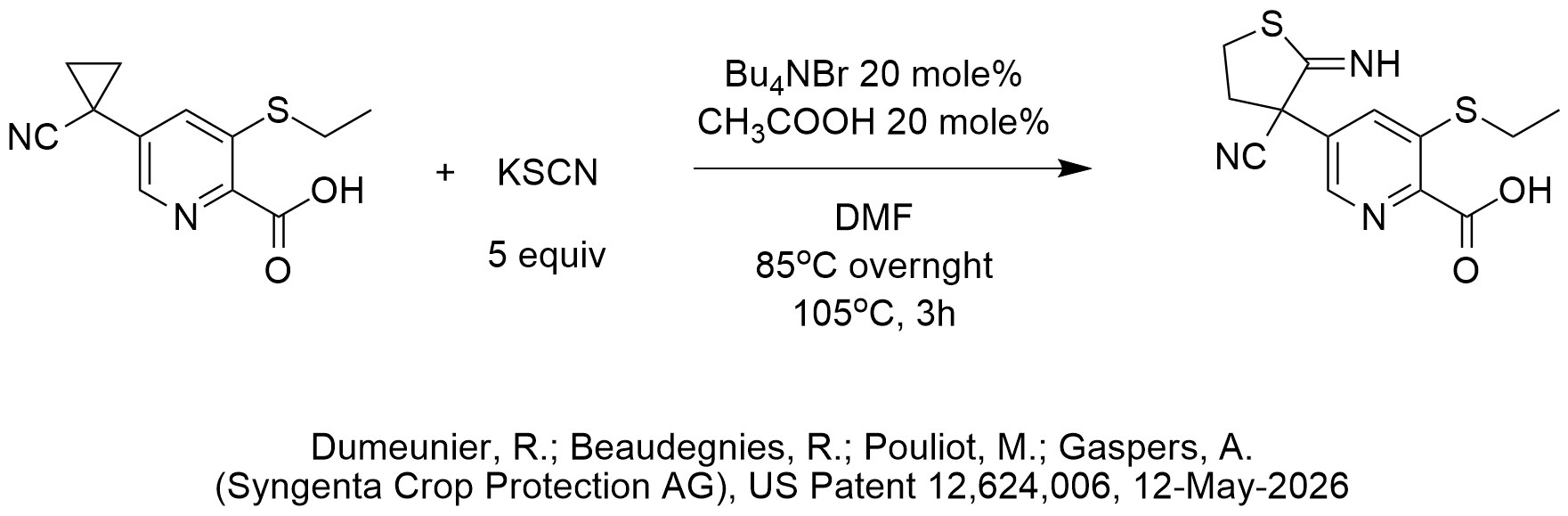
The reaction shown in the diagram uses thiocyanate as a reactant we commend the inventors for using PTC. Potassium thiocyanate provides SCN⁻, which opens the strained cyclopropane under acidic, high-temperature polar conditions. The resulting sulfur/nitrile-containing intermediate then cyclizes to a 2-imino-tetrahydrothiophene ring.

This appears to be a solid-liquid PTC system. Solid-liquid PTC is a successful method for many PTC systems using inorganic anionic nucleophiles.  However, we question the use of DMF as the solvent. In this case, TBAB generates the organophilic tetrabutylammonium thiocyanate ion pair in situ. A process chemist should then ask whether DMF is truly required, or whether an appropriate quaternary ammonium catalyst could enable the reaction in solvents that enable easier workup such as toluene, MIBK, 2-MeTHF, CPME, ethyl acetate, isopropyl acetate, or another more process-acceptable solvent that will solubilize the product.

There is likely room for other process improvements such as reducing the excess thiocyanate, better choice of phase-transfer catalyst, reducing the catalyst loading and others. However, the purpose of this reaction was to produce samples as standards, not to develop an economical process. So, we do not fault the inventors for choosing less than optimal conditions.

By the way, in case you were wondering about pKa’s (like I was), the pKa of HSCN is about -1, the pKa of pyridine carboxylic acid is about 1-2 and the pKa of acetic acid is about 4.8. Therefore, the thiocyanate anion remains predominantly in the anionic form even under the seemingly acidic conditions described in the procedure under which both carboxylic acids remain protonated.

About Marc Halpern

Marc Halpern

Dr. Halpern is founder and president of PTC Organics, Inc., the only company dedicated exclusively to developing low-cost high-performance green chemistry processes for the manufacture of organic chemicals using Phase Transfer Catalysis. Dr. Halpern has innovated PTC breakthroughs for pharmaceuticals, agrochemicals, petrochemicals, monomers, polymers, flavors & fragrances, dyes & pigments and solvents. Dr. Halpern has provided PTC services on-site at more than 260 industrial process R&D departments in 37 countries and has helped chemical companies save > $200 million. Dr. Halpern co-authored five books including the best-selling “Phase-Transfer Catalysis: Fundamentals, Applications and Industrial Perspectives” and has presented the 2-day course “Practical Phase-Transfer Catalysis” at 50 locations in the US, Europe and Asia.

Dr. Halpern founded the journal “Industrial Phase-Transfer Catalysis” and “The PTC Tip of the Month” enjoyed by 2,100 qualified subscribers, now beyond 130 issues. In 2014, Dr. Halpern is celebrating his 30th year in the chemical industry, including serving as a process chemist at Dow Chemical, a supervisor of process chemistry at ICI, Director of R&D at Sybron Chemicals and founder and president of PTC Organics Inc. (15 years) and PTC Communications Inc. (20 years). Dr. Halpern also co-founded PTC Interface Inc. in 1989 and PTC Value Recovery Inc. in 1999. His academic breakthroughs include the PTC pKa Guidelines, the q-value for quat accessibility and he has achieved industrial PTC breakthroughs for a dozen strong base reactions as well as esterifications, transesterifications, epoxidations and chloromethylations plus contributed to more than 100 other industrial PTC process development projects.

Dr. Halpern has dedicated his adult life to his family and to phase-transfer catalysis (in that order!).

Leave a Reply

Your email address will not be published. Required fields are marked *

PTC Course - In-House

Learn to choose
PTC process conditions
LIKE AN EXPERT!

Learn More