

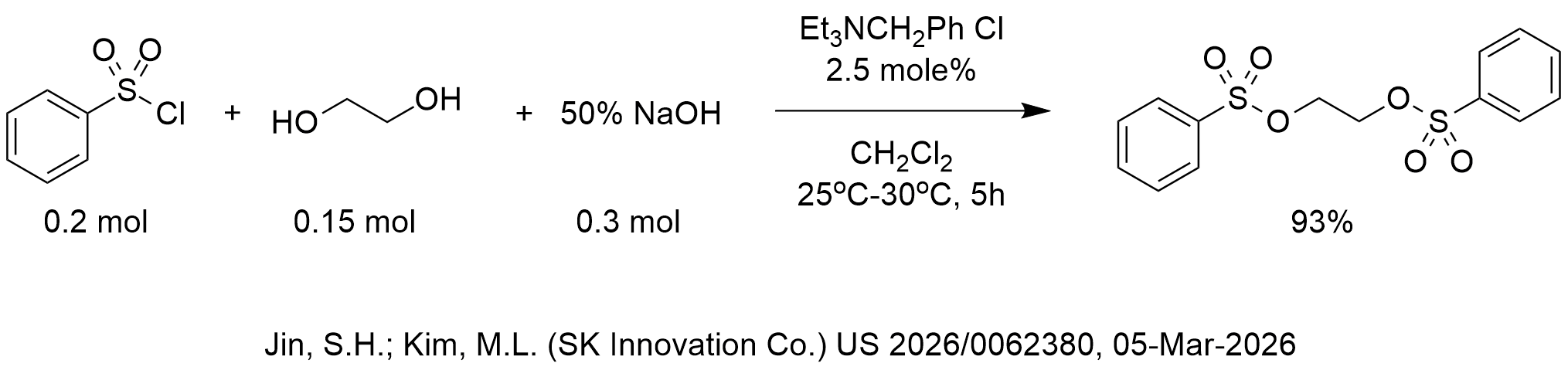
The examples reported for the reaction shown in the diagram demonstrate, yet again, that phase-transfer catalysis excels in delivering high performance when reacting water-sensitive and base-sensitive compounds in the presence of 50% NaOH.
In this reaction, the desired product, 1,2-bis(benzenesulfonyloxy)ethane, is obtained in yields in the 90’s from the reaction of ethylene glycol, base and benzenesulfonyl chloride. Obviously, benzenesulfonyl chloride can undergo hydrolysis in the presence of 50% NaOH and the process conditions were chosen to minimize this hydrolysis that included the use of a phase-transfer catalyst. This outcome highlights a recurring theme in our 23 years of published the PTC Tip of the Month newsletter which is that careful choice of PTC conditions can suppress competing hydrolysis even in highly aqueous, strongly basic environments.
The procedure reveals that the key to this performance lies in minimizing direct contact between the water-sensitive sulfonyl chloride and the aqueous hydroxide phase. The organic components, including benzenesulfonyl chloride, ethylene glycol, and benzyltriethylammonium chloride, are first dissolved in dichloromethane. This establishes a well-defined organic phase prior to introduction of base. The subsequent addition of 50% NaOH is performed in a controlled manner, with the internal temperature maintained below 30 °C. The maximum temperature is one of three key reasons for the high performance.
Slow addition inherently limits local hydroxide concentration at the interface and reduces the probability of direct, interfacial non-catalyzed hydrolysis. The biphasic system therefore acts as a protective environment, where reaction occurs primarily through phase transfer rather than bulk mixing.
Mechanistically, hydroxide reacts with ethylene glycol to generate the monoalkoxide, which is then transferred into the organic phase as an ion pair with the quaternary ammonium cation. Reaction with benzenesulfonyl chloride occurs within the organic phase, away from excess water. The initially formed monosulfonate remains sufficiently organophilic to continue participating in the catalytic cycle in the bulk organic phase, ultimately leading to the disulfonate product.
The system inherently favors full conversion of both hydroxyl groups, consistent with the known preference of quaternary ammonium salts to associate with less hydrated, more organophilic anions, including the preference of quat cations to pair with monoanions over dianions. Careful control of temperature and base addition rate limits competing hydrolysis and avoids the need for large excesses of sulfonyl chloride. Minimizing excess sulfonyl chloride obviously minimized waste and minimizes cost.
Agitation plays a crucial role, even though it is not explicitly discussed in the procedure. Sufficient mixing is required to sustain mass transfer, yet excessive agitation would increase interfacial area and promote direct contact between hydroxide and sulfonyl chloride, leading to interfacialial non-catalyzed hydrolysis. The reported high yields imply that mixing conditions were balanced to favor catalytic transfer over interfacial hydrolysis. Reaction temperature further reinforces this balance, since elevated temperatures would accelerate both hydrolysis and catalyst degradation pathways.
In our 2-day course “Industrial Phase-Transfer Catalysis,” we conduct a group exercise in which the participants must interpret data reported in the literature that shows how excessive agitation efficiently results in huge waste when reacting benzoyl chloride with phenol in the presence of 50% NaOH and a phase-transfer catalyst. We show the optimal agitation required to achieve the highest yield with the least waste due to interfacial non-catalyzed hydrolysis.
The data in Table 1 reinforce that hydration is a dominant factor in performance. Higher concentration sodium hydroxide provides superior yields compared to more dilute base, despite similar stoichiometry. This reflects the reduced hydration of hydroxide under concentrated conditions, which enhances nucleophilicity of the alkoxide from ethylene glycol.
Table 1 also shows that variations in the identity of the quaternary ammonium catalyst have a comparatively modest effect. Benzyltriethylammonium chloride and tetrabutylammonium bromide deliver similar yields, indicating that catalyst structure is secondary to control of hydration and phase behavior in this system. The absence of catalyst, however, leads to a clear drop in yield, confirming that phase transfer is required for optimal efficiency even if some background reaction occurs.
From a process standpoint, benzyltriethylammonium chloride offers cost advantages but introduces potential liabilities. Ethyl substituents are the most susceptible to Hofmann elimination under strongly basic conditions, and the benzyl group can participate in nucleophilic substitution, potentially leading to side products. These pathways are likely suppressed here by the controlled temperature and limited exposure of the catalyst to concentrated hydroxide.
The choice of dichloromethane as solvent is a concern for more than the usual environmental reasons. Under strongly basic PTC conditions, dichloromethane can generate formaldehyde. This is obviously a safety issue that must be avoided. Dichloromethane may also act as an alkylating agent and often results in “methylene bridged” byproducts. Alternative solvents such as toluene could eliminate these concerns while maintaining two phases with water that protects the sulfonyl chloride from hydrolysis and facilitates separation of salts by aqueous washes during workup.
Overall, the success of this reaction is governed by three major factors: maintaining low temperature throughout the process, controlling the rate and timing of aqueous base addition, and operating under mixing conditions that favor catalytic transfer rather than direct phase contact between the sensitive sulfonyl chloride and the water/base. PTC enables all of this.
Together, these parameters allow a highly water-sensitive electrophile to be transformed efficiently in the presence of concentrated aqueous base, demonstrating once again that phase transfer catalysis wins when working with water-sensitive and base-sensitive reactants and products.
When your company needs to develop low-cost high-performance green chemistry processes for water-sensitive and base-sensitive reactants and/or products, now contact Marc Halpern of PTC Organics to benefit from 5 decades of highly specialized PTC expertise.