
The Industrial Phase-Transfer Catalysis Experts

PTC Tip of the Month E-Newsletter

PTC Reaction of the Month - February 2026

PTC Polysulfide Production With Catalyst Recycle

By Marc Halpern, the leading expert in industrial phase-transfer catalysis.

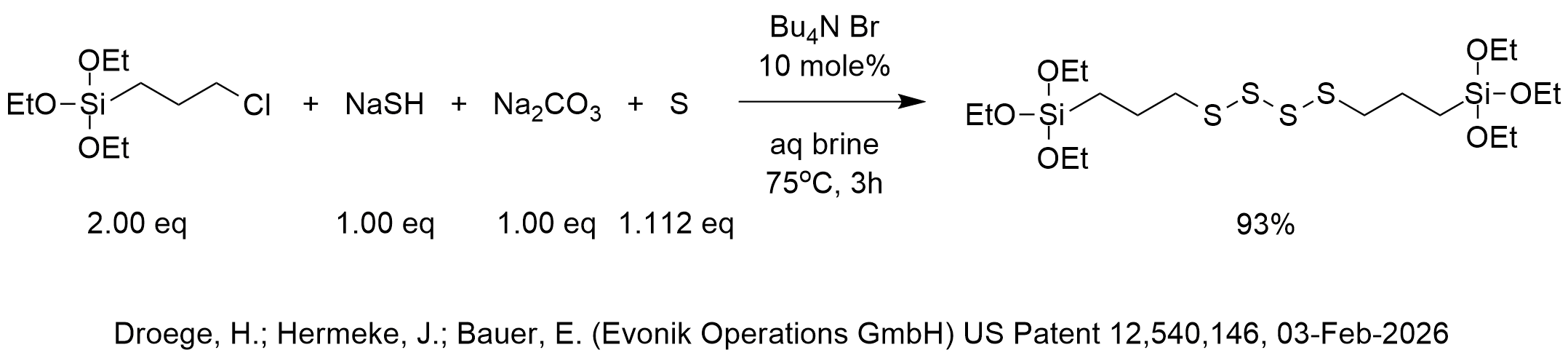
This patent describes a PTC process for manufacturing bis(trialkoxysilylpropyl) polysulfides. In addition to a high yield S-alkylation, a key aspect of this patent is a brine-recycle strategy that retains catalyst and unreacted starting materials in the aqueous phase, reduces fresh water consumption, minimizes chloride discharge, and lowers total catalyst make-up per batch.

Polysulfide anions are generated in aqueous phase from sodium hydroxide (or carbonate), sodium hydrosulfide, and elemental sulfur. A quaternary ammonium catalyst, typically TBAB, transfers these anions into the organic silane phase, where SN2 substitution on 3-chloropropyltrialkoxysilane forms the bis(trialkoxysilylpropyl) polysulfide with controlled sulfur-chain distribution. The system operates as a multiphase slurry followed by warm phase separation and thin-film evaporation to isolate the product.

The strength of the process lies in how the PTC system is managed. Recycled brine replaces fresh water, carrying dissolved catalyst and residual reactants forward into the next batch. Portion-wise or continuous catalyst addition reduces onium residence time, limiting decomposition and lowering overall catalyst consumption. The unwanted byproducts go into the solid salt cake. The useful components stay in solution. This makes sulfide handling easier and reduces downstream treatment. The result is lower water usage, reduced distillation and treatment energy, smaller equipment demand, and improved environmental compliance in regions with strict chloride limits.

From a PTC standpoint, the system leverages classic ion-transfer behavior: hydrated polysulfide anions are transported into the organic silane phase, where reduced hydration and looser ion pairing enhance effective nucleophilicity and enable efficient substitution under mild conditions. The silane serves as the organic phase, eliminating the need for polar aprotic solvents while maintaining practical cycle times.


About Marc Halpern

Marc Halpern

Dr. Halpern is founder and president of PTC Organics, Inc., the only company dedicated exclusively to developing low-cost high-performance green chemistry processes for the manufacture of organic chemicals using Phase Transfer Catalysis. Dr. Halpern has innovated PTC breakthroughs for pharmaceuticals, agrochemicals, petrochemicals, monomers, polymers, flavors & fragrances, dyes & pigments and solvents. Dr. Halpern has provided PTC services on-site at more than 260 industrial process R&D departments in 37 countries and has helped chemical companies save > $200 million. Dr. Halpern co-authored five books including the best-selling “Phase-Transfer Catalysis: Fundamentals, Applications and Industrial Perspectives” and has presented the 2-day course “Practical Phase-Transfer Catalysis” at 50 locations in the US, Europe and Asia.

Dr. Halpern founded the journal “Industrial Phase-Transfer Catalysis” and “The PTC Tip of the Month” enjoyed by 2,100 qualified subscribers, now beyond 130 issues. In 2014, Dr. Halpern is celebrating his 30th year in the chemical industry, including serving as a process chemist at Dow Chemical, a supervisor of process chemistry at ICI, Director of R&D at Sybron Chemicals and founder and president of PTC Organics Inc. (15 years) and PTC Communications Inc. (20 years). Dr. Halpern also co-founded PTC Interface Inc. in 1989 and PTC Value Recovery Inc. in 1999. His academic breakthroughs include the PTC pKa Guidelines, the q-value for quat accessibility and he has achieved industrial PTC breakthroughs for a dozen strong base reactions as well as esterifications, transesterifications, epoxidations and chloromethylations plus contributed to more than 100 other industrial PTC process development projects.

Dr. Halpern has dedicated his adult life to his family and to phase-transfer catalysis (in that order!).

Leave a Reply

Your email address will not be published. Required fields are marked *