

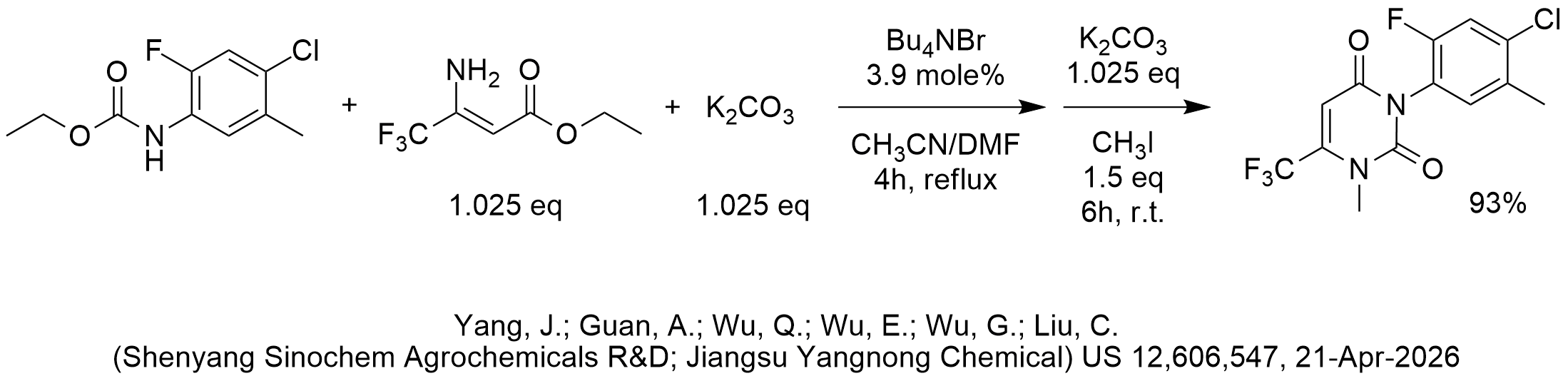
The patent describes a 2-step PTC sequence consisting of a carbonate/TBAB-mediated heterocycle-forming process followed by PTC N-methylation. In the first operation, the N–H of the aryl carbamate is sufficiently acidic to be activated by potassium carbonate under phase-transfer conditions, enabling reaction with ethyl 3-amino-4,4,4-trifluorocrotonate and subsequent cyclocondensation to form the trifluoromethyl uracil structure. This is not a simple one-bond substitution; it is a heterocycle-forming condensation in which the carbamate nitrogen, carbamate carbonyl, β-amino alkenoate nitrogen, ester carbonyl, and alkene carbons are assembled into the uracil ring.
It is notable that the PTC process uses only 3.87 mol% tetrabutylammonium bromide (TBAB) with K₂CO₃. That is a practical and economically attractive catalyst loading. Potassium carbonate is a mild, inexpensive base, but in many organic systems it is not reactive enough unless PTC activates the base as is the case in thousands of documented PTC-base systems. TBAB likely improves the functional basicity and nucleophilicity of the carbonate/uracilate system by forming more reactive quaternary-ammonium-associated ion pairs.
In the second step of the process, after formation of the uracil ring, additional K₂CO₃ and methyl iodide are introduced, and the remaining acidic uracil N–H undergoes a classic N-methylation by SN2 reaction with MeI.
The solvent choice is interesting and deserves comment. The use of polar solvent is understandable because both the carbamate starting material and the uracil product are highly polar, nitrogen- and carbonyl-rich compounds. This may be the reason that classical nonpolar PTC solvents such as toluene could not be used.
Acetonitrile alone would be attractive from a process standpoint because it is polar, relatively easy to remove, and compatible with many PTC alkylations. However, the reaction also generates ethanol during the condensation/cyclization, and the patent procedure removes low-boiling solvent continuously during the reaction. One plausible interpretation is that acetonitrile helps carry ethanol out of the system by co-distillation, while DMF remains as a higher-boiling polar reaction medium to maintain solubility and allow the condensation to proceed at a useful temperature after the acetonitrile-rich fraction has been removed.
We speculate that if DMF was not chosen as a co-solvent, then a much larger quantity of acetonitrile might have been needed to remove all of the ethanol and it is even possible that the cyclization may have needed a higher temperature than the boiling point of acetonitrile. However, we still try to avoid DMF when possible. The workup removes the DMF by the addition of water and the product precipitates. The DMF, salts, TBAB, and inorganic byproducts remain largely in the aqueous mother liquor. Separating DMF from water on a large scale for DMF recovery is difficult and expensive.
But it’s hard to argue with the outcome of 93% yield at 97.8% HPLC purity. The results suggest that the selected PTC conditions are effective. Still, a second-generation process-development program would reasonably examine whether DMF could be reduced or replaced while preserving the excellent yield and straightforward isolation.