

Over the years, this newsletter has discussed several PTC or PTC-like systems designed for reacting carbon dioxide with epoxides to form cyclic carbonates, often using tetra-n-butylammonium salts. Examples include:
- Cyclic Carbonate from Epoxide and CO2 at Atmospheric Pressure
- Cyclic Carbonates from CO2 and Epoxides
- TBAB-Catalyzed Cyclic Carbonate from Epoxidized Soybean Oil and CO2
- Quat Carboxylates for CO2 Capture
A recently published patent application adds a new perspective:
Lee, H. J.; Lee, U.; Yoo, C.-J.; Won, D.; Kim, K.; Kim, J. (Korea Institute of Science and Technology), US Patent Application 2026/0008765, 08-Jan-2026.
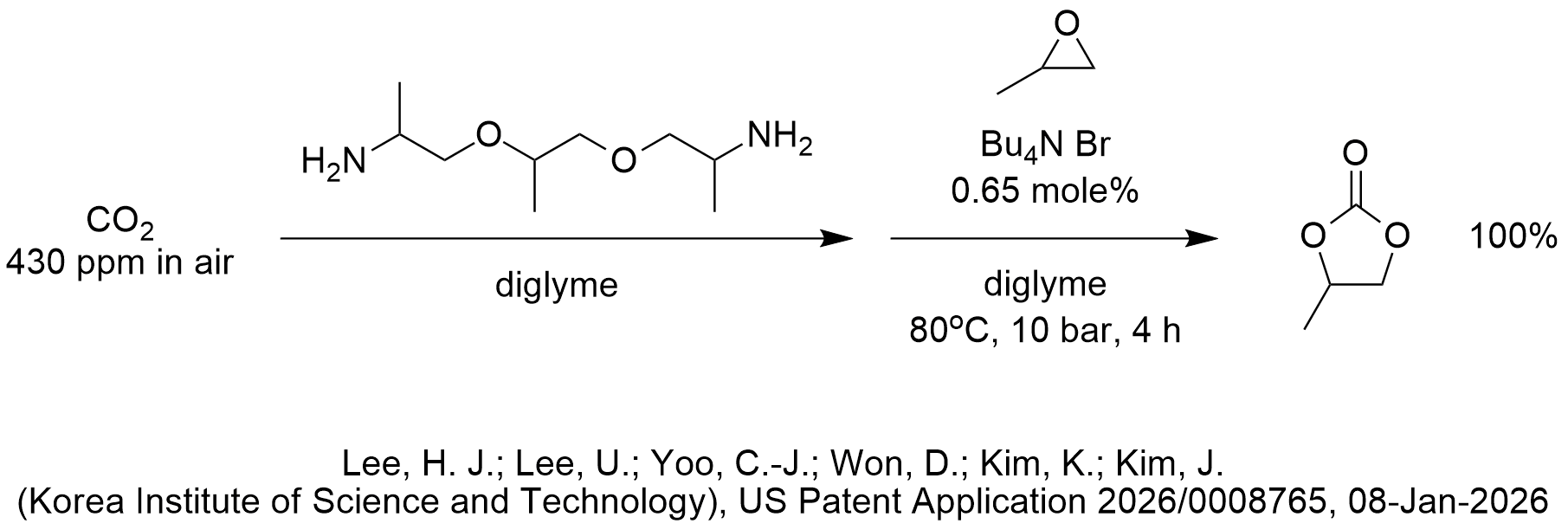
This patent describes a method for capturing carbon dioxide directly from ambient air using a diamine solution in diglyme, and then reacting the captured CO2 with an epoxide (specifically, propylene oxide) in the presence of a quaternary ammonium halide catalyst to form a cyclic carbonate, propylene carbonate. Notably, the process avoids the energy-intensive CO2 stripping step typically required in amine capture systems that the inventors state use 80% of the energy in the processes reported in prior art. The inventors appear to suggest that this new process is less energy intensive.
In Example 2 of the patent, the inventors describe a reaction in which propylene oxide (4.5 g, 77.5 mmol) is added to a diglyme solution containing a diamine that has previously captured CO2 from air containing 430 ppm CO2. A quaternary ammonium bromide salt (0.5 mmol) is used as the catalyst, and the mixture is reacted at 80 °C for 4 hours under 10 bar of nitrogen. Yields of propylene carbonate are compared across six catalysts:
Table 2 – Reaction of Propylene Oxide with CO2 to Form Propylene Carbonate
| Catalyst | Yield of Propylene Carbonate (%) |
| NH4Br | 20 |
| Tetramethylammonium Br | 0 |
| Cetyl trimethyl ammonium Br | 76 |
| Teteraethylammonium Br | 17 |
| Tetraproyplammonium Br | 100 |
| Tetrabutylammonium Br | 100 |
The pattern here is familiar to those of us in phase-transfer catalysis: symmetrical quats with at least 12 carbon atoms (TPAB and TBAB) show optimal reactivity, while TMAB, with its short chains, fails entirely. Surprisingly, even simple ammonium bromide gives 20% yield. CTAB performs modestly at 76%, likely due to its head-and-tail asymmetry and tendency to form micelles. This outcome reinforces a key PTC principle: symmetrical quats with sufficient lipophilicity and proper solubility balance generally excel.
In Example 4, the inventors conduct a similar reaction with the same epoxide (propylene oxide), but this time using tetrabutylammonium salts with different halide counterions: iodide, bromide, and chloride. The solvent is also varied (triglyme or tetraglyme), and the rest of the conditions are held constant.
Table 4 – Reaction of Propylene Oxide with CO2 Using Tetrabutylammonium Halides
| Catalyst | Solvent | Yield of Propylene Carbonate (%) |
| TBAB | Triglyme | 93 |
| TBACl | Tetraglyme | 86 |
| TBAI | Tetraglyme | 100 |
The trend here follows classic expectations from PTC theory: iodide > bromide > chloride in terms of nucleophilicity and catalytic activity. This result is consistent with earlier PTC work, where iodides often outperform due to their superior leaving group abilities and their ability to stabilize transition states.
As someone with a background in phase-transfer catalysis but without specific expertise in carbon dioxide capture chemistry, I find the data compelling, but I still have questions. For example, although the inventors avoid the energy cost of a stripping step, it remains unclear how scalable or energy-efficient the overall system would be at 10 bar. Perhaps the inventors have additional data to address these questions.
In addition, the inventors are critical of the use of amines in prior art to capture the carbon dioxide, but they use amines in their reported process. I do not fully understand how easy it is to liberate the carbon dioxide from the complex with the amine. Other reports described in earlier issues of the PTC Tip of the Month do not use amines.
For readers interested in this topic, I recommend revisiting the earlier posts on CO2/epoxide systems listed at the beginning. Comparing them with the current patent provides a broader view of where PTC strategies for CO2 utilization are heading.