

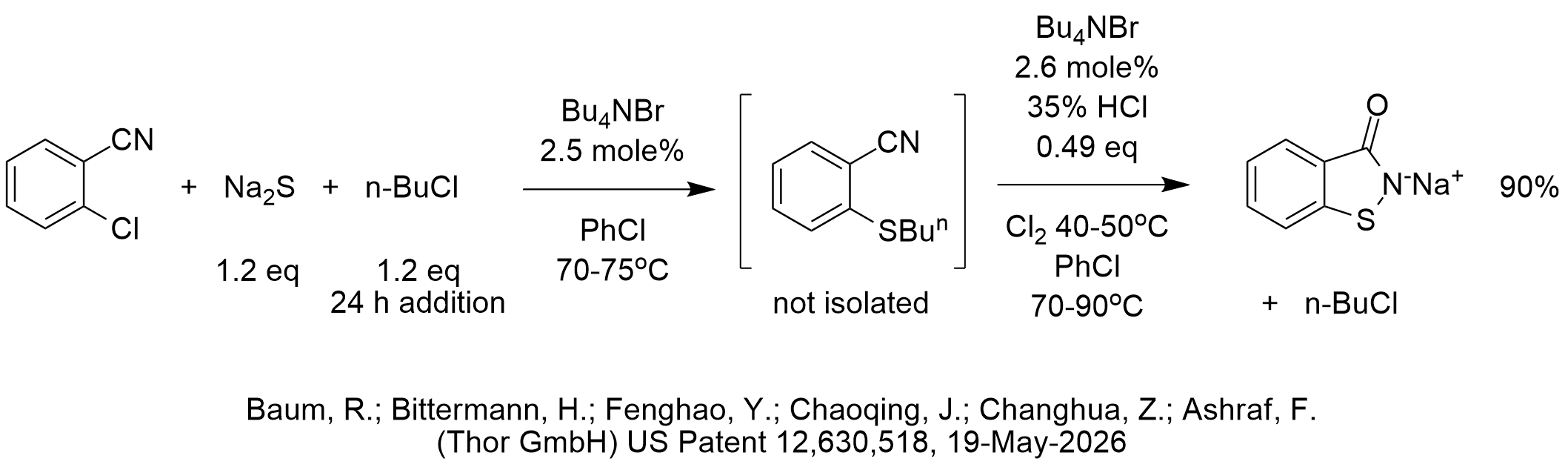
This month’s PTC Reaction of the Month highlights a recently issued patent from Thor GmbH describing an efficient two-step preparation of 1,2-benzisothiazolin-3-one, commonly known as BIT, from 2-chlorobenzonitrile. BIT is an important industrial biocide used broadly in coatings, adhesives, detergents, emulsions, and related preserved aqueous systems.
In the first step, which actually includes two reactions, 2-chlorobenzonitrile is reacted with sodium sulfide and 1-chlorobutane in chlorobenzene using TBAB as the phase-transfer catalyst.
In the second step. Cl₂ converts the ortho-alkylthio nitrile into an ortho-sulfenyl chloride. In wet acid, the adjacent nitrile is hydrated/protonated into an imidic acid / amide-like nitrogen nucleophile, which intramolecularly attacks the electrophilic sulfur to form the N–S bond. Tautomerization/hydrolysis then gives BIT.
More specifically, chlorine is introduced at 40–50 °C until HPLC shows consumption of the intermediate. The mixture is then heated to 70 °C, followed by water addition and heating to 90 °C, during which 1-chlorobutane is distilled off. The BIT product is isolated by crystallization/filtration, and additional BIT is recovered from the organic phase as the sodium salt.
The chemistry is noteworthy because the patent reports a 90% total yield over two steps, based on 2-chlorobenzonitrile, using a practical phase-transfer catalyzed sulfide chemistry followed by what may be described as oxidative cyclization.
The patent addresses a long-standing practical issue in BIT manufacture: how to prepare BIT efficiently while avoiding routes that generate problematic volatile mercaptans or require isolation of malodorous intermediates.
The attractive features are:
- High overall yield: 90% over two steps.
- Commercially available starting material: 2-chlorobenzonitrile.
- PTC-enabled sulfide chemistry: sodium sulfide is used effectively in an organic medium.
- No need to isolate the sulfide intermediate.
- Byproduct management: 1-chlorobutane is regenerated/recovered in the second step, and dibutyl sulfide is removed by distillation.
- Industrial solvent: chlorobenzene is used as the main organic solvent.
- Practical excess of starting materials: only 20 mole% excess sulfide and butyl chloride.
There are several additional aspects of the process that are noteworthy.
First, the sulfide used is anhydrous 93% sodium sulfide. As we teach in our 2-day course “Industrial Phase-Transfer Catalysis,” the amount of water present in solid-liquid PTC systems can be crucial to the performance and profitability of the process. When developing a solid-liquid PTC-sulfide process, it would be worthwhile to test the reactivity and selectivity at various levels of hydration to identify the optimal amount of water.
Another interesting thought is that the controlled feed of 1-chlorobutane is likely important for minimizing unproductive sulfide alkylation and controlling formation of dibutyl sulfide.
Overall, this procedure demonstrates yet again that PTC can be very effective for achieving high yield for multiple consecutive steps while avoiding isolation of intermediates.