
As we teach in our 2-day course “Industrial Phase-Transfer Catalysis,” the thiocyanate anion has one of the highest selective affinities for quat cation out of more than 20 common inorganic anionic nucleophiles, oxidants and reductants. For that reason, whenever you need to react thiocyanate, you should almost certainly consider PTC for your process.
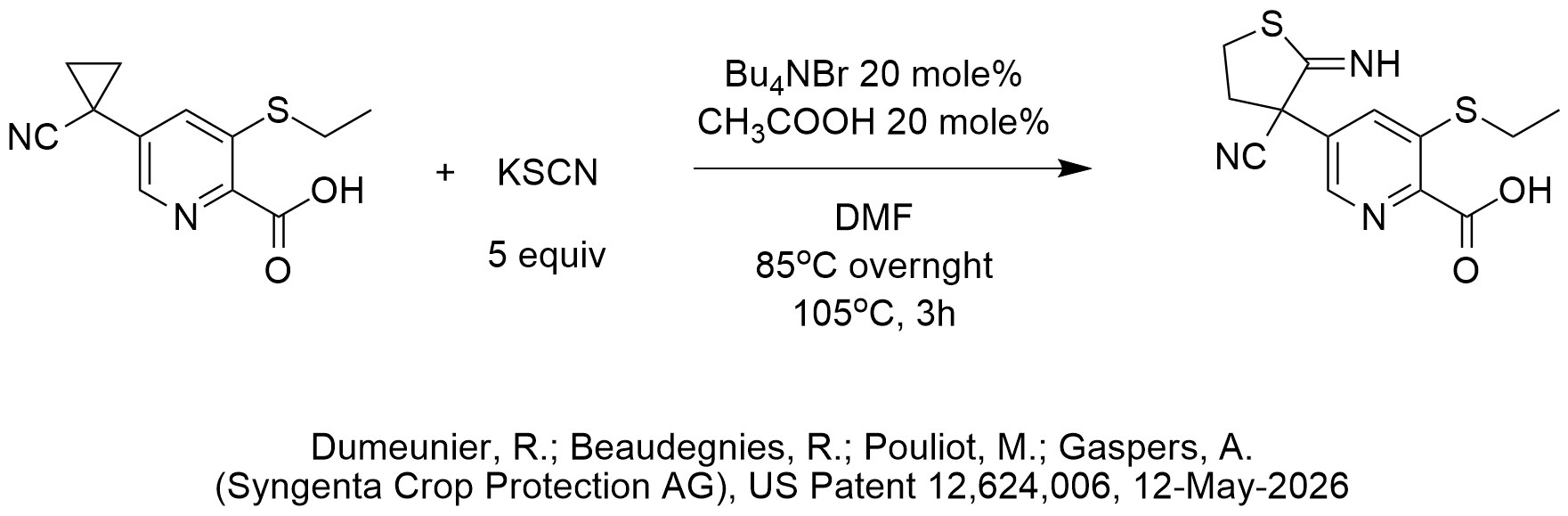
The reaction shown in the diagram uses thiocyanate as a reactant we commend the inventors for using PTC. Potassium thiocyanate provides SCN⁻, which opens the strained cyclopropane under acidic, high-temperature polar conditions. The resulting sulfur/nitrile-containing intermediate then cyclizes to a 2-imino-tetrahydrothiophene ring.
This appears to be a solid-liquid PTC system. Solid-liquid PTC is a successful method for many PTC systems using inorganic anionic nucleophiles. However, we question the use of DMF as the solvent. In this case, TBAB generates the organophilic tetrabutylammonium thiocyanate ion pair in situ. A process chemist should then ask whether DMF is truly required, or whether an appropriate quaternary ammonium catalyst could enable the reaction in solvents that enable easier workup such as toluene, MIBK, 2-MeTHF, CPME, ethyl acetate, isopropyl acetate, or another more process-acceptable solvent that will solubilize the product.
There is likely room for other process improvements such as reducing the excess thiocyanate, better choice of phase-transfer catalyst, reducing the catalyst loading and others. However, the purpose of this reaction was to produce samples as standards, not to develop an economical process. So, we do not fault the inventors for choosing less than optimal conditions.
By the way, in case you were wondering about pKa’s (like I was), the pKa of HSCN is about -1, the pKa of pyridine carboxylic acid is about 1-2 and the pKa of acetic acid is about 4.8. Therefore, the thiocyanate anion remains predominantly in the anionic form even under the seemingly acidic conditions described in the procedure under which both carboxylic acids remain protonated.