

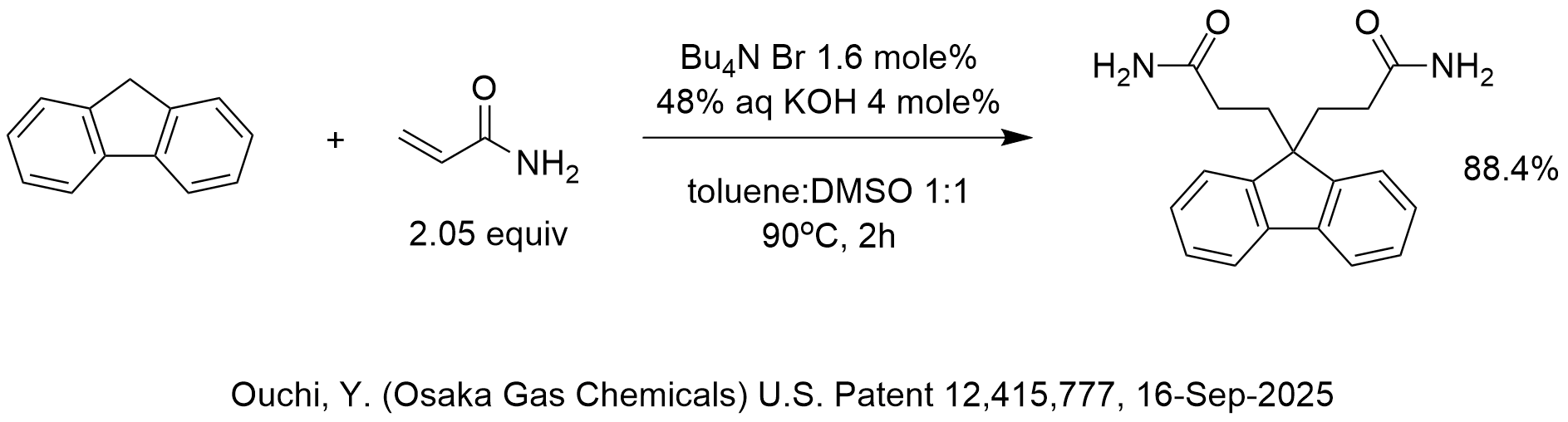
When I formulated the “Halpern pKa Guidelines for the Evaluation and Optimization of New PTC Applications” in the early 1980’s, I used fluorene as the reference point for the upper limit for transition between T-Reaction and I-Reaction. The pKa of fluorene is 23 and is routinely deprotonated by hydroxide under PTC conditions followed by PTC activation of the fluorenyl carbanion as a nucleophile.
PTC is used in commercial C-alkylations of fluorene and the reaction discussed here is an effective PTC Michael Addition with the fluorenyl anion as the nucleophile.
The reaction shown in the diagram is a 1,4-conjugate addition of the fluorenyl anion to the α,β-unsaturated double bond of acrylamide, followed by protonation to yield a β-substituted amide.
We usually recommend performing PTC reactions in non-polar solvents such as toluene or somewhat polar solvents such as MIBK that are immiscible with water in order to facilitate workup. However, acrylamide is not soluble in toluene and apparently not even sufficiently soluble in MIBK. For this reason, the inventors probably had no choice but to use a mixed solvent 50/50 toluene/DMSO.
The reaction uses catalytic 48% KOH (4 mole%) since hydroxide is not consumed. The concentrated KOH promotes effective deprotonation.
Tetrabutylammonium is sufficiently stable under these conditions at 90 deg C for 2 hours to achieve complete conversion. The yield of 88.4% is after workup.
While this reaction may not be remarkable, it does remind us that PTC-hydroxide conditions are very effective for deprotonating organic substrates with acidic C-H groups that are many orders of magnitude less acidic than water (pKa 15.7), which is the conjugate acid of hydroxide and then activate the resulting carbanion to perform nucleophilic attack in high yield.
Marc Halpern has 49 years of practical experience in PTC-hydroxide reactions. If your company needs to achieve low-cost high-performance green chemistry reactions using strong base, now contact Marc Halpern of PTC Organics to determine if you can improve your R&D efficiency developing such processes.