

A very interesting patent was issued this month to my good friend and veteran PTC champion, Dr. Reinhard Sommerlade. The reaction is shown in the diagram and the mechanism of the reaction was not obvious to me, so I contacted Dr. Sommerlade who was very gracious to compose this post for the PTC newsletter and blog.
First, I would like to introduce the company SCD Dr. Sommerlade Chemistry Design GmbH that provides chemical process research consulting as well as being a supplier of certain specialty products, including the unique photolatent base (photobase generator) SCD-PLB 090 which they offer in bulk amounts.
Learn more about SCD’s products and services at https://www.sommerchem.com/. Send your inquiries through the contact form on this website.
More specifically, Dr. Sommerlade has special expertise in organophosphorus chemistry, organometallic chemistry, photoinitiators, organic flame retardants for polymers and plastic additives.
Following is the description of this reaction and mechanism written by Dr. Sommerlade, for which I am very grateful for his expert contribution.
Even though the mechanism is not 100% clear, radical intermediates are very likely involved.
A strong base is required to form substantial amounts of the ketone enolate. In an SET reaction, the electron rich enolate is converted to an alpha-ketoalkyl radical by transfer of an electron to the haloalkane CCl4 or C2Cl6 which in turn loses a chloride anion to form a trichloromethane radical or a pentachloroethyl radical, respectively. The latter are losing a chlorine radical in a slow reaction.
In the case of CCl4 as the reagent, dichlorocarbene is formed first while the chlorine radical is again abstracting an electron from unchanged ketone enolate which itself is abstracting a chlorine atom from tetrachloromethane (or hexachloroethane) in a chain propagation step to give an alpha-chloro ketone. The hydroxide present is attacking the alpha-chloroketone to form an alpha-hydroxy epoxide (an epoxy hemiacetal) which is easily hydrolyzed by acidifying in the last step to give the final alpha-hydroxy ketone product.
The fate of the dichlorocarbene in the CCl4 case is its hydrolysis to give carbon monoxide, sodium formate, chloride ion, and water, as long as no additional reaction partner, e.g. an olefin, is present.
Since the organic starting materials are not miscible with the aqueous base this process can only be conducted with the help of phase transfer catalysts.
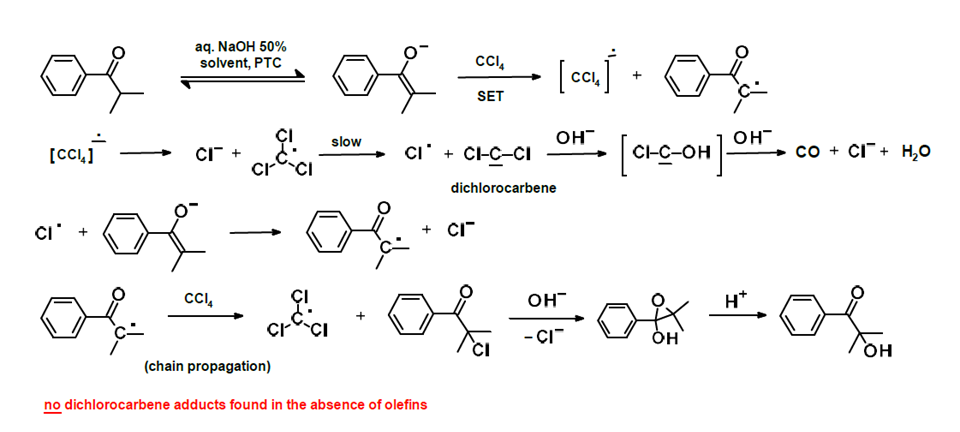
In order to avoid the formation of dichlorocarbene and the use of highly toxic tetrachloromethane, hexachloroethane (HCE) was found to be the perfect substitute in the alpha-chlorination process, not only in terms of toxicity but also in selectivity and recovery of the reagent. In the first step, a pentachloroethyl radical is formed which cannot form a carbene but instead loses another chloro radical to produce the elimination product tetrachloroethylene (TCE). Likewise, this chloro radical is abstracting an electron from the enolate to give the alpha keto radical and chloride ion. The subsequent reaction is following the above-mentioned corresponding mechanism to the CCl4-process. According to this mechanism, at least two equivalents of chlorinating agent are required. Best results were obtained with a slight excess of HCE.
Gratifyingly, the reaction product TCE proved to also serve very well as a solvent for the reaction.
TCE can easily recovered in near quantitative yield and high purity and rechlorinated to hexachloroethane independently in a separate process in high yield (circular use, very little waste).
Again, I want to thank Dr. Sommerlade for being so kind to provide this detailed explanation. Please check out SCD’s website at https://www.sommerchem.com/.
I rarely endorse companies and consultants, but the following rare individuals Dr. Reinhard Sommerlade, Dr. Neal Anderson and Dr. Peter Wuts, meet the highest standards of best-in-class expertise in industrial chemistry, personal ethics and are a pleasure to work with.