
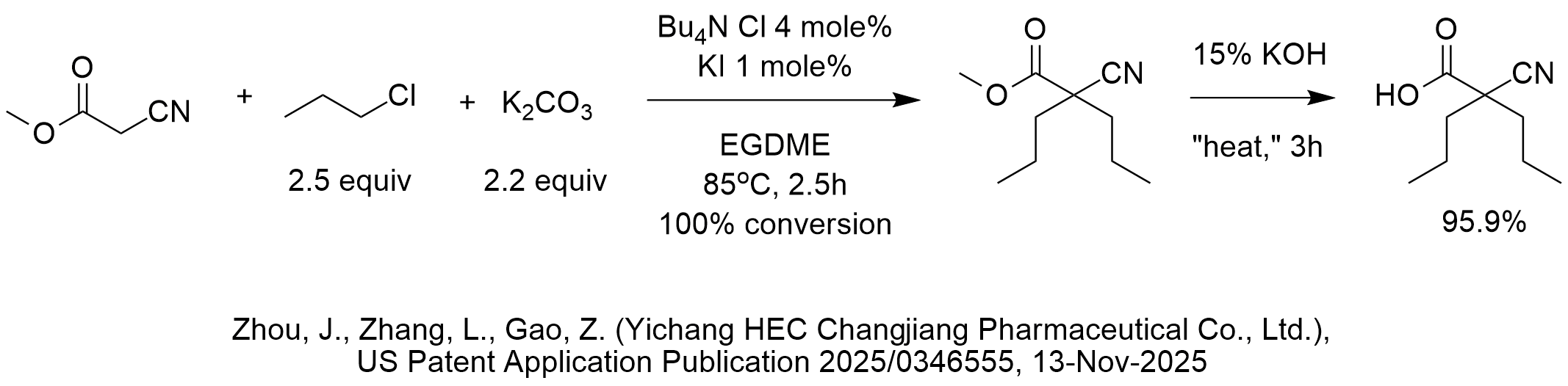
PTC has been used in several C-alkylations for derivatives of valproic acid over the past 30+ years. The reaction shown in the diagram starts with methyl cyanoacetate as the starting material which is different than other PTC C-alkylations I have seen for valproic acid derivatives.
In this article, I want to address four choices of process parameters for this application: choice of solvent, choice of base, choice of iodide co-catalyst and choice of counteranion for the phase-transfer catalyst.
Choice of Base: The pKa of ethyl cyanoacetate (closest analog to methyl cyanoacetate) is 9. For this reason, potassium carbonate is sufficiently basic to deprotonate the methylene group. Obviously, potassium carbonate will not hydrolyze the ester before C-alkylation so it is a better choice than using NaOH or KOH which would be overkill from a basicity standpoint. In fact, KOH is used to hydrolyze the ester after the C-alkylation.
Choice of Solvent: Potassium carbonate does not dissolve substantially in DMF or ethylene glycol dimethyl ether (diglyme). These are the two solvents reported to be used in this patent application. Therefore, this C-alkylation is a solid-liquid PTC system.
Since one of the advantages of phase-transfer catalysis is the ability to replace water miscible solvents with solvents that form two phases with water, and since the appropriate use of potassium carbonate forces this to be a solid-liquid PTC system, we would have recommended screening solvents that are immiscible with water. Unfortunately, only DMF and diglyme were reported in the patent application and they are both miscible with water. Choice of solvent may have been a missed opportunity in this patent application, though I do not have experience with this reaction so I can’t know for sure.
Example 1 in this patent application used DMF (b.p. 153 deg C) as the solvent for the alkylation. In Example 2, the solvent was replaced by ethylene glycol dimethyl ether (b.p. 85 deg C). Obviously, diglyme is easier to recover and handle. For reasons not explained, DMF was used in the other examples for the C-alkylation. We find this surprising.
Choice of Iodide Co-Catalyst: As we describe in the 2-day course “Industrial Phase-Transfer Catalysis,” iodide is not only an excellent Finkelstein-type catalyst to increase the rate of alkylations, iodide also has an extra-strong affinity for quat cations. So, the combination of PTC with iodide co-catalyst is a particularly powerful match.
Iodide co-catalyst in PTC systems is typically used at a lower mole% loading than the quat, among other reasons to avoid catalyst poisoning. In this case, 1 mole% KI was used with 4 mole% quat. This is not unusual.
Choice of Quat Counterion: The reaction shown in the diagram is Example 2 that uses diglyme. In that particular example, tetrabutylammonium chloride (TBAC) was used as the phase-transfer catalyst. Considering that an iodide co-catalyst was used and considering that TBAC is more expensive than tetrabutylammonium bromide (TBAB), it is a waste of money to use TBAC. TBAB was used in Examples 1, 3 and 7. TBAC was used in Examples 2, 4 and 5.
It is always interesting to observe the thought process used in the design of the experiments reported in patents, even while recognizing that not all experiments performed are reported in the patent, while also recognizing that best mode must be disclosed.
Choosing even one process parameter wrong for a PTC application can have significant cost consequences. The cost of PTC Process Consulting by PTC Organics is very low compared to the lost profit opportunity from just one non-optimal choice. Now contact Marc Halpern of PTC Organics to avoid wasting money or otherwise compromising process performance and process R&D efficiency.