

Over the years, PTC has been used in reactions of carbon disulfide, particularly to form dithiocarbamates in 2-step 1-pot processes.
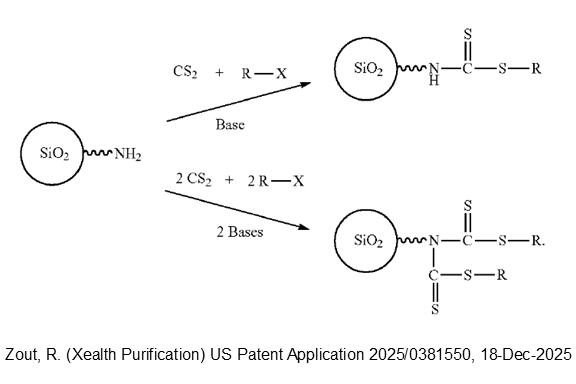 PTC excels in esterification of carboxylic acids and when the two oxygen atoms are replaced with sulfur, the anion is not only more nucleophilic, the soft nature of the anion (polarizable low charge density) enhances its affinity toward soft quats that helps ion pairing in an activated form.
The patent application US 2025/0381550 reports the attack of nucleophiles on CS₂ followed by PTC nucleophilic substitution between the intermediate dithiocarbamate anion and alkylating agents. The application is CS₂ modification of organosilanes.
The inventor is well aware of PTC and dedicates claim 39 to citing about two dozen phase-transfer catalysts, including quaternary ammonium and phosphonium salts. However, in the examples section of the patent application, the inventor does not specify which phase-transfer catalysts were used and does not report yields. So, it’s hard to draw conclusions about efficacy or structure-activity relationships.
Another surprising aspect of the patent application is that the experimental examples do not explicitly include a base. While there are reports in other publications and patents that use PTC with carbon disulfide without base, Claim 37 in this patent application lists about two dozen bases, including alkali metal hydroxides, alkaline earth hydroxides, and related basic reagents that would ordinarily be used to generate nucleophilic species capable of attacking CS₂. Together, these claims describe a conventional and chemically sound PTC framework for CS₂-based transformations. The omission of bases in the examples raises the possibility that the base was simply left out of the example descriptions inadvertently, especially given its prominent role elsewhere in the disclosure. An alternative, more speculative interpretation is that the inventors relied on the less conventional activation mode of CS₂ involving nucleophilic participation of the halide counterion from the quaternary ammonium phase-transfer catalyst, making it more susceptible to attack by amines or other nucleophiles under near-neutral conditions.
So, the absence of reported yields and omission of base in the examples makes it hard to interpret the usefulness of the claimed process. Nevertheless, the broader message of the application remains clear and worth emphasizing: phase-transfer catalysis is a powerful and enabling strategy for promoting reactions of carbon disulfide and justifies publishing this in PTC Tip of the Month, even when the experimental details are lacking.
If your company is developing commercial processes in which carbon disulfide is a raw material for forming dithiocarbamates, you will do your company a service by engaging PTC Organics to help you reduce your development time, achieve better process performance and write patent claims that protect your PTC IP. Now contact Marc Halpern of PTC Organics to inquire about expert industrial process PTC consulting.