

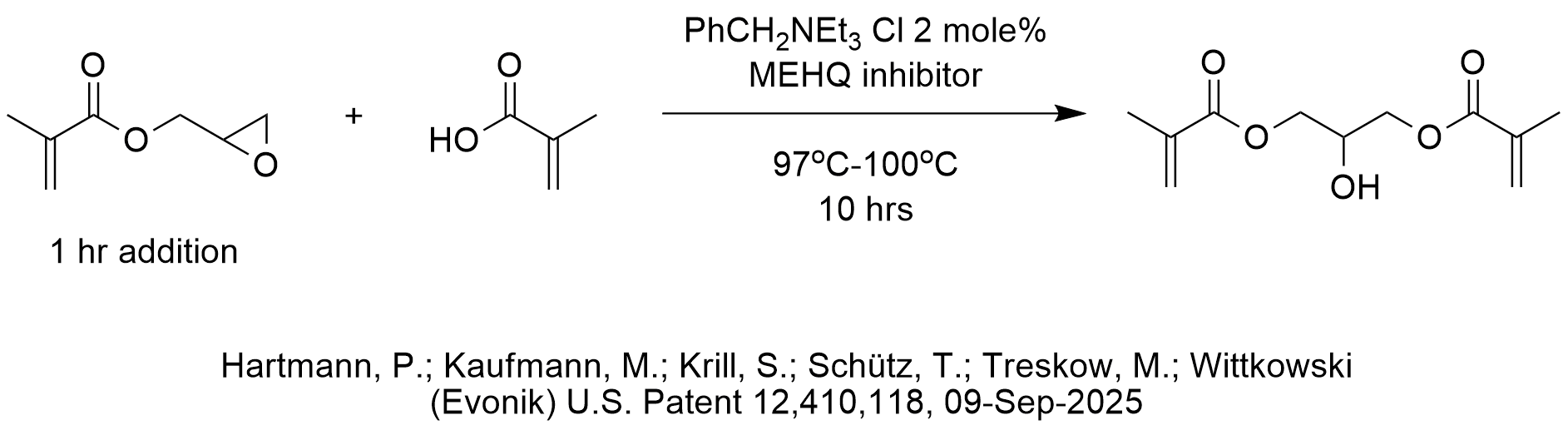
The use of triethyl benzyl ammonium (TEBA) chloride was reported for the reaction shown in the diagram.
The reaction was between methacrylic acid and glycidyl methacrylate that ring-opened the epoxide followed by esterification to produce glycerol dimethacrylate that contains very low levels of residual glycidyl methacrylate that is toxic.
Historically, it is known that the halide of a quat halide can initiate the ring opening of an epoxide to form a halohydrin intermediate, then the halide can serve as a leaving group when a nucleophile is present. The use of quat chloride to ring-open an epoxide is known for etherification with alcohols.
In the reaction between methacrylic acid and glycidyl methacrylate (GMA), the methacrylic acid is a very weak nucleophile unless a base is present to neutralize the carboxylic acid. In this case, it is desired to avoid the presence of base due to a variety of potential side reactions.
Accordingly, one may speculate that the quat chloride reacts with GMA forms the chlorohydrin and then the hydroxyl of the neutral carboxylic acid attacks the chlorohydrin to perform the esterification to produce glycerol dimethacrylate. Perhaps the weak nucleophilicity of the neutral methacrylic acid is strong enough to perform this attack at the elevated temperature of 97-100 deg C for 10 hours.
The choice of TEBA as the quat is questionable since this quat is not very stable at 100 deg C for many hours in the presence of nucleophiles. The same temperature that is apparently required to activate the nucleophilicity of the neutral carboxylic acid, may undesirably cause the attack of the methacrylic acid on the benzyl group of benzyl triethylammonium chloride that would produce benzyl methacrylate and triethyl amine as the leaving group.
This is one reason that at PTC Organics we avoid the use of benzylated quats in industrial commercial PTC applications, especially TEBA since benzylation of the nucleophile is often observed and constitutes an undesired impurity. We would choose more stable quat chloride that do not contain a benzyl group (or an allyl group) since they are labile, especially at higher temperatures such as 100 deg C over many hours.
In my early days using PTC in the 1970’s, I learned the hard way that TEBA chloride causes benzylated impurities even though this phase-transfer catalyst with a q-value of about 1.6 is excellent to promote the reactivity of PTC T-Reactions.
If your company is using benzylated quats, especially TEBA, in commercial processes, you should actively look for benzylated byproducts. If you find them, now contact Marc Halpern of PTC Organics for consulting on the best alternatives for TEBA for your specific application.