
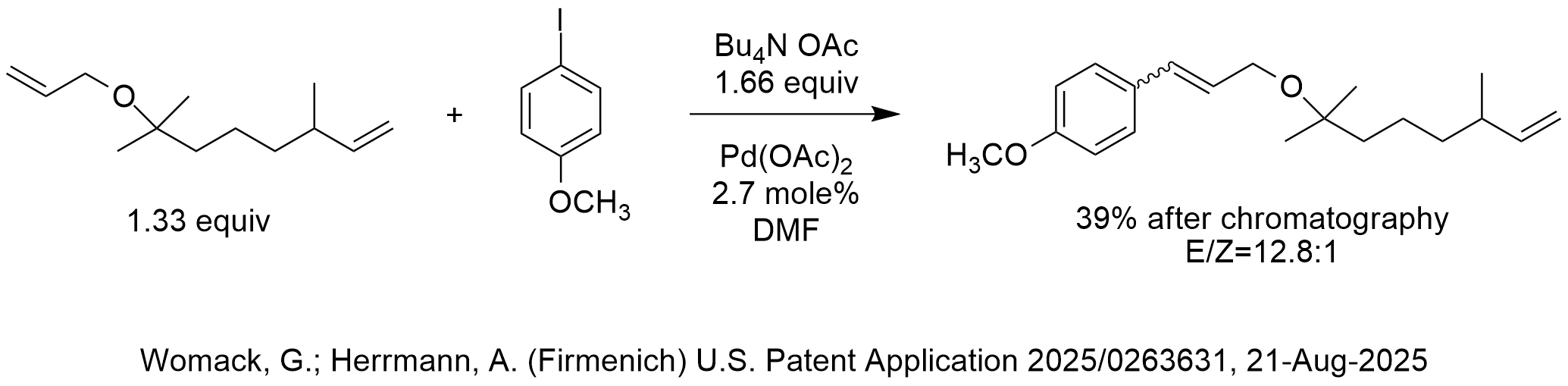
The Heck reaction was used to prepare cinnamyl ethers under carefully controlled conditions in Womack, G.; Herrmann, A. (Firmenich) U.S. Patent Application 2025/0263631, 21-Aug-2025. The process employs more than stoichiometric tetrabutylammonium acetate (TBAA) in DMF to enable effective coupling of aryl iodides with allyl ethers.
Whenever I see a Heck reaction using a quat salt, I always wonder whether it’s possible to use stoichiometric or excess inorganic salt such as NaOAc or KOAc with catalytic quat chloride to save money and make workup easier. After all, solid-liquid PTC nucleophilic substitutions work extremely well with catalytic quat salt for thousands of applications.
Apparently, the choice of stoichiometric quat acetate (or quat iodide or other quat salt) for the Heck reaction is deliberate and essential.
The Heck reaction is not a conventional liquid-liquid or solid-liquid PTC reaction. It is organometallic, involving Pd(0)/Pd(II) cycling, and requires homogeneous conditions for the Pd species to remain stable and active.
Even though PTC simulates homogeneous conditions in the organic reaction phase in solid-liquid PTC systems, there is at least one requirement in the Heck reaction that other solid-liquid PTC systems don’t have, which is to prevent the precipitation of Pd(0) during the Pd(0)/Pd(II) cycling.
It is speculated that if there is not enough quat acetate near the beginning of the reaction to tie up the Pd(II) with the appropriate ligands, the Pd(0) might agglomerate and precipitate and that would irreversibly shut down the reaction. Since sodium acetate is poorly soluble in DMF, the ion exchange equilibrium with catalytic TBAC for example, apparently would not generate sufficient TBA acetate in situ to support continuous Pd catalysis.
As the reaction proceeds, this may be less of a problem if the iodide leaving group becomes an effective ligand for the Pd(II). As we teach in the 2-day course “Industrial Phase-Transfer Catalysis,” the affinity of the quat cation for iodide is orders of magnitude higher than for chloride or acetate. Therefore, in this application, the potential presence of chloride from TBAC would reduce the acetate in the organic reaction phase at the outset of the reaction, though later on as the iodide leaving group is generated, the quat ensures sufficient solubility and concentration of the iodide in the organic reaction phase such that there is plenty of iodide to serve as a ligand for the Pd(II) which is again important during the Pd(0)/Pd(II) cycling.
It is important to remember that the acetate is consumed in the reaction since it serves as a weak base to neutralize the HI formed. As acetate is consumed, it is replaced by the iodide that is liberated which in turn pairs with the quat cation that delivers it to the Pd(II) as a ligand.
The reaction is classified as an I-reaction. Such systems require a phase-transfer catalyst that efficiently transports anions into the organic phase and supports stable Pd catalysis. Catalytic TBA chloride does not meet these requirements. Stoichiometric TBA acetate, by contrast, provides a fully soluble source of acetate, stabilizes the Pd species, and maintains high reaction rates with predictable workup and product quality.
Conclusion: Apparently, in the Heck reactions, stoichiometric or more quat is not optional, it is likely critical to reaction success.